Shimmer


Interview with Philip J. Lees

April 28th, 2007

Philip J. Lees’ short story, Duets, appears in the Winter 2007 issue of Shimmer. Check out his website.

Questions About The Story

Where did the idea come from?

From seeing the light reflecting off my guitar, maybe? From the Shakespearian line, “If music be the food of love, play on”? The truth is, I don’t remember.

How did the story change as you developed it?

I think this was one that came into my head pretty much fully formed, in terms of both plot and style. After all, it’s quite short. It was just a matter of writing it down (just!).

You know the advice “Sometimes you have to kill your darlings.” Was there a scene or line that it really hurt to cut, but cutting it made the story stronger? May we reprint that scene or line? Or link to a very old version so that we may marvel at how much it changed?

The nice people at Shimmer asked me to cut the original introduction—about 100 words. I didn’t really want to do that, although I could understand the reason for it. Whether the story is stronger for the change is, I think, a matter of taste. As a reader, I have an old-fashioned preference for a slow opening to a story. I enjoy the sensation of a door opening on a different world and being drawn into it, immersed in it, before the action begins. The modern tendency is to hurl the readers directly onto the bobsleigh run and let them figure out where they are and what’s happening while they’re already hurtling down.

In the case of “Duets,” the short opening introduced the first person narrator and set the tone of the piece. Not strictly necessary, I admit. I think the story works fine without it. By all means print the deleted paragraphs if you like (though I have the feeling this answer is not what you were looking for).

As a rule, I feel pleased when I can cut something from a story. It means that I’m making an improvement, and that I’m close to getting it the way I want it. My early drafts tend to be underwritten, rather than overwritten, so the first revisions usually involve more adding than subtracting. Pruning away the dead wood is the final stage.

How is this story like your other work? How is it different?

Duets is not typical of my work, but then, none of my stories are (insert smiley here). Really, though, my fiction is all over the place, from literary stories involving characters I’ve encountered while living in Greece, through crime and mystery (sometimes with a speculative element, sometimes not), magic realism, fake mythology, to straight science fiction with spaceships and aliens.

Duets was something of an experiment in a couple of ways. It was the first time I’d written anything that involved magic (although whether the reader interprets it in that way is a matter of choice: as Clarke’s Third Law states, “Any sufficiently advanced technology is indistinguishable from magic.”). More importantly, I wanted to play around with a more formalized, but at the same time lyrical style of writing, aiming to use musical rhythms in the prose and musical metaphors in the storytelling.

Questions About Writing

What writing projects are you presently working on?

I just finished a short story that examines the intersection of TV game shows and euthanasia. I have two or three other stories half written and I will finish them very soon, really I will. I’m also working on my third novel, Triple Jeopardy, which is a cult religious futuristic ecological thriller detective mystery story set in multiple alternate quantum realities. So far, I have a complete outline and the opening chapters. Another work in progress is a non-fiction article about how the Internet will affect home computers and the software industry (I am, or was, a bona fide computer scientist, among other things, so I have some credentials for this kind of speculation).

On the business side, I’m seeking a publisher for my second novel, The Changelings, which is about space exploration, human cloning, planetary colonization, interracial relationships, and all that kind of thing. At some point, I hope, I’ll also need to find an agent to represent me. I try to keep the short story submissions going out on a steady basis, not letting them languish on my hard drive.

Are you satisfied with traditional labels for genre fiction? Do words like “speculative,” “slipstream,” and, for that matter, “genre” cover it? What would you suggest?

I don’t like putting labels on any kind of creative output or on the people who produce it. However, I recognize that publishers, booksellers and the reading public (if there is such a thing any more) need to have a way of categorizing fiction. There are serious problems, though. To start with, nobody can agree on standard definitions. I once put a story of mine through a critique group and at the end I asked the question: Is this a science fiction story or not? The answers ranged from “Definitely a science fiction story” to “Contains no science fiction elements at all.” I wasn’t surprised. Then there’s the lack of consistency. Much of Michael Crichton’s fiction, for example, fits my personal definition of science fiction (I think that Jurassic Park fits any reasonable definition of science fiction), yet most people don’t think of Crichton as a science fiction author.

Living in Crete has made me more aware of mythology, and when you think about those ancient tales it’s clear they were the science fiction and fantasy of their time. Take the story of Daedalus and Icarus, for example—a story that almost everyone knows. I would say that it is clearly science fiction, because technology plays such a pivotal role. The Minotaur was an animal-human hybrid—another science fiction trope. Hercules was the first superhero, and so on. So what we call ’speculative fiction’ and think of as something cool and modern is in fact one of the oldest forms of storytelling.

If we absolutely must have a name for it, I suppose I prefer speculative fiction, which at least suggests that it includes some aspect of the unreal, be it magical or technological. Using a catchall word like ‘genre’ is just a way of dodging the problem.

In any case, I’m happy to leave the labeling to the professors and the literary critics. I don’t think it matters what you call it: there’s just good writing, and not.

Do you think living for so long in a different country from the one where you were born has contributed to your writing?

Definitely. Learning about another culture has been fascinating in itself, but has also given me a different perspective on the society I grew up in. People who spend their whole lives in a single cultural milieu inevitably come to believe that the values and codes of behavior they’re familiar with are simply “the way things are” and don’t realize how much of it is arbitrary. So what is seen as polite in one culture can come over as priggish and standoffish in another, for example. On a broader ethical level, a large part of what people consider as “right versus wrong” is not a matter of absolutes, but can change depending on the local conditions and the point of view. Being aware of that gives me more freedom as a writer, because I don’t have to be blinkered by presuppositions. Matters like this have always been grist to the writer’s mill, of course, and if you look at writers’ biographies you find that many have lived in more than one country or have traveled extensively.

In more practical terms, becoming fluent in modern Greek has made me more aware of the capabilities (and the limitations) of my native English. With languages, as with cultures, there’s a huge difference between knowing just one and knowing two.

Do you have a specific food or drink that you consider a writing staple?

No, though I do tend to treat myself to a bottle of good wine to celebrate good news on the writing front (like having Duets accepted by Shimmer).

Do you work with a critique or writers group?

I used to participate in the Critters on-line workshop and I learned a lot there. I exchange critiques with a number of other writers, some of whom are present or former members of that workshop, others not.

Does your work tend to explore any particular themes?

I’m interested in characters who learn something about themselves, through the way they respond to circumstances or the way they interact with other people. One of the grandest themes in fiction is when a character, through stupendous effort, transcends his or her own limitations and becomes more than before. Of course, you can’t do that all the time or it would become trite.

On the other hand, I think that speculative fiction is a wonderful way of carrying out thought experiments involving technological or social issues. It’s much better than plain philosophical discussion because it lets you ask the question, “What if . . .?”, while being free of any constraints whatsoever.

It’s been said that readers can be divided into two groups: those who like The Iliad and those who like The Odyssey. Which camp are you in?

On Mondays, Wednesdays and Fridays, the former; on Tuesdays, Thursdays and Saturdays, the latter. On Sundays I can’t remember the question. Really! Who comes up with this stuff?

Of course, the correct answer is that readers can be divided into two groups: those who believe that people can be divided into two groups, and those who reject such a ridiculously simplistic notion.

Random Questions

What is your darkest secret?

I’m sure there must be one, but it’s so horrendously awful it’s erased itself from my conscious memory.

Have you ever eaten a crayon? Tell us about it.

Not crayons, but as a child I used to chew on plasticine. That’s what we used to call it in England. I think in America it’s usually just called modeling clay. Lots of different, bright colors, for kids to play with. I can still remember the taste. Yum!

Fast food: Yea or Nay?

Neither. It’s an oxymoron.

All-time favorite movie?

Hard to say. Citizen Kane and The Third Man would be on the list. Terry Gilliam’s Brazil is certainly a leading candidate. Several of Gilliam’s other movies, too. Richard Attenborough’s semi-biographical Gandhi was amazing. Kubrick’s 2001 is still my yardstick for science fiction movies.

What are some of your hobbies?

I play bridge on a fairly regular basis. In the cooler months of the year I like brisk walking for getting the blood and the creative juices flowing. I listen to a lot of music, mainly jazz. I enjoy web programming and sometimes I even get to do it for money.

Is there anything that you would sell your soul for?

No. Anybody who’s read any significant amount of fiction knows that it’s always a really bad idea.

Quiz: How many writers does it take to change a lightbulb? Please explain your answer:

Certainly not more than two. More than two writers together as a group are incapable of accomplishing anything at all practical. Two writers might be able to collaborate long enough to do it, but by the time they finished they’d also have changed the socket, the light fitting, and the entire décor of the room.

So that leaves us with one writer. However, the correct answer is NONE: because writers like the dark.

Interview with Angela Slatter

April 13th, 2007

Angela SlatterAngela Slatter’s short story, The Little Match Girl, appears in the Spring 2006 issue of Shimmer.

Questions About the Story

Where did the idea come from?
I had signed up for my Masters in Creative Writing, looking at rewritten/recycled/reclaimed fairytales and was wondering where to start. I was sitting on the bus one day, thinking “Which fairy tale from childhood affected me most?” and remembered that my Mum had read The Little Match Girl to me when I was about 9 and it devastated me! She died!!!! That’s not a story for a kid! So, I started to think about TLMG and who she might have been (rather than a defenseless child), and that’s how my girl became someone who stands outside of society and refuses to bend to what others think she should do. I started scribbling it on a piece of paper on the bus, then had to decipher my handwriting at home later.

How did the story change as you developed it?
The main change came when I decided to use the matches to segment the different stories of her life – they provide the threshold moments for her. Things flowed much better from that point on… It was mainly a structural thing because the story itself came pretty much full-blown to my mind.

You know the advice “Sometimes you have to kill your darlings.” Was there a scene or line that it really hurt to cut, but cutting it made the story stronger?

Mmmmm, I think the only thing I refused to cut was the last line! My supervisor felt it did not work but I was determined it should stay because it summed my character up perfectly in her refusal to obey – she chose her own fate and I was very determined that the last line should stay. Funnily enough, that is the thing most readers comment on, how much they love that line and how powerful they think it is. Yay!

How is this story like your other work? How is it different?
It’s like my other work in the genre and the strong female character. It’s unlike my other pieces in that the main character is stripped of all her ‘helpers’, and her solution to her situation is definitely the most extreme.

Questions About Writing

Who do you write for? Yourself or someone else?
Me. Me, me, me! It’s the one area that I’m totally selfish in (I hope).

What writing projects are you presently working on?
I have 2 chick-lit novels half finished; and have a novel about suicide in families started (I’m taking that with me to the Tin House Summer Writers Workshop this year in the US). I also have started a book of re-written fairy tales for kids.

What time of day do you prefer to do your writing?
I’m a night person. On weekends I get up at the crack of midday, wander around for a while and start writing about 2 in the afternoon at the earliest…then I may write until the early hours of the morning. I try to write 500 words a day on weekdays, just to maintain the discipline – even if I throw out those 500 words, I’ve at least made myself do what I’m supposed to do. On weekends I write more. I heard yesterday from a friend that another mutual acquaintance had written his latest novel in 18 days – 4000 words a day for 18 consecutive days…I was filled with equal parts admiration and professional hatred!

Favorite book read when you were a child?
Ahhhhhh…? Too many. I loved Enid Blyton books when I was little and fairy tale collections; then as I grew older I read a lot of Nancy Drew mysteries; then ‘To Kill a Mockingbird’, ‘Tangara’, and ‘A Wrinkle in Time’ in my teens…

Random Questions

If you could trade places with anyone, who would it be? And Why?
I just kinda like being me. Everyone has their problems, so if you swap lives you just swap your set of problems for someone else’s – so better the devil you know. If I could time-travel? I’d be a muse in a salon in eighteenth century France (great dresses).

Watch much TV? If so, what shows do you watch? Which shows are guilty pleasures?
TV is the thing to do at the end of a bad day; turn it on, stare at the pretty colours, and just zone out. There’ s a lot of crap on TV at the moment, nothing I rush home to watch. Am waiting for the return of Oz (fifth season about to run in Australia), I miss Sex and the City desperately, hate Desperate Housewives, I know NCIS is bad but I just can’t help watching it (think I may be mesmerized by Mark Harmon’s eyebrows). Any British cop drama is worth watching – especially the Val McDermid ‘Wire in the Blood’ series.

Favourite restaurant?
A place in Sydney called ‘Vamps’…superb food but the problem is that I’m now living in Brisbane! So, in Brisbane: CruBar or Luna Lounge or Ouzeri.

Cat or dog person? (or something else, like birds, iguanas, or even evil robot monkeys?)
Cats are cool coz they are dignified; dogs are great when you want unconditional love. I like them both…but don’t have any pets at the moment apart from the traditional Brisbane geckos.

If you had a working time machine what advice would you give a younger self?
It will all be okay – relax more, stress less. And don’t dye your hair blonde EVER.

Quiz: How many writers does it take to change a lightbulb? Please explain your answer:
None – you can always write by the light of the laptop…

Interview with Michael Livingston

April 7th, 2007

Michael Livingston’s short story, Catch of the Day, appears in the Winter 2007 issue of Shimmer. To learn more about Michael, visit his website.

QUESTIONS ABOUT THE STORY:

Where did the idea come from?
One afternoon, a few years ago, I wrote a vignette in which I tried to convey the thrill of fly-fishing. It was just a little thing — still visible if you look just at the experiential parts of the final narrative. I more or less forgot about it until recently, when I found myself stuck on another writing project. Wanting to work on something fresh to recharge my batteries, I pulled The Fishing Trip(as it was then titled) out of the archives and decided to give it a make-over.

How did the story change as you developed it?
The obvious change was to work my vignette into a “first contact” story. After that, I started submitting it.

You know the advice “Sometimes you have to kill your darlings.” Was there a scene or line that it really hurt to cut, but cutting it made the story stronger?
It’s rare that I end up cutting things — contrary to that old writing proverb. Some folks work on the -10% rule, cutting 10% out of a work once it’s finished to make it tight and neat. I’m more likely to work on the +10% rule, writing too subtle in my first pass.

In this case, Shimmer’s loving editors felt my first contact tale lacked conflict. So I sat down to put it through a third rewriting (rare for me) in an effort to add a bit more bing-bang-boom to it. It was my intention, first and foremost, to add the framing narrative of the interrogation. This was a vital alteration, I felt, as it allowed much more characterization of the narrator. Once that was established, I set about rewriting the conclusion of the piece, going for a bit more punch, a bit more payoff. My plan was to have the alien heal our dear Doctor Harris of his infertility — even if it meant the inclusion of some sort of joke about erectile dysfunction, though I hoped it would never come to such lengths. (bada-bing!)

Anyway, I found that this original plan of de-infertilization still lacked the ooomph I was looking for. It was okay, but something about it was a bit too happy la-la-land for me. I wanted more complication. Thankfully, I found that with a pinch and a tweak I could take the de-infertilization in a slightly different direction: the hydran impregnates the narrator.

It was at this point that I went back through the whole story, changing the narrator to a woman in order to make this impregnation gambit seem a bit more real. But, alas, the change in gender seemed to cause more problems than it solved since I had to grapple with too many other questions at that point — e.g., why is she the fisherperson, and not her husband? So back to a man, with his wife on the shore.

The end result? An additional 2000 words, if I recall rightly.

One other point in this regard is that in my resubmit I *did* try to kill a darling — the final 700 words of the tale. What I sent back to the editors ended at the man in black’s pronouncement to Doctor Harris that they would “both” be okay — and Harris’ wife, too. It seemed to me that everything after that (the extended ending) was just beating the reader down. Shimmer’s editors, however, disagreed. Finding out about the longer ending (and reading it) finally convinced them to buy the piece.

How is this story like your other work? How is it different?
Fewer gnomes, more fishes. (Duh.)
Seriously, if you want to get a feel for my work, check out my website.

QUESTIONS ABOUT WRITING:

How long had you been submitting before you made your first sale?
A year maybe. Probably less. I’m not sure, exactly.

Do you work with a critique or writers group?
I critiqued a few things with a writers’ group, but that was very much the exception rather than the rule. And I don’t really do it anymore.

What authors, if any, have had the most influence on your work?
Among current writers, Dan Simmons, Umberto Eco, and Parke Godwin come to mind.

Favorite short story you’ve read recently?
Hmmm… a toss-up: The Ninth of Av, by Dan Simmons (in the collection WORLDS ENOUGH AND TIME), or Blackberry Witch, by Scott Roberts (in WRITERS OF THE FUTURE XXI).

RANDOM QUESTIONS:

Do you believe in ghosts or the supernatural? Why?
I almost wrote “Yes, I believe in God,” but then I realized that nothing could be more natural than God. So … “No.”

Fast food: Yea or Nay?
Yea. With a guilt-driven jog later that night.

Name one place in your hometown that you love to go to and would recommend to others to visit.
It ain’t my hometown, but here in Charleston I’d recommend visiting The Battery. The depth of the history is astonishing, and it also happens to be extraordinarily beautiful.

Is there anything that you would “sell your soul” for?
Not to be boring, but hell no.

Do you have a secret skill that you never get to show off? (i.e. ambidextrous writing, blood-curdling screams, double-jointed, badminton champion…)
Not that I can tell anyone about, no.

Quiz: How many writers does it take to change a lightbulb? Please explain your answer:
As a writer, I refuse to rewrite my previous answer to this question. I was clear before, damnit. I owe the reader nothing! Nothing!

Winter 2007 Shimmer is released into the world.

April 2nd, 2007
Winter 2007We are proud to announce the contents of our Winter 2007 issue. Please click on any of the thumbnails below for a quick peek at a select choice of first pages.
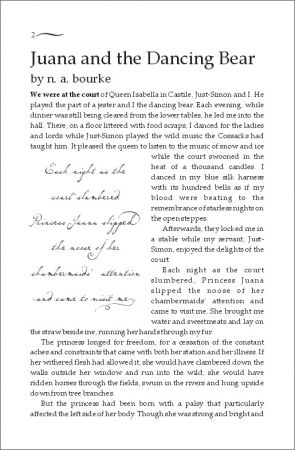
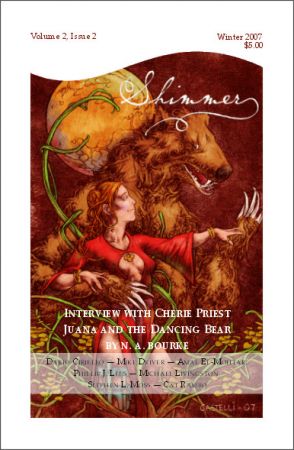
Juana and the Dancing BearJuana and the Dancing Bear by n. a. bourke

We were at the court of Queen Isabella in Castile, Just-Simon and I. He played the part of a jester and I the dancing bear. Each evening, while dinner was still being cleared from the lower tables, he led me into the hall. There, on a floor littered with food scraps, I danced for the ladies and lords while Just-Simon played the wild music the Cossacks had taught him. It pleased the queen to listen to the music of snow and ice while the court swooned in the heat of a thousand candles. I danced in my blue silk harness with its hundred bells as if my blood were beating to the remembrance of starless nights on the open steppes.

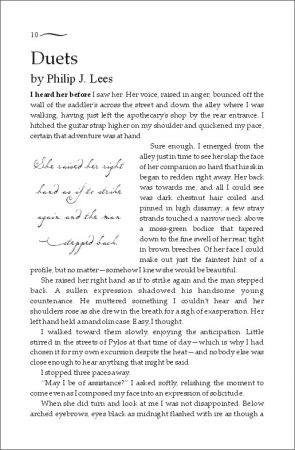
DuetsDuets, by Philip J. Lees

I heard her before I saw her. Her voice, raised in anger, bounced off the wall of the saddler’s across the street and down the alley where I was walking, having just left the apothecary’s shop by the rear entrance. I hitched the guitar strap higher on my shoulder and quickened my pace, certain that adventure was at hand.

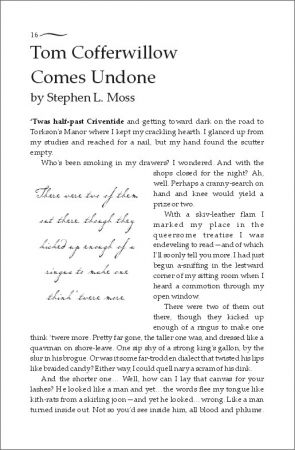
Tom Cofferwillow Comes UndoneTom Cofferwillow Comes Undone by Stephen L. Moss

‘Twas half-past Criventide and getting toward dark on the road to Torkson’s Manor where I kept my crackling hearth. I glanced up from my studies and reached for a nail, but my hand found the scutter empty.

Who’s been smoking in my drawers? I wondered. And with the shops closed for the night? Ah, well. Perhaps a cranny-search on hand and knee would yield a prize or two.

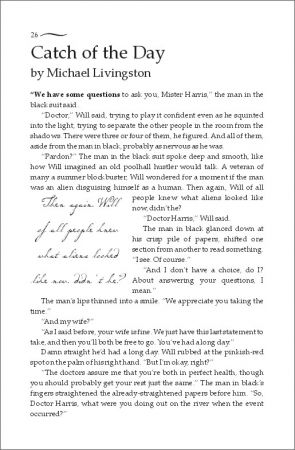
Catch of the DayCatch of the Day by Michael Livingston

“We have some questions to ask you, Mister Harris,” the man in the black suit said.

“Doctor,” Will said, trying to play it confident even as he squinted into the light, trying to separate the other people in the room from the shadows. There were three or four of them, he figured. And all of them, aside from the man in black, probably as nervous as he was.

“Pardon?” The man in the black suit spoke deep and smooth, like how Will imagined an old poolhall hustler would talk. A veteran of many a summer blockbuster, Will wondered for a moment if the man was an alien disguising himself as a human. Then again, Will of all people knew what aliens looked like now, didn’t he?

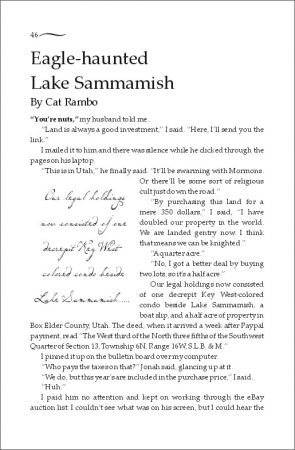
Eagle-haunted Lake SammamishEagle-haunted Lake Sammamish by Cat Rambo

“You’re nuts,” my husband told me.

“Land is always a good investment,” I said. “Here, I’ll send you the link.”

I mailed it to him and there was silence while he clicked through the pages on his laptop.

“This is in Utah,” he finally said. “It’ll be swarming with Mormons. Or there’ll be some sort of religious cult just down the road.”

“By purchasing this land for a mere 350 dollars,” I said, “I have doubled our property in the world. We are landed gentry now. I think that means we can be knighted.”

Interview with Cherie Priest

Lucy, by Chrissy Ellsworth

Night Milling, by Mike Driver

Lights out. Night milling.

Empty console room, bathed in flickering blue light from the VDU’s. Last delivery came in at 11pm, full load; lifters took the contents from the lorry bearing the blue Adams Grain logo into silo forty-three. Driver signed himself in, signed himself out. Security man checked the manifest and waved him through. Now the load makes its way from the silo into the tubes that lead to the grinding floor. Twenty-two grinders, some single, some double, speed into life; no one is there and the bright yellow ear defenders hang unused on their hook on the wall. Grind wheels grind, air pumps cycle silently to increase the flow, the mill wheels sift the finer grains, the remainder is recycled; more grist to get those sharp serrated teeth chattering excitedly. More to tonight’s delivery than usual.

Dwell on Her Graciousness, by Dario Ciriello

Yvène felt the pressure against her soul the moment she woke. She barely made it to the tiny cabin sink before she threw up. Gasping, she released the cabin’s foldout seat and settled before the little shrine she’d arranged in the study nook. She closed her eyes and breathed.

It normally took her less than a minute to uplink via her Dea implant, but she felt instead as if she were trying to work free of a wet blanket tied around her.

She ran a diagnostic on her uplink soulware. Nothing. She tried a second time. Still nothing.

Sparrow and Egg, by Amal El-Mohtar

A sparrow lies within an egg that lies beneath a sparrow.

“Egg,” says the hidden sparrow, dreamily, “I love you.”

“I love you too, sparrow,” says the egg.

“But egg, I love you more.”

“That may be, though I doubt it,” says the egg, “but I will love you longer.”