
In Shimmer‘s slush pile we see a lot of competent stories, many of which deserve a home … yet don’t end up with us.
Why?
We’re weirdos. We love weird stories that still work as stories. We love compelling characters and deep emotional impact and we love love love beautiful writing.
Good prose will keep us reading, certainly, but a strong, compelling, voice will win our hearts. (Note: We still might not buy it. The bottom line will always be stories that work as a whole.)
So, what is this strong voice we love so much?
Voice can be tricky to spot in writing. It’s easiest to see in first person. Check out the first couple lines from Erin Cashier’s “Near the Flame”:
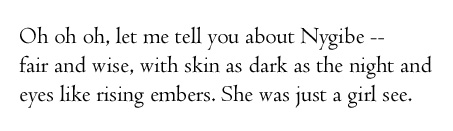 Do you hear that character? Do you already have a sense of them? When voice is working you’ll see them as a unique individual person. You’ll start to see their worldview and attitude. More importantly you’ll see them as a compelling person, someone you’re curious about.
Voice is there in third person narration too, and just as important. Voice is one of the things that makes the story unique. You can spot some authors just by the tone and voice of their work.
In Jen Waverly’s “An Organization Man in the Time Long After Legends,” we see a very different worldview and tone, even though the character isn’t narrating himself.
 Is there any doubt that the two bits are two different characters? By two different authors?

So, again, what’s voice?
It’s hard to pin down, but it should be distinctive without being distracting. It should ring true without sounding boring.
Easy to say, hard to do, right?
Lot’s of new writers worry about finding their voice. Honestly, don’t worry about it. I’ll give you some hints below to avoid weak voice, but really, the more you write, the more your voice will just come out naturally.
Here’s a secret: Voice is an element of style. “Style” is really just how each of us chooses to solve our writing problems. We try to interest the reader, to convey image and feeling and mood through these little black marks on paper. I might choose a casual tight voice, you might go for dense flowery speech. How we solve those communication and visualization problems becomes our style and, to an extent, our voice. We can’t help it.
That said, here’s three steps toward finding your own voice (and avoiding weak voice.)
Learn the basics
Sure, we all say there are only guidelines in writing and you can break the rules of grammar … but learn them first. Read Strunk and White, learn about passive sentence construction, make your junior high teacher proud.
Learn the basics so you’re coming from a solid knowledge of how writing works. Then feel free to play with language, experiment and see what works best for you.
Write strong and tight
Practice saying only what you need to say. Use only words that exactly convey what you’re saying. Look at your verbs. Are they exact? Are they strong and specific?
Look at these two paragraphs, which reads more compelling?
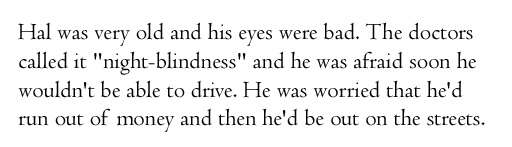
Sure, there’s information’s there. But do you really have any sense of Hal as a person? How about this instead:
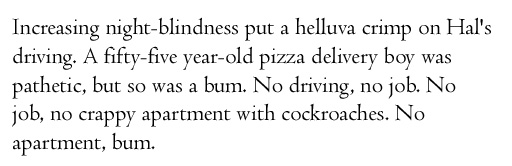
In the second version, do we have more of a sense of how Hal see’s the world? Or the narrator? Or both?
No matter how you choose to convey your story to your reader, make sure you are doing so with clarity. Choose language as much for its effect as for what it says directly.
Learn, but don’t emulate. And while you’re at it, don’t try so darn hard
You come from somewhere with a local dialect. Your parents gave you their speech patterns, so did your school, and friends. There’s no such thing as right or wrong voice, so have faith that if you’re writing directly, truthfully, and with confidence your voice will compel. Don’t feel like you have to make everyone speak in stilted strange language, but do make sure your characters talk like someone.
So, what is strong voice? It’s writing that walks a balance between directness and confidence and subtlety and uniqueness. It’s loose and playful enough to sound unique, but grounded enough so as not to throw us out of your story.
 In a way, having strong voice comes from learning all the rules you can, learning from everyone you read … and then letting yourself relax and just write with energy and spontaneity. The balance is in learning enough that you can forget it all and just write.
Does it still sound hard to write with strong voice? Then write. Write a whole bunch, garner your own set of skills and problem solving tricks, your own unique balance.
Keep on learning from the best, but don’t try to copy their voice. We don’t want to hear a new Ursula Le Guin, we want to hear you.