Drinking at the Awesome Bar

Firefox 4.0 now calls the address bar in their browser the “Awesome Bar,” which has me envisioning a bar filled to over brimming with editors and writers. New and seasoned alike, everyone has their nook or cranny, shoulders rub, they buy each other drinks and swap pages in a haze of purple and green neon while Duran Duran and After the Fire pulse in the background. Books and magazines line the walls. It’s a place everyone is welcome–because everyone has come to find the awesome.

When I first started submitting my fiction to markets, I felt like they were all against me. There was no way I would even reach the Awesome Bar, because too many friends of editors blocked the way. Oh, I could see the pulsing neon, but couldn’t dance in it. Rejections piled up; could my writing suck this much? I couldn’t fathom it–it had to be the editors! They didn’t like me and loved only their close circle, so there was no way I was getting a drink at that bar.

Then, logic intruded.

Editors Aren’t Against You

Having become an editor and seeing how this side of the process works, editors really aren’t against you. A rejection is never personal. It’s the words that aren’t right, not you, because trust me, editors are looking for the awesome in every submission. Editors need your stories, otherwise they have nothing to publish. They’re always on the lookout for that fresh new voice, and want to share it with the world. Believe this.

We Want to Find the Awesome

Every story has the potential to be the awesome before we open it. I look at it as Schrödinger’s Submissions; before I open the story, it can be both The Awesome and The Not Quite Right. The scales are equally balanced. To keep them balanced, I usually don’t read the cover letter first, and I often don’t look at the title. I want to get to that first page; I want to see if page one rolls smoothly into page two and keeps me hooked into the story. Get me to the end of the story. I hope I make it every single time.

Finding the Awesome

We never know what flavor the awesome will take. I point time and again to Grá Linnea’s caveman story, “20th Century Caveman” (Shimmer #9), because this was not a story I expected to find awesome. The title gave me pause (which is why I rarely look at them before I start reading now!). Caveman, I thought. What? Can that even work? Really? By the end of paragraph two, I was already sold. Likewise with “You Had Me at Rarrrgg” by Nicky Draden (Shimmer #12). Zombies…wait, no, a zombie love story. Really? Really.

Belly up!

Defining the Awesome?

Almost impossible for me, because it can be a hundred different things. It may be a turn of phrase that links the entire story together. It may be a clever premise. It may be a captivating voice. Maybe it’s a point of view we’ve never seen before, a daring twist, or sometimes it’s an amazing blend of all these things. One of the best things? At Shimmer, we have seven people reading submissions. Each of us likes something different so your chances are that much better that your writing will strike a chord with one of us.

Come to the Awesome Bar

From prior entries here, you might think that working through the slush is a terrible journey. It’s truly not, because every story has the potential to be the awesome, to be the one we take to our fellow editors, “Heeey, lookit this.” Make this be your story. We want to see you get to the Awesome Bar and have a drink with us, as much as you want to be there!

Rock the Casbah

What are you doing with your writing today to reach the Awesome Bar?

Review: Perchance to Dream

Perchance to Dream, by Lisa Mantchev

Picking up where the enchanting Eyes Like Stars left off, we rejoin Beatrice Shakespeare on the journey of a lifetime, to free a pirate from a sea witch. The outside world is nothing Bertie expected though; despite her steadfast friends, nothing goes as she imagined.

No one sees every twist and turn to a story, least of all Bertie. She knows that freeing Nate from the sea witch won’t be an easy thing, but surely doesn’t expect her own father to complicate the mission. Her heart proves another complication, for Nate and Ariel both tug at it. Nate’s love for Bertie may prove a good defense against his prison, but Ariel is at Bertie’s side every day, drawing her ever close.

Magic and wonder abounds in this second volume; not only is our amusing cast traveling around in what seems a gypsy’s wagon, they encounter a delightful circus which can’t help but woo the reader. While it would have been easy to have the story follow predictable lines, Mantchev strengthens Bertie in this one and has her wondering who she is–beyond the young men she loves.

Peaseblossom, Mustardseed, Cobweb, and Moth are, of course, back for more adventure and sweets–the opening paragraph of this book may well be one of my all-time favorites. Mantchev stays true to the world she created in Eyes Like Stars, yet gives us an ever-widening look at it, as we finally move beyond the walls of the Theater.

Brava, brava! Act 3, So Silver Bright, is due this fall.

(And the cover art? Get out! Jason Chan is amazing, and really captures the feel of the characters and Mantchev’s world here. Just beautiful.)

Grow Your Voice

In Shimmer‘s slush pile we see a lot of competent stories, many of which deserve a home … yet don’t end up with us.

Why?

We’re weirdos. We love weird stories that still work as stories. We love compelling characters and deep emotional impact and we love love love beautiful writing.

Good prose will keep us reading, certainly, but a strong, compelling, voice will win our hearts. (Note: We still might not buy it. The bottom line will always be stories that work as a whole.)

So, what is this strong voice we love so much?

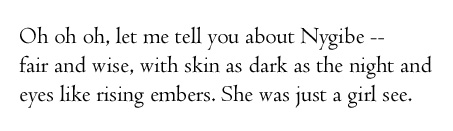
Voice can be tricky to spot in writing. It’s easiest to see in first person. Check out the first couple lines from Erin Cashier’s “Near the Flame”:

Do you hear that character? Do you already have a sense of them? When voice is working you’ll see them as a unique individual person. You’ll start to see their worldview and attitude. More importantly you’ll see them as a compelling person, someone you’re curious about.

Voice is there in third person narration too, and just as important. Voice is one of the things that makes the story unique. You can spot some authors just by the tone and voice of their work.

In Jen Waverly’s “An Organization Man in the Time Long After Legends,” we see a very different worldview and tone, even though the character isn’t narrating himself.

Is there any doubt that the two bits are two different characters? By two different authors?

So, again, what’s voice?

It’s hard to pin down, but it should be distinctive without being distracting. It should ring true without sounding boring.

Easy to say, hard to do, right?

Lot’s of new writers worry about finding their voice. Honestly, don’t worry about it. I’ll give you some hints below to avoid weak voice, but really, the more you write, the more your voice will just come out naturally.

Here’s a secret: Voice is an element of style. “Style” is really just how each of us chooses to solve our writing problems. We try to interest the reader, to convey image and feeling and mood through these little black marks on paper. I might choose a casual tight voice, you might go for dense flowery speech. How we solve those communication and visualization problems becomes our style and, to an extent, our voice. We can’t help it.

That said, here’s three steps toward finding your own voice (and avoiding weak voice.)

Learn the basics

Sure, we all say there are only guidelines in writing and you can break the rules of grammar … but learn them first. Read Strunk and White, learn about passive sentence construction, make your junior high teacher proud.

Learn the basics so you’re coming from a solid knowledge of how writing works. Then feel free to play with language, experiment and see what works best for you.

Write strong and tight

Practice saying only what you need to say. Use only words that exactly convey what you’re saying. Look at your verbs. Are they exact? Are they strong and specific?

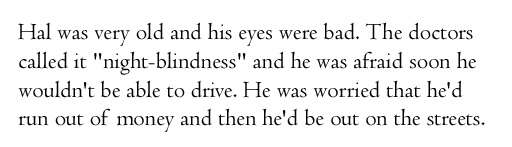
Look at these two paragraphs, which reads more compelling?

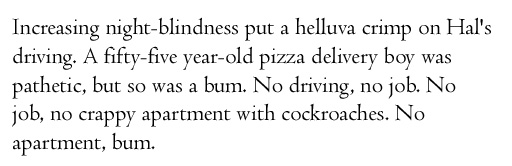
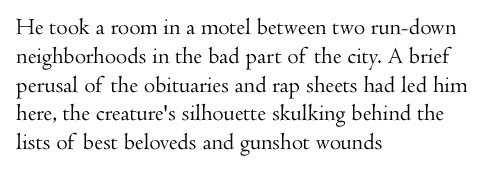
Sure, there’s information’s there. But do you really have any sense of Hal as a person? How about this instead:


In the second version, do we have more of a sense of how Hal see’s the world? Or the narrator? Or both?

No matter how you choose to convey your story to your reader, make sure you are doing so with clarity. Choose language as much for its effect as for what it says directly.

Learn, but don’t emulate. And while you’re at it, don’t try so darn hard

You come from somewhere with a local dialect. Your parents gave you their speech patterns, so did your school, and friends. There’s no such thing as right or wrong voice, so have faith that if you’re writing directly, truthfully, and with confidence your voice will compel. Don’t feel like you have to make everyone speak in stilted strange language, but do make sure your characters talk like someone.

So, what is strong voice? It’s writing that walks a balance between directness and confidence and subtlety and uniqueness. It’s loose and playful enough to sound unique, but grounded enough so as not to throw us out of your story.

In a way, having strong voice comes from learning all the rules you can, learning from everyone you read … and then letting yourself relax and just write with energy and spontaneity. The balance is in learning enough that you can forget it all and just write.

Does it still sound hard to write with strong voice? Then write. Write a whole bunch, garner your own set of skills and problem solving tricks, your own unique balance.

Keep on learning from the best, but don’t try to copy their voice. We don’t want to hear a new Ursula Le Guin, we want to hear you.

Review: Shades of Milk and Honey

Shades of Milk and Honey

by Mary Robinette Kowal

There are some books you never expect to steal your heart; the first time I tried to read Pride and Prejudice, I found it a terrible bore. Perhaps I was too young, for the second time I picked it up, it latched onto me. Shades of Milk and Honey latched on from the first chapter and didn’t let me go.

The sisters Ellsworth are two sides of a coin: one beautiful and one not, one skilled in glamour and one not. While Melody basks in the attention of young men, Jane is seemingly content to better learn the craft of glamour, weaving art throughout their world. At twenty-eight, Jane knows her own chances at marrying are slim, but she begins to envy the path Melody is on.

Enter one Captain Livingston, young and dashing and home from the war; mix in the rakish Mr. Dunkirk; swirl with the surly Mr. Vincent. You have a pot that fairly seethes with intrigues and secrets, all tightly-wrapped of course, being that this is the proper Regency era where one was expected to mind one’s manners. Still, if you put a lid on a seething pot, what happens? Yes, Reader, it overflows.

Jane’s journey is one to enjoy, and what a delight to see women forming friendships and not sniping at one another. Yes, the relationship of Jane and Melody has its moments, but in the end they are sisters–Rossetti said it best: “there is no friend like a sister / In calm or stormy weather.” I’ve read “complaints” that the book is “light” and “airy,” but I don’t see how this could possibly be a failing. Sometimes, you don’t want a 1000-page doorstop of a book, do you? Sometimes, light and airy and magical is precisely what your brain calls for.

You can tell Kowal enjoyed writing this; the pages fairly seem to glow with happiness–Shades of Milk and Honey has a glamour all its own.

Stay True to Rodney

There’s a particular kind of story that shows up in my slush pile with depressing regularity. It’s characterized by the ending. Here’s an example (and pretty bad one, at that!):

Rodney aimed his gun at the betentacled horror that loomed over him. The creature roared at him in a voice that sounded like that of his beloved wife, Sheila.

“No, Rodney, no!” the foul creature roared.

But Rodney was not fooled. His beautiful Sheila was gone, long gone; she had been transformed by unspeakable eldritch powers into this drooling, ravenous beast. He pulled the trigger. The creature shrieked in agony and then died.

As Rodney stood over the body, panting, his vision seemed to clear, and he was aghast. It was Sheila laying at his feet, not a creature from the abyss! Oh no! He dipped his finger in her blood and wrote a message on the wall.

Then he raised the gun to his temple, and squeezed the trigger.

* * *

“Ewww,” said the cop, a rookie who had never worked a homicide before.

“Seen it a million times,” said his partner, a grizzled veteran. “Just don’t puke on the evidence.”

“You mean evidence like that message written in blood on the wall? That says ‘I KILLED THE MONSTER FROM THE ABYSS. I AM NOT CRAZY. REALLY.'”

“Yup,” said the veteran. “Tragic, ain’t it? Guy reads Lovecraft, goes insane, kills his wife, then himself. Yep, that’s what happened here. You can tell because she’s dead, and he’s crazy. That’s what happened. Saddest damn thing.”

Then they went to the old cop’s retirement party.

THE END

OK, see why that sucks? (I mean besides the clumsy prose, clichéd characters, and the tired reworking of Lovecraft.)

It’s insulting. I am smart enough to figure out that Rodney killed his wife and himself without the cop explaining it. Really.

It’s disengaging. Any time you shift POV in a short story, you risk losing the reader. You’re interrupting the connection I’ve formed with the character, and it takes a lot of skill to bridge that interruption so that the reader is transported easily. How much more disengaging is it when I’ve spent the entire story in Rodney’s head, watching with horror and empathy as his world disintegrates around him, only to find myself abruptly shoved off to two new characters that I don’t know about or care about?

It’s unnecessary. If the body of the story has done its work, you don’t need an extra scene to explain. If you find that your critique group is confused by your story, the answer is not to tack on an explanation, but to strengthen and clarify the main story so that your intent is unambiguous.

It’s oversimplified. Lots of stories create tension by ambiguity throughout–is Rodney insane? Or are there really eldritch forces at work? It’s Rodney’s story, and it’s his vision of the events. Don’t betray poor Rodney’s vision by replacing his experiences with a quick summary by a bored cop at the end. Stay true to Rodney.

It’s insecure. Have faith in your story and your skill and your audience.

Confessions of a Slush Reader: Why Should I Care?

Slush readers are like lonely folks sitting at a singles bar: we came here to fall in love.  The odds aren’t good because the goods are odd, as the old saying goes, but there is one truth—when we start reading your story, we want it to be beautiful.  Our Hope-O-Meter is maxed out.

What is our Hope-O-Meter, you ask?  It is the internal gauge every slush reader has when he or she reads a story.  As we lay our eyes upon the first sentence of your epic tale, we are filled with the hope that you—yes, you!—will win the Nebula for this very story.

What you as a writer must understand is that our Hope-O-Meter starts topped off—but as we encounter each bit of bad writing in your story, our Hope-O-Meter drops.

When we first pick up your tale, our Hope-O-Meter looks like this:

However, as we read on, we may discover a vital issue: we don’t care about what’s happening.  And usually, that lack of caring comes because we don’t know one of three things:

  • Who is this character we’re expected to follow along until the end of the story?
  • What is s/he doing, and why is s/he doing it?
  • Why should we care about this particular action?

If we don’t know all three of those soon, then generally speaking we’re going to lose interest.  (Great writers can break any rule, of course… but if you’re a great writer, then why are you still in our slush pile?)

As we lose interest, we start to skim, looking to see if there’s anything else that might be kinda-cool—our attention fades.  We start thinking about the other twenty stories we have to read before dinner, and wondering whether this one is going to be a waste of our time.

We’re still reading, but at this point our Hope-O-Meter has dropped.  We’re not reading closely.  We have a faint optimism that maybe you can drag us back in, but it’s not a sure thing now.  Our gauge now looks like this:

Then at some point, we hit the final bump and our Hope-O-Meter has redlined.  We know that in our heart of hearts, we can’t recommend this story to our editor and feel good about it.  And we realize that we are going to have to reject a writer — which, since we are writers ourselves, never feels like a good thing.

How long does this Hope-O-Meter take to drop?  Depends on the writer; if you’re really incompetent, you can drop it all the way to zero in the first sentence.  But for most writers, you have until about the middle of page two before our Hope-O-Meter drops to the middle and we’re pretty sure we’re not going to buy your story.

The average point at which I realize that I utterly am not going to pass this on?  Page three.  I’ll skim to the end to make sure I didn’t miss a spectacular ending–but many slush readers won’t.  Thus, beginnings are vital.

So what you’re doubtlessly asking by now is, “How can I keep that Hope-O-Meter filled all the way up?”  And the answer is, “Get me to care about your characters, quickly and efficiently.”

How do you do that?  By answering the right questions.

Let’s take some real-life examples of openings from actual slush, and talk about where they went wrong.  I’ve filed off the serial numbers of these rejected stories, rewriting the opening paragraphs so that the flaws remain but the original prose has been burned away.

Jason’s hand trembled as he crouched in the bush and aimed at the slaver on the rooftop.  The slavers had come to Juniper County to put anyone they could find in shackles, so now Jason had no choice: he had to shoot.

The slaver turned, his eyes going wide as he saw Jason.  Jason pulled the trigger; the slaver’s head burst open.

Swallowing back nausea, terrified that someone had heard, he ran for cover…

This is an action-packed adventure, to be sure, but I’m already wondering one thing: Who the hell is Jason?

Because right now, we have a guy who’s shooting slavers in defense of his home town — something most people would do, I think — but we know nothing about him.  There’s some indication that he’s not an experienced fighter — the nausea, the nervousness — but it’s also possible that Jason could just be in fear of being caught.

That “who” makes a huge difference.  We don’t need to know that Jason is a Community College Grad who went on to become an in-home accountant with a moderate business and a flair for interior decoration… But we do need to know what he’s fighting for (does he have family here?), how experienced a fighter he is (since it’s going to make a huge difference to the story if he’s an experienced woodsman vs. an accountant who’s never fired a rifle before) , and what his ultimate goals are (escape, drive the invaders out, rescue a friend).

Does it need to be in the first three paragraphs?  Absolutely it does.  You don’t need to tell; you can show by having Jason, say, be a little concerned whether this Wal-Mart bought rifle will actually fire now that he’s taken it out of the gun safe — or you can have him be confident that Ol’ Bessie will do her job.  And he’s not just concerned about Juniper County as an abstract, he’s concerned about living long enough to find his beloved son Tommy.

Again, “Who” is critical.  It may sound silly— but for most writers, if they haven’t answered who this guy is in the first three paragraphs, they’re not going to answer it in the next fifteen pages.

At six o’clock on the dot, Damien clicked off his computer and stacked his unfinished paperwork neatly in his in-tray. The desk had become untidy over the course of the day, so he lined everything up geometrically; the desk blotter perfectly parallel with the keyboard, the monitor at a forty-five degree angle.

He made his way to the elevator, observing a spot on his shiny leather shoes.  He unfolded a handkerchief to buff it clean, then pressed the exact center of the button that marked the first floor.

When the elevator arrived, Damien spritzed the air with a small can of perfume, trying to neutralize the odors of stale BO and farts pent up within …

Good job!  In the first paragraph, you’ve up that Damien as a meticulous and retentive man.  I know who Damien is.

What I lack now is a “What.”

Why are we following Damien?  I need a reason that we’re here watching him, because if all that’s going to happen is an extensively-detailed trip of his journey back home, then I don’t care.  People do a lot of mundane things in their lives, but part of being a storyteller is leaving out the boring parts.

So why are we being asked to watch Damien buff his shoes and get on the elevator?  These are unimportant moments in Damien’s life, the kind of thing he’ll forget in an hour or so — so why should we be invested in them?

Stories should not consist of insignificant moments.

I know what this author is leading up to — somewhere around page two or three, Something Unusual will happen to Damien, breaking the pattern of his everyday life — but even a “mundane” life has tensions that can be called out.

Note how this opening has no real indicators of Damien’s wants or needs, aside from a clean shoe and a fart-free elevator.  It’s a kind of weak characterization, because it does tell us what his immediate needs are without letting us know what his goals are.

However, if we know that Damien is leaving work to go to a pick-up bar to try and get a girl, then suddenly all of these mundane details take on personal shape; he’s buffing his shoes so he’ll look good, he’s spraying the elevator to avoid smelling bad for his partner.

Or, if we know he’s going to visit his dying mother in the hospital, the rituals take on an air of desperation; his mother’s illness is out of his control, but he can control his own personal space.

Regardless, the point here is that just showing what a character is like is only half the battle; we need to know what that character’s goals are early on.  What’s Damien hoping to get done?  Even if the Devil is going to show up on page three and make him an offer, give poor Damien some internal goals before the first plot point arrives!

Beatrice stirred her soup in time to the rhythm of her husband chopping wood outside. Her cousin Jack took over stirring as she went into the bedroom to check in on Cindy. As Beatrice picked her daughter up, she wriggled and grinned.

This one has two problems.  The first is that there are too many generic characters to keep track of.

Interesting characters do things that no one else would do in their circumstance; that’s why you remember them.  After all, you’d probably be unlikely to walk into a cave empty-handed to try to talk a dragon out of devouring someone else’s crops, but that’s what Jim the Dragon Diplomat does for a living!

In this case, you have four characters in the first paragraph, none of them doing anything that makes them memorable.  Anyone can chop wood, if they need to.  Anyone can stir soup or check on a baby.

So the unspoken question is, “Why are we watching these characters?  What’s going to make them so fascinating I want to spend the next 4,000 words reading about them?”  And when you have not one but four characters, each doing generic things, you’re going to forget who’s who.

But even more than that, there are no interesting story questions.  This family seems fine.  The kid’s healthy.  So again, why are we here watching them?  I’m bored and slightly confused before the end of the first paragraph!  And so the hope-o-meter just dropped by fifty percent.

Maybe if the child was sick and coughing, that’d be something of interest — a little cliché, perhaps, but sick babies are a constant problem in frontier/medieval stories, and always significant.  Or maybe if we knew that they were all preparing for the night before the werewolves came to eat them.  (Or, more mundanely, that they were chopping wood and preparing food for winter… But hey, I read spec fic.  I expect blood and alien creatures.)

The point is that I need to know why we’re watching them.  Give me a reason to care, stat!

The work will take three months, and if done poorly, risks fatally poisoning you,” Nellie explained to the scent-engineer. “So I need to make sure your skills are up to speed.” She tightbeamed a spec over to his PDA; he whistled.

This is quite an unusual request,” murmured Paco.  “Even if you granted me full access to your family’s pheromone farms, I’m not sure it could be done.” He nodded, contemplating the request.  “But if so, I’m the only man who can do it.”

That’s the attitude I’m looking for,” she said, reaching out to clasp hands and seal the bio-contract.

So we have a clearly defined set of goals, an interesting job (pheromone farms? Scent engineers?), and a good story question: these two people want to accomplish something dangerous that’s never been done before.  So what’s the problem?

“It.”

A lot of writers, for some reason, think it’s more interesting to conceal the central premise of their story and then reveal it later on.  At some point around page five or six, we’re going to finally have the Big Reveal that what Nellie is looking for is an Enslavement Pheromone to turn humans into mindless ant-drones.  Mwoo hah hah!

Unfortunately, the irritation of leaving your reader in the dark is almost never as cool as your actual central concept.  Plus, to make this sort of delayed-reveal work, you usually have to work in a lot of awkward vagueness that competent characters wouldn’t actually engage in.  As the story goes on, you’ll have to keep referring to the Big Plot (or Hidden Monster, or Secret Goal) as “it,” and have the characters ask very nonspecific questions, and so forth.

All so… what?  If they get to the end of your first section, they’ll be hooked?  Have some faith, man!  If your concept is that cool, hook them right away!  You don’t need some artificial stall to build tension.

Break right out there with having her talk about her need for an Enslavement Pheromone.  Like Catherynne Valente says, get to the Ghostpigs.  And get there quickly.

…because man, a lot of you do this.  A lot.

The woods were moist with the morning dew, as the sun rose and lent a rosy glow to the land.  A deer, ever-vigilant, stopped to drink from a placid pool.  A fish flipped out from the pool, splashing the water and scaring the deer, who bolted into the thick brush.

Lance and Judy wiped the sweat from their brows as they set up the tent…

Writers love to start off their stories with descriptions of the landscape.  They discuss the roads and the weather and the creaky old house across the way and the gables of the roof… And then, after circling the point for several hours, they get to the actual story.

To be fair, some folks can pull off the all-landscape introduction.  One of the greatest novels in recent history, Watership Down, starts with an extensive description of the landscape.  (Though that was, it should be noted, a novel and not a short story — people have more patience for novels.)  And if you have a beautiful writing style, you can effectively start out your tale with a prose poem — enticing your readers with the mere power of evocative language.

Most of the landscape introductions, however, are like this — not particularly beautiful, not particularly florid, just workaday descriptions of the place the story’s set in.  And the place the story is set in is usually not that interesting, either — the tale’s in the deep woods, or the haunted graveyard, or the dark castle, or the mansion the rich people live in, or one of a thousand stock Hollywood sets that folks are traditionally placed in at the beginning of a tale.

Now, if a story started with, “The tendril-fields were wet and pulsing, the rose-pink tentacles reaching up to grab at the spine-birds that flew overhead,” then fine, I’d be like, that’s amazingTell me more. But generic descriptions of landscape are a pace-killer.

Furthermore, note how this description of the landscape doesn’t tie into the story at all.  You could pretty much start with Lance and Judy and lose nothing except for a bit of visualization — and, with some competent in-the-body descriptions as Lance and Judy set up the tent, you could create that same woodsy atmosphere from Lance and/or Judy’s perspective.

The reason Watership Down’s intro works is because we really need to know the area the rabbits live in — it’s vital to them, and turns out to be vital to the plot — and it is elegiacally written in breathtakingly beautiful words.  If you can do neither, then skip it.

The wind whipped through my hair as I stood on the high precipice of the city. The sky was a chaotic blur of neon streaks of all colors, with vehicles zipping through the air, dodging their way around the acid rain-scarred skyscrapers of Keystone metropolis. The holographic billboards blared advertisements in Japanese and English.  It all looked a little faded, like an old video game on an antique system, bright lights going to seed.

This isn’t a generic landscape description, but it is clichéd.  Essentially, what we’re looking at is the Blade Runner universe, which we’ve been to a lot of times.

Be careful when you’re writing that you’re not inadvertently ripping someone off a little too much.  If you are — and it’s not an inexcusable crime, to want to play in someone else’s tone-poems — then be sure to start the story somewhere a little more unique to you.

Incidentally, this is why a lot of editors love reading stories by non-American authors — it seems like every other story I see features a white guy in a detective’s office, or a white guy scientist in his lab, or a white rich guy regretting his past actions, or something.  They’re all generically American, almost a blank space that we’re expected to fill in with our culture.

Whereas if you’re writing a tale of, say, Medieval Africa, you have to set up the atmosphere and setting, which makes it automatically more interesting just by virtue of being Not A White Upper-Class Dude In America Doing White Upper-Class Stuff.  Even if the writing levels of the two authors are exactly the same, the story with the more unusual background winds up standing out more.

You who know the comfort of sanity look askance upon me; I watch you as you view my broken spirit and walk away.  Yet my so-called madness has opened up new worlds within me; I feel jubilation, exhilaration, exhaustion.  You may flee, but I — I see the bitter truth.

This is a particularly bad example of the trope, but this is what I call the Abstracted Emotions Gamble.  You see this particularly in Lovecraftian stories.

Thing is, there’s a big difference between “he’s insane” and “he thinks bugs crawl into his ear whenever he talks on his cell phone.”  There’s a big difference between “He’s in love” and “Every time he fills up at the gas station, he buys a single flower for his wife and leaves it on her pillow.”  There’s a big difference between “exhilaration” and “The story you spent three months agonizing over just found a home at Shimmer.”

Stories are about concrete details.  If you write about emotions as though they’re just these abstracted principles, then your story lacks all power.  When you write about characters feeling stuff, get as gritty as you can; it’ll make them more unique and pay off, and it won’t make us slush editors go, “Oh, yes, another story written by a madman who doesn’t actually sound all that insane.”

In Conclusion

Not giving us the answer to “Why should we care?” is the most common way of losing us as a slush reader, but there are a thousand others — simple grammatical errors and spelling mistakes, names that are too silly (“The Farhplock was in high dunder that day, given that the Kapl’u’rk’a had been stolen”), submissions that are clearly not a fit for our magazine, and of course the ever-popular “This story doesn’t actually start until page six.”

Best of luck! If this is of interest, let me know; I may follow up with a note on “Why did this fail?” — an essay on endings that don’t quite work.

The Art of Naming Characters

So you want to name a character

Naming a character can be a tricky thing. Names can be an easy way to identify a character, or to give your character some characterization without even trying.

Try this little exercise: think about a character named Bill. What does Bill look like?  What color is his hair? What color is his skin? What are his hobbies? What does he do for a living? If you asked five people this question you’d find some overlapping answers. For me, Bill works in insurance in Kansas, plays golf on Saturday mornings, and barbecues with the neighbors after the game on Sunday.

What about the name Horatio? You probably think of someone who doesn’t look like Bill, or like the same thing he likes. How about the name Oksana? Again, a different idea of someone that comes with a certain shared set of features. This is basically how stereotypes work: a belief or idea about a certain type of person based on a simple idea.

To sum this up using the old television show King of the Hill: there’s a reason his name is Hank, and not Lamar.

Going against expectations

Sometimes a character is given a certain name specifically because it plays off a stereotype. In the book Confederacy of Dunces, the absolutely absurd character has an equally absurd name: Ignatius J. Reilly. If I asked you to paint a picture of someone named Ignatius, you probably wouldn’t create a character described by the author as such:

A green hunting cap squeezed the top of the fleshy balloon of a head. The green earflaps, full of large ears and uncut hair and the fine bristles that grew in the ears themselves, stuck out on either side like turn signals indicating two directions at once. Full, pursed lips protruded beneath the bushy black moustache and, at their corners, sank into little folds filled with disapproval and potato chip crumbs.

Similarly, a character named Romeo who was not passionately in love would be another example of an author going against a stereotype for a specific effect. I would advise you to use this particular naming method with caution, as it can be obvious and induce a serious case of eye-rolling in the reader.

What rhymes with X’yzlulzq’uzk?

I have seen stories where the alien or the monster has a weird and unpronounceable name. This is good logic: something foreign to humans will probably not be named Mike or Steve, and may possess a name consisting of sounds produced by body parts we may lack. However, the reader of your story is most likely to be a human, so go ahead and make the name easy to pronounce. A reader, when presented with the name X’yzlulzq’uzk will not pause every time to sound it out, and if they do, will be so kicked out of your story they probably won’t finish it.

Don’t try to be cute

Probably the most important rule of naming characters is don’t try to be cute or clever. Naming a character who has been through two major wars, has a prosthetic limb, and a patch of over a missing eye “Lucky” is bumper sticker humor, and will probably make the editor roll her eyes until they fall out and roll under the couch. Obviously if done well, one can break any rule and still find success. I will point to the example of Orson Scott Card’s Ender’s Game.  Naming your main character Ender, and then having that character go on to (highlight to see spoiler!) nearly kill an entire alien species shouldn’t work. It should make you groan and throw the book at the wall, but instead it’s done so well that it’s perfect.

So, 1) don’t try to be cute, and 2) there are exceptions to every rule.

Make the name part of the character, part of your story

In Kelly Link’s story “Magic for Beginners,” the main character is named Jeremy Mars. A couple times in the story the main character talks (or thinks) about the planet Mars. How could they not? Names define us. Names remind us of those who’ve come before us, and connect us to certain ideas or objects. Of course Jeremy Mars thinks about Mars. His friends probably mention it often. Every new person he introduces himself to must comment on it. This is one way to make your character’s name an important part of your story.

Has your name ever been brought up in a conversation, or mispronounced constantly, or made fun of by other children when you were young? Your character might experience the same thing, depending on their name.

A simple rule for naming your characters

Make your character’s name simple and interesting, but unobtrusive. Probably the best example of this I’ve seen recently is the main character from The Hunger Games.  Katniss Everdeen is a simple name, it’s easy to say, but has a memorable quality to it, because it is uncommon. It is not too cutesy and the author shows how others might make fun of the name (playing off of catnip).

Remember, simple and interesting, but unobtrusive.

Your Turn

What are some of your favorite character names–from your own work or that of others? Tell us in the comments.

Things I’ve Learned From Slush

Reading slush is actually an incredibly educational process. Apart from the obvious “don’t be a jerk” rules that I now understand, I’ve started to realize that slushing is actually benefiting my writing. And so, in the hope that things that I’ve learned can somehow help you, I present: Things I’ve Learned from Slush.

Your first line,

while important, shouldn’t overshadow the rest of your writing. If your first line is fabulous, then the rest of the lines in your story should also be fabulous. And while first lines are great, and fun to write, and fun to read, editors aren’t just buying
your first lines. They’re buying your stories. So your first line should be representative of your story – no flashy explosions or mass murders if your story is going to be a quiet psychological study of a young woman in a small Iowan town, please.

As you write your first line, you should consider how it fits within the context of your story, but also how it fits within the context of the first paragraph – or whatever you have in the first few lines of your story. Writing isn’t just about pretty sentences, after all, it’s about putting those sentences together.

Think about your ending

as much as your beginning – it shows if you don’t. I hate writing endings, because I can never figure out how they’re supposed to work. Somehow, you have to juggle emotional resonance, plot, character development, and voice throughout your entire story, and then catch them all again at the end. Drop one and the entire story falls apart. Who knew?

It’s also very easy to tell when someone hasn’t thought about their ending. I’m so guilty of this, myself. I figure that as soon as I reach the ending, the story will take care of itself. This rarely happens, so think about your endings. Edit them. (You should be editing everything. Do not only edit your endings.) Read them over. Do they resonate? Do they relate to the beginning, middle, and end? Or does it read like a cop-out, or worse, a Big Lipped Alligator moment?

Typos

are really the absolute worst. Not only are they embarrassing when they turn up in your own work, but when I read them in a story, or in a cover letter, they completely throw me out of the story. Is this nit-picky? No, not really. I’ve definitely sent out stories with typos, and when I realize it, I’m always mortified. Typos are an amateur’s mistake that any professional can make, and being on either the giving or receiving end of a submission with typos is just the absolute worst.

I guess what I’ve realized is that reading slush is sort of like a trial by fire, just like going through the slushpile is a trial by fire. You develop Slush-o-Vision to pick out the best stories and become good at seeing problems because you have to. When you take those Slush-o-Vision eyes to your own work, you realize, “Oh. Wow. Oops.” Then you get working.

Your Turn

Do you read slush? If so, what has it taught you about writing? Leave us a comment!

When to Edit Your Story

I’m going to be rude in this post and just assume that you don’t write perfect first drafts. Right? Your first draft isn’t perfect. I know this because I’ve read tons of first drafts in the slush I know everything. Even this week’s lottery numbers, which is why I don’t buy Lotto tickets, since that’d be cheating.

In any case, the trivial answer to the question is that you should edit after you finish your first draft but before you submit to magazines. In an ideal world, you finish a draft, tweak it slightly, submit, and then get back a glowing response in which the editor begs you to sell them the story. And everything else on your hard drive.

In the real world, things aren’t quite so clear-cut.

While You’re Writing

This really falls under the category of “unavoidable differences in author processes.” Some authors need to have a complete draft before they can edit. Other authors will edit as they go – tweak what they wrote before, and then add another page of new material.

I’m sure you’ve heard this before: “You should never edit before the draft is complete.”

Meh. I often go back and make minor edits while I write. These edits make the plot more consistent or add in foreshadowing and character details. I find that it’s more efficient to just make the changes than it is to write myself a note for later. Such is the wonder of the word processor.

The advice against editing mid-draft is primarily to help new writers avoid falling into a black hole of always-rewriting-never-finishing. If you can avoid that loop? Great. If not, then you should either force an ending to the story and fix it later or move on to a new story.

After You’ve Got a Draft! (But before you submit.)

I don’t have to say much about this, do I? Finish the story, edit it, and then send it out to see the world.

I do recommend at least two editing passes, even if all you end up fixing is a typo or two. If you have a first reader or critique group, edit at least once before you send it to them, and at least once after you get their comments. Why edit before critiques? The cleaner the draft you give to your critique group, the easier it will be for them to see any major structural issues in the story.

That might seem like it goes without saying, but this advice is based on having seen way too many stories up for critique that still need a spell check.

After You Submit

You’ve just sent your story–and two days later you realize exactly how you should have ended it. Now what?

I strongly recommend against beginning to re-edit a story that is currently on submission.

Here’s the thing–editors read and decide on the story you send them. If you make major changes after the story is submitted and you get an offer of acceptance, there’s no guarantee that the editor will also like your changes (and they probably won’t.) Yes, anything is possible, but at that point, you’re essentially taking an acceptance and transforming it back into another submission. This just makes more work for everybody–and I feel confident in saying that no editor wants to send an acceptance and get back, “Oh, thanks, but I’d rather you bought this story.”

I don’t even open the files of stories that are actively on submission somewhere. No matter how much I like the story I sent out, there’s still a temptation to edit and that can only end in tears or vodka.

After a Rejection

Oh no! Your story has just come back with another rejection. Should you rewrite based on the rejection?

If an editor has rejected your story, you have no obligation to pay any attention to the rest of the email. Seriously. The only part that’s important is that they said “no” to your story. (Okay, okay. Exceptions: If the editor tells you something that is specific to their magazine, keep that in mind for your next submission. You know, like if they say, “FOR THE LOVE OF ALL THAT IS GOOD IN THIS WORLD NO MORE VAMPIRE STORIES” totally send a werewolf story next. Also, if the editor says “please send me your next story” they totally mean that.)

Usually the correct option is just to send the story on to the next magazine and write a new story. How will you ever have time to write a new story if all you’re doing is rewriting?

However… it is possible to get a rejection in which the editor is willing to look at the story if you rewrite it. In that case it might be worth rewriting, depending on how badly you want to be in the magazine – but keep in mind that there’s no guarantee that the story will be purchased after rewrites. I also only recommend writing to the comments in that rejection if you find that they inspire you. Do you think these comments will make your story better? Then rewrite to your heart’s content! That way, even if the editor doesn’t want your rewritten story, you’ve at least improved what you do have.

Your Turn

Have you ever rewritten a story after a rejection? Did it help?

Speculative fiction for a miscreant world

Powered by eShop v.6