
Category Archives: News
Winter 2006 Contributors

|
The Persian Box – Gerald Costlow is a middle-aged man living a middle-class life in Michigan. He did a bit of traveling in his youth and eventually picked up Buddhism in Korea and a wife in Ohio. His short stories have appeared in the November 2004 issue of Flytrap magazine, the Fall 2004 Fantasque anthology, and several webzines now defunct. His novels have yet to find a publisher. |
| The Goldsmith – Ian Creasey was born in 1969 and lives in Yorkshire, England. He began writing when rock & roll stardom failed to return his calls. His fiction has appeared in various publications including Oceans of the Mind, Gothic.Net, Paradox, On Spec, and The Mammoth Book Of Legal Thrillers. His spare time interests include hiking, gardening, and environmental conservation work — anything to get him outdoors and away from the computer screen. | |
 |
Interview with Ellen Datlow – Ellen Datlow was editor of SCIFICTION, the multi award-winning fiction area of SCIFI.COM, for almost six years. She was fiction editor of OMNI for over seventeen years. During those years she has worked with and published many of the most important writers in the science fiction, fantasy, and horror field including Susanna Clarke, Neil Gaiman, Ursula K. LeGuin, Bruce Sterling, Peter Straub, Stephen King, Dan Simmons, George R. R. Martin, William Gibson, Cory Doctorow, Joyce Carol Oates, William Burroughs, and others.
She has edited several original science fiction and horror anthologies plus, with Terri Windling, edited the adult fairy tale series, a children’s fairy tale series, and a young adult series of fantasy anthologies. In addition, she has edited the horror half of The Year’s Best Fantasy and Horror anthologies for nineteen years. Datlow has won the World Fantasy Award seven times, two Bram Stoker Awards, the International Horror Guild Award, the 2002 and 2005 Hugo Award, and the 2005 Locus Award, for her work as an editor. SCIFICTION won the 2005 Hugo Award for Best Website. |
 |
Route Nine – Samantha Henderson lives in Southern California with her family and increasing numbers of corgis and rabbits. Her work has been published in Strange Horizons, Weird Tales, The Fortean Bureau, Abyss and Apex, Lone Star Stories, and Sybil’s Garage. Her website is here: www.samanthahenderson.com. |
 |
The Black Back-Lands – Jay Lake lives and works in Portland, Oregon, within sight of an 11,000 foot volcano. He is the author of dozens of short stories, three collections, a chapbook, and the novel Rocket Science from Fairwood Press. Jay is also the co-editor with Deborah Layne of the critically-acclaimed Polyphony anthology series from Wheatland Press, twice nominated for the World Fantasy Award. In 2004, Jay won the John W. Campbell Award for Best New Writer. He has also been a Hugo nominee for his short fiction. Jay can be reached via his Web site at http://www.jlake.com/ or by email at jlake@jlake.com. |
 |
Neighbor – Jason A. D. MacDonaldcan’t really say how he ended up at this party but intends to make the most of the buffet table. He earned his Masters Degree in English Literature from Carleton University and proceeded to fame and fortune as a graveyard-shift security guard at Canada Post Corporation. When not dreaming of a cushy public service cubicle, he loses himself in exploring other fantasy worlds, such as the works of George R. R. Martin, and by inventing his own with a focus on strong characters and non-rationalized magic. A handful of his poems have appeared in Yield Magazine. He currently lives in Ottawa, Ontario with his partner and pet rat. |
 |
Music in D Minor – Erynn Miles writes plays as well as prose. She resides in Chicago with her paramour Cory, an actor, as well as her two cats Nija and Boopstie, who are also actors. |
 |
One-Leaf-Two – Edo Mor is an Israeli-American who now calls Pennyslvania home, at least for eight months of the year. He resides in Argentina for the remainder, because being a glass artist permits such nomadic indulgences, and because his wife is from there and prefers it over the US, and perhaps because in a past life he was a migrating bird. Edo is a graduate of ClarionWest 2005. Visit his day job at http://www.momoglass.com.
One-Leaf-Two was conceived at the very tip of southern Spain, where the waters of the Atlantic and the Mediterranean mingle together and winds can exceed fifty mph for days on end. |
 |
Sell Your Soul to the Devil Blues – Tom Pendergrass is a former intelligence officer who now makes his home in Hunstville, Alabama with his wife and two sons. In addition to writing, he also grows bonsai. Tom won a Writers of the Future award in 2004 and his stories have been published in a number of speculative fiction magazines. He is a member of Codex Writers. |
 |
Action Team-Ups Number Thirty-Seven – Ken Scholes started writing stories in the first grade. He started submitting stories in the tenth grade and then, after a long break, started selling some of them. He has work appearing in Talebones, Fortean Bureau, Aeon Speculative Fiction, Son and Foe and the anthologies Best of the Rest 3: Best Unknown Science Fiction and Fantasy of 2001, TEL : Stories, 44 Clowns and L. Ron Hubbard Presents The Writers of the Future, Volume XXI. His speculative fiction has won honorable mention in several venues including Year’s Best Science Fiction and he is a winner of the Writers of the Future contest for 2004. Ken is a member of the Science Fiction and Fantasy Writers of America (SFWA) and the Codex writers group.
Ken’s background includes service in two branches of the military, a degree in history, a brief stint as a clergyman, an even briefer stint as a label-gun repairman and over ten years experience managing nonprofit organizations. Originally from the Puget Sound area, Ken currently lives in Gresham, Oregon, with his amazing wonder-wife Jen, two cats, five guitars and more books than you’d ever want to help him move. Visit his website. |
Winter 2006 Contents
Issue #2 – Winter 2006

This issue has our interview with Ellen Datlow, and stories from Ken Scholes, Jay Lake, and Samantha Henderson. Tom Pendergrass’s story, “Sell Your Soul to the Devil Blues,” received an Honorable Mention in the Year’s Best Fantasy and Horror. Nine marvelous stories.
I missed the premier issue of Shimmer, but found this second issue a joy to read. It was like opening a box of mixed chocolates. Although I like some of the fillings better than others, all were delicious and I couldn’t stop eating (er…reading) until all were consumed. — Tangent Online.
Buy your copy today!
[wp_eStore:product_id:8:end] [wp_eStore_cart_when_not_empty]
Table of Contents
The Black Back-Lands, by Jay Lake
They say the Silent People can hear you talking in your dreams. I guess ‘cause the Silent People only speak in dreams, they listen real good there, too. Kind of like the dead, maybe. But I always been told to keep my mouth shut when dreaming comes upon me, so’s not to give away too much of myself and get sewn into some woodspocket, and carried ever more through the fir shadows and pine bays while my body starves and fevers.
Action Team-Ups Number Thirty-Seven, by Ken Scholes
Thursday, 3:32 p.m.
The dentures I lost on reconnaissance last week have come back to haunt me. Cavanaugh made a big show of it, waving them beneath my nose in the cafeteria line. Smug bastard. If I were ten years younger or if he were forty years older, I’d have shown him completely new uses for tapioca pudding. Regardless, I have my teeth back and that made lunch slightly more tolerable.
Sell Your Soul to the Devil Blues, by Tom Pendergrass
It gets hot in the Delta—evil hot—the kind of heat that fills a man’s lungs with fire and crushes his breath stillborn. Preacherman came through here, ‘bout a year ago, and said this is what it’s like in Hell, so you best behave and live straight. Now God forgive me, that preacher had no notion what he was talking ‘bout. But I met someone a few years back who does.
Route Nine, by Samantha Henderson
Good to see you, Tex. It’s been a while, I know. Haven’t been out this way since I got my route switched. Wouldn’t be here now except there wasn’t anyone else to drive it.
Why? Well, I guess there’s time to tell you. Nothing’s gonna happen till the bar clears out. Need another beer, though.
The Goldsmith, by Ian Creasey
Corinne closed the nail-studded door behind her, and walked down the narrow steps. The goldsmith’s shop was small, full of little cabinets lined with black cloth displaying brooches, earrings, and necklaces of thin golden chain. Corinne got the impression that the entire shop could be stuffed into a bag for a swift getaway from riots, pogroms, or excise men.
Music in D Minor, by Erynn Miles
I awake to the sound of a piano tinkling a low, sleepy melody. It is coming from Charlie’s body. This melody almost always comes from him as he sleeps. He lies in bed next to me, the sound swelling beneath his skin , seeping out of his pores. I hear it in the saliva dripping from his half-open mouth. His arm shifts a little and I hear a hint of lazy cello.
But it is not time yet.
Interview with Ellen Datlow
Neighbor, by Jason A. D. MacDonald
There it was again!
Water pipes groaned behind the drywall, like alpine horns blown by cockroaches. As I started my dishes, the upstairs neighbor had turned on his kitchen faucet. There was a three second differential between the flow in my sink starting and the echo in the wall. I put the dish soap down, stared moodily at the white stucco ceiling of my one-bedroom apartment, and cut off the hot water. Three seconds later, the mockery above stopped too.
The Persian Box, by Gerald Costlow
Pardon me? Oh, you’re interested in the box. Yes, it’s quite beautiful, and quite old.
From Persia, yes.
You’re not the first stranger to remark upon it. People are attracted to its beauty, but it is rare for someone to recognize its origin. You must be a scholar like myself. I am Angelo Demetrius, by the way. Pleased to meet you. Would you care to sit down? I find drinking goes best with a little conversation.
One-Leaf-Two, by Edo Mor
South Wind was blowing now. All today and all of yesterday as well. Cool and steady and persistent. Clenched in his fist (so that they wouldn’t blow away) were sweet, good things of earth: a sticky husk of anis and three gomabarros, helical and phosphorescent in the night, clay-red like the eyes of culebras. Squeezed together, they smelled tart, sweet, and spicy all at once, and his stomach riffled with expectant notes. But he couldn’t eat them. He would wait. They were saved things, saved for her.
[wp_eStore:product_id:8:end] [wp_eStore_cart_when_not_empty]
Holiday Gift
Happy Holidays from Shimmer!
To read The Winter Tree: A Seasonal Tragedy by Kate Harrad simply click here.
Purchase Back Issues
Did you miss an issue of Shimmer? It’s not too late! You can always purchase the electronic edition, and we’ve still got a few copies of the print edition for some issues.
Issue 11: The Clockwork Jungle Book (Autumn 09)

Our collection of twenty fabulous steampunk animal tales. We’ve got an origin story from Jay Lake, and a tale of the end of the world from Sara Genge. Stories set in London, China, Alabama, Castle Frankenstein, and the moon. We’ve got snakes and dinosaurs, elephants and wolves, bees and fish, birds and goats, and yes, even a monkey or two. 172 pages, available in both print and electronic. Shweta Narayan’s story, “The Mechanical Aviary of Emperor Jalal-ud-din Muhammad Akbar,” has been reprinted in Jeff VanderMeer’s Steampunk Reloaded: Volume II.
The Clockwork Jungle Book … does not disappoint. This was a flawless issue Shimmer and a big thick one, too. — SF Revu
For more information, check out the Table of Contents. Autumn 2009.
_____
Issue 10: Winter 2009.

To celebrate our tenth issue, we put the whole thing up online: download it for free! This issue features Nir Yaniv’s “A Painter, a Sheep, and a Boa Constrictor,” which was reprinted in Rich Horton’s Year’s Best Science Fiction and Fantasy 2010. Five stories were selected for Ellen Datlow’s Honorable Mention list in the Year’s Best Horror, including our cover story, Caitlin Paxson’s “The Carnivale of Abandoned Tales.” The others: “Counting Down to the End of the Universe,” by Sara Genge; “The Spoils of Springfield” by Alex Wilson; “What to Do with the Dead,” by Claude Lalumière; and “A Painter, a Sheep, and a Boa Constrictor.” You also don’t want to miss Shweta Narayan’s “One for Sorrow,” and the cover art by the brilliant Carrie Ann Baade.
They are unfailingly well written, which gives hope for the future of the genre. — Tangent Online
For more information, check out the Table of Contents.
_____________
Issue #9: Spring 2008. Eleven delicious stories! Our cover story is M. K. Hobson’s “The Hand of the Devil on a String,” which appears on the Best American Fantasy 3 Recommended Reading List. Four stories from this issue were selected as Honorable Mentions in Ellen Datlow’s Year’s Best Horror: “The Hummingbird Heart,” by Angela Slatter; “The Shape of her Sorrow,” by Joy Marchand, “The Hand of the Devil on a String,” and “Chimera and Qi,” by Tinatsu Wallace.
Beneath the glossy cover art by Aunia Kahn, the 2008 Spring issue of Shimmer is filled with illustrated stories loosely based on relationships, and how the power of love or the lack of it influences people’s lives. This issue will satisfy the widely diverse palates of fantasy readers. –The Fix.
For more information, check out the Table of Contents.
_____________
Issue #8: The Art Issue (Winter 2008). In this issue, art director Mary Robinette Kowal first selected the art; then we approached some of our favorite authors to write stories inspired by the art.
- John Piccacio’s “Penny’s Grave” inspired “Pennywise,” by Kurt Kirchmeier.
- “Cherub,” by Sandro Castelli, lead to “A Very Young Boy With Largely Clipped Wings,” by Michael Livingston.
- Fatima Azimova’s “Conception of the Mind” was the inspiration for “Within the City of the Swan” by Aliette de Bodard. (Best American Fantasy 3 Recommended Reading List)
- Chrissy Ellsworth’s “My Career as a Fashion Designer” lead to “Dresses, Three” by Angela Slatter (honorable mention in Ellen Datlow’s Year’s Best Horror.)
- Carrie Ann Baade’s amazing untitled image gave us “Flying and Falling” by Kuzhali Manickavel, which was reprinted in Best American Fantasy 3.
For more information, check out the Table of Contents.
_____________
Issue #7: The Pirate Issue (Autumn 2007). Guest-edited by John Joseph Adams, this special themed issue contains ten swashbuckling stories, our interview with the creator of the Flying Spaghetti Monster, and is illustrated throughout by James Owen. Avast!
John Joseph Adams was invited by the editors at Shimmer to be the editor, and his skills at choosing good stories that have plots, characters, and are under 5000 words shows through. –Grasping for the Wind.
For more information, check out the Table of Contents.
_____________
Issue #6: Winter 2007. Nine magical stories, including “Sparrow and Egg,” from Amal El-Mohtar, and n.a. bourke’s gorgeous “Juana and the Dancing Bear.” Cover art by the marvelous Sandro Castelli.
“…Full of magic, love, poetic prose, and again, magic. Not the kind of magic you expect in traditional fantasy stories—spells and bewitchment—but the kind of magic that pulses through the veins of a well drafted collection to enchant the heart. You will remember these stories long after you have tucked the small paperback among your other collectibles.”–Tangent Online
For more information, check out the Table of Contents.
_____________
Issue #5: Autumn 2006. Eight stories, including Angela Slatter’s Aurealis-award nominated story “The Angel Wood,” and our interview with John Scalzi. Two stories received an honorable mention in the Year’s Best Fantasy and Horror: Aliette de Bodard’s “Through the Obsidian Gates” and “A Wizard on the Road,” by Nir Yaniv (trans. Lavie Tidhar).
It was a totally enjoyable experience … Shimmer is one of the best small press magazines out there and you should all be subscribing to it! — SF Revu
For more information, check out the Table of Contents.
_____________
Issue #4 – Summer 2006. With a magical cover by Chrissy Ellsworth, Issue Four presents nine stories. We’ve got Amal El-Mohtar’s first fiction publication, Angela Slatter’s “Bluebeard,” (which received an Honorable Mention in the Year’s Best Fantasy and Horror), and seven other treats.
Shimmer is the type of publication that you’re proud of reading in front of your peers. It is journal-sized, with an attractive, simple front and back cover layout. The interior has a clean, professional design. The font is eye-grabbing and large enough for most eyes to read without hassle…. Shimmer has some of the best dark fantasy and horror to be found in the small press. More people need to be exposed to this magazine. — Tangent Online
For more information, check out the Table of Contents.
_____________
Issue #3 – Spring 2006. Nine stories, including two Year’s Best honorable mentions: the haunting “Litany,” by John Mantooth, and the devastating “The Little Match Girl,” by Angela Slatter.
This issue of Shimmer is full of the well-written slipstream and interstitial stories that show why the magazine has become a favorite with both the fans and the critics. — Tangent Online
For more information, check out the Table of Contents.
_____________
Issue #2 – Winter 2006. This issue has our interview with Ellen Datlow, stories from Ken Scholes, Jay Lake, and Samantha Henderson. Tom Pendergrass’s story, “Sell Your Soul to the Devil Blues,” received an Honorable Mention in the Year’s Best Fantasy and Horror. Nine marvelous stories.
I missed the premier issue of Shimmer, but found this second issue a joy to read. It was like opening a box of mixed chocolates. Although I like some of the fillings better than others, all were delicious and I couldn’t stop eating (er…reading) until all were consumed. — Tangent Online.
For more information, check out the Table of Contents.
_____________
Issue #1: Autumn 2005. Our debut issue! See how it all began. We kicked things off with nine stories and a book review from John Joseph Adams. “Nobody’s Fool,” by Edward Cox, received an Honorable Mention in the Year’s Best Fantasy and Horror.
If I had seen Shimmer in a store, I would have snatched it up right away, because I am a book snob, and, to my shame, am too easily seduced by gorgeous cover art. However, had I indeed picked up a copy in a fit of unmitigated passion for its prettiness, I would not have been disappointed; this is an excellent magazine with high editorial standards, a tight, sure vision of what it seeks to accomplish, and a degree of success with that goal that’s decidedly gratifying. — Amal El Mohtar, SFSite.
For more information, check out the Table of Contents.
Holiday Greetings
Happy Holidays from Shimmer!
THE WINTER TREE:
A Seasonal Tragedy
by Kate Harrad
The village of Muddlenose was extremely tiny and extremely isolated, and was situated not quite in the heart of England but perhaps somewhere around its stomach, or small intestine. Few people ever found it or even looked for it. Indeed, any signs pointing the way to Muddlenose tended to blow down in the wind or be unexpectedly burnt to a crisp one night, such was the Muddlenosians’ desire for privacy. And the villagers got on well enough by themselves, mostly: marrying each other and giving birth to small Muddlenosians, each emerging from the womb with the village’s characteristic expression of suspicious self-sufficiency.
“We don’t need anyone else,” Mrs. Mallowfudge would often say to her gentleman visitor, Audacious Skinwillow. And he would reply, “And they don’t need us.” Or sometimes, “And we don’t want anyone either.” Then they would nod firmly at each other before indulging in self-sufficient, Muddlenosian lovemaking. For the village was not opposed to fornication between the unmarried, or indeed adultery (for it was never clear if there was or had ever been a Mr. Mallowfudge). In fact, the village was rarely opposed to anything, provided it was done by a Muddlenosian.
One year, however, in spite of their precautions, a stranger did find Muddlenose. He stumbled in one day in high summer, blinking as if he had just emerged from darkness, and somehow he stayed.
The woman from whom he rented a room, Miss Audrey Chasepaper (a lady of indeterminate age, weight and moral fiber), could not pronounce his name. So he came to be called Mr. Glittergrime. Once he had arranged terms with Miss Chasepaper, Mr. Glittergrime was rarely heard to speak. He stayed in his room, or went walking in the extensive woods to the east of the village, and seemed content. The villagers began to ignore his tall, spare figure as it hurried about the market square or disappeared among the trees, and before long Muddlenose had more or less accepted him.
Until winter came.
Autumn was long that year and winter came suddenly, breaking in on the brown and gold landscape almost overnight, like a guest who hopes to distract from his lateness with the violence of his entry. In other words, one morning there was a chill in the air; the next day there was a shimmering of frost; and on the third day, the village woke up to find itself deep in snow.
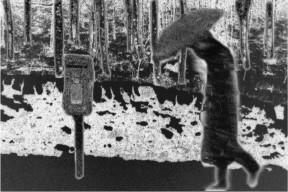
But not the snow they expected. For the snowfall was not, as they had previously found it to be, white. It was black. Black snowflakes fell and covered the square, plastered the thatches of houses, and shrouded the old oak tree by the village church. On the roads and paths, tremendous black snowdrifts made passage difficult. The snow was thick and deep and beautiful, but the villagers of Muddlenose did not notice that. They simply stared in astonishment at the midnight blackness all around them, for they had no idea what to think.
“What’s going on?” said Mrs. Mallowfudge to Audacious Skinwillow. He shrugged. Neither of them liked to admit ignorance about anything at any time, but this was outside their experience. Both were lying in bed, looking out of the window at the seasonal and strange weather.
“Could it be a mirage?” she asked.
“I think those only happen in deserts.”
“Oh.”
“Perhaps,” Audacious Skinwillow said, “we all ate too many of those delicious and interesting mushrooms over the autumn.”
“I ate none,” she told him, “and yet I still see the black snowfall as clearly as I see you.”
“Perhaps we are dreaming?” said Audacious Skinwillow.
Mrs. Mallowfudge reached over and pinched his left testicle rather sharply.
“Aah! Very well then, we are awake.”
“We are certainly awake. And if we are neither dreaming nor hallucinating, there can only be one possibility left.”
“And that would be?” he said.
“It is a sign.”
“A sign?” he repeated, nursing his bruised appendage.
“A sign, and perhaps even a curse. This is a warning to us.”
“What should we do?”
“Wait,” said Mrs. Mallowfudge, darkly. “And see.”
Over the next two weeks, the black snow continued to fall, and the village became darker and darker until you could barely see it once night had come. There were a number of accidents: barked shins, heads knocked against walls, and several sprained ankles. The villagers began to stay in at night. When they did venture out, they went to the village pub, the Muddlenose Arms, where they reported all the odd and curious incidents they had experienced. Mr. Barleygrow had lost his walking stick and found it several hours later, upside down in his garden. Louise Wandlesticks had seen a robin in the woods that refused to sing for her. Old Mrs. Pettigram had suddenly taken an implacable dislike to bacon, formerly her favorite of all foods. The villagers muttered, and drank, and then muttered louder.
After some more drinking, the muttering became open discussion, and the theme of the discussion was: “What has changed since last year?” For, as Audacious Skinwillow pointed out, and all agreed, the snow had been the right and proper colour of white last winter, and nothing untoward had occurred at all. Indeed, as Mrs. Mallowfudge asserted, and all further agreed, nothing strange had happened in Muddlenose for the whole time she had lived there, and that was a good fifty years. Old Mrs. Pettigram was enlisted to confirm that the thirty years before that had also been entirely uneventful.
In short, the village was in an uproar, and the question asked over and over again with increasing force and meaning, was “What is different?” Finally, somebody — and they could never remember which of them it was but it could have been any one of the assembled throng — somebody said, “We have a stranger here now.”
“Yes.”
“Mr. Glittergrime.”
“A new arrival.”
“Never speaks.”
“Goes for long walks.”
“Never smiles.”
“And when he does it seems somehow menacing.”
“I never hear any sound from his room,” offered Miss Chasepaper. “Quiet as a mouse. Or as the grave.”
“Or as the grave,” someone repeated.
There was a moment of silence.
And then out of the blue and with a note of alarm that at once infected the rest of the pub, old Mrs. Pettigram said, “What if Christmas doesn’t come this year?”
Suddenly everyone knew, knew for certain, that she was right. If snow could be black, then it was possible that Christmas would not come.
Muddlenose loved Christmas. Everyone gave everyone else a present, the old oak tree was hung with candles, and every house was decorated with red berries and green ivy. The preparations for Christmas were due to start tomorrow. But what would be the point if Christmas was not going to come?
A chill fell upon the villagers. “What if Christmas doesn’t come?” they repeated softly.
Mrs. Mallowfudge stood up with the light of prophecy in her eyes.
“Christmas will not come,” she pronounced, as if she had heard it from the lips of Santa himself. “Christmas will not come this year, unless we find a cure for our curse.” She paused, taking in the sight of the villagers with their eyes open as wide as mince pies. “We must heal ourselves, somehow.”
Mr. Barleygrow looked thoughtful. “I have some ointment at home,” he offered. “It is supposed to be for rheumatism, but…”
“What we need is a priest,” Miss Chasepaper said, more firmly. “We’ll get the vicar to do an exorcism. Like in the Bible. Drive out the demon.”
There was a pause while the villagers contemplated the idea of the elderly and vague Reverend Finkbottle conducting an exorcism to drive out a demon. There was a communal twitch at the corner of their mouths.
“Perhaps,” said Mrs. Pettigram timidly, “we could dye the snow white again? I have some bleach and a mop…”
Mrs. Mallowfudge sighed and climbed on to a chair. “Listen,” she called. They all listened. “I know what we have to do, to be safe. Trust me.” She paused. “We have to offer a sacrifice.”
There was silence, and a certain amount of shuffling. The villagers’ faces were blank. But Audacious stood up next to Mrs. Mallowfudge, and he nodded vehemently. “We have an intruder,” he said. “We have an interloper.”
The villagers’ faces were still blank, but beginning to be tinged with acceptance. Mr. Glittergrime had done wrong to none of them, but he was undoubtedly a stranger, and if something had gone wrong with winter, it was perfectly logical to assume that he was, in some way, to blame.
One of the more enquiring Muddlenosians, ventured to ask the awkward but perhaps necessary question: “How did he do it?”
And that crystallized something in the people’s minds, because they had not been sure till then whether he was a passive agent, unknowing, or an active agent, evil. Except for Mrs. Mallowfudge and Audacious Skinwillow, who had known at once, or even before, that Mr. Glittergrime was, in essence, and ultimately, bad. This knowledge was not based on events but on instinct: the unerring recognition of dark and light, which was conveniently typified by the black snow falling instead of white, and which could only be interpreted as a direct and unsubtle symbol whose meaning was, of course, corruption.
“He cursed us,” said the two village leaders together, both knowing it was true.
“He may be a demon,” Audacious said, “or a servant of demons. Note how he cannot speak human language, and that he cringes when we approach. He walks in the woods at midnight.”
“To commune,” said Mrs. Mallowfudge.
“And his diabolical conjurings have borne terrible fruit, as you can see all around you in the form of this black, black snow.”
The villagers nodded, although they could not, in fact, actually see the snow because it was nighttime. Yet they accepted it as a rhetorical device, and dutifully pictured their dark village, and shuddered. Muddlenose had the very whiff of demon about it they believed.
With sudden fervor, Mr. Barleygrow said, “I found his familiar! Last night, walking in the woods, I saw a figure built of snow, black snow, looming out of the darkness. It had the stench of evil about it.”
There was a collective gasp.
“We face a crisis,” said Mrs. Mallowfudge, with all the authority at her command — and after thirty or so years as the unofficial but universally accepted village leader, that was a lot of authority. “We must deal with it swiftly, and strongly.”
“So we must make a sacrifice to the spirit of Christmas?” said Miss Chasepaper, trying the idea out for size.
“And then Christmas will come, and the black snow will melt,” said Mr. Barleygrow hopefully.
“And then all will be back to normal.”
“And we will be freed from this horrible weather.”
“Yes,” said Mrs. Mallowfudge. “We will sacrifice the demon.”
Everyone cheered.
Mr. Glittergrime, needless to say, had not been in the pub. He was in his room, reading. He had been confused by the black snowfall, but this was his first winter in England, so he presumed that black snow was peculiar to the country, like smog. Nevertheless, he had come to enjoy the sensation of striding through crisp, dark snowdrifts and feeling black snowflakes falling on his head. He had even built a black snowman in the woods. He was contented.
He was therefore extremely confused to find an angry mob standing outside his window, throwing black snowballs against the glass and shouting. When he went downstairs and opened the front door, raising an enquiring eyebrow, he became further confused to find himself being dragged from the warm hallway out to the freezing road and from thence to the big oak tree by the church. The tree was a stark and cheerless object now, flinging its empty branches to the sky, almost crushed with the weight of the jet snow that covered it.
The villagers tied Mr. Glittergrime to the tree. Then some of them went to their homes and fetched great bundles of ivy and candles to put in the branches, brightly colored cloths to decorate the trunk, and they poured mead around the base of the tree so that it sank into the roots. They tore branches from the tree so that they would have light to see by, and flames lit up the churchyard. They adorned the Winter Tree for Christmas with Mr. Glittergrime as the centerpiece, wrapped in red and green fabrics and bound with ivy. He did not resist. He asked, once, “What on Earth is going on?” But he asked it in Czech, his only language, and since the villagers did not understand him, they pretended not to hear him.
Finally, the tree was ready, and they stood around it in solemn admiration for a few moments, ignoring the cold that crept into their arms and legs and noses.
“Christmas,” said Audacious, flinging up his arms, “do not desert us!”
“Accept our tribute!” Mrs. Mallowfudge said to the sky. “Not just the demon who would take you from us, but our Tree, which has stood here for as many years as any of us can remember, and will stand no longer. Take it! Accept it!”
And she took a flaming branch and set fire to the Winter Tree.
The oak was too green to burn well, but the smoky, unsatisfying fire burned Mr. Glittergrime nonetheless. All of the adults of Muddlenose stood and watched in the dark. The passion they had worked up earlier in the warm, lit pub slowly melted away until all that was left was the darkness and the flames and the choking smoke. Still, they stood there till the end, as if warming their hands at a bonfire –- but nobody’s hands were warm.
When the fire finally burned out, Mr. Glittergrime was dead –- most likely from the smoke, although no one could stand to look at his blackened body for long enough to tell.
And then morning came.
Mrs. Mallowfudge and Audacious Skinwillow tried to whip Muddlenose into a sensation of triumph and accomplishment, but they met with little success. When Reverend Finkbottle emerged from the vicarage, Mrs. Pettigram quickly engaged him in conversation and led him away so that he would not see their shame: for the villagers knew now that it was shame they felt.
The children came out of their houses and started to run around, but their parents shushed them and sent them back inside. The Muddlenosians grimly cut down their victim and laid him in the snow, where his naked body was so charred that it became camouflaged by the snow. The villagers shut his eyes and crossed his hands.
And then they dispersed to their homes, or to the woods, and were quiet. The pub was deserted. Nobody went near the remains of the Winter Tree, and nobody put up any decorations. Except for Mrs. Mallowfudge, who defiantly strung a row of brightly colored paper lanterns across her front garden, and found them trampled only an hour later.
Two mornings after the Winter Tree Sacrifice, Mrs. Mallowfudge and Audacious Skinwillow left the village. They did it silently, without goodbyes. They packed suitcases, stole a horse and cart, and disappeared. In fact, they only went as far as the next village, Hayfeather, which was slightly larger, but the effect was to remove them as thoroughly as if they had died. Occasional rumors floated back –- that one of them had murdered the other, that both had suffocated themselves in the snow, that they had opened a hat shop together –- but even though Muddlenose liked its gossip, they did not pursue the rumors. The couple had gone, and no one mourned them.
But the villagers mourned Mr. Glittergrime, whose real name they never knew. On the day that Mrs. Mallowfudge and Audacious Skinwillow left, Muddlenose held a funeral for him under the name they had given him, and his gravestone said the same.
The day after that was Christmas Eve, and then, finally, they put up Christmas decorations and roasted their turkeys and mulled their wine, and Christmas came as usual. (For, as Mrs. Pettigram remarked to Mr. Barleygrow in a shamefaced whisper, how could it not come, when they created it themselves? A fact that had not previously occurred to them.)
The next year, the snow was white, and Muddlenose never did find out why they had had the year of black snow.
In the years that followed, on every Christmas Eve, the entire village would gather by the churchyard, by the stump of the Winter Tree, and they would bring a feast: plum puddings, apple tarts, roast chickens, mince pies, jugs of cider and mead. They would decorate one of the trees in the churchyard with ivy and berries, and they would eat and drink in the cold, with a fire to keep themselves warm. When they had finished eating, they would scrape some of the ashes from the fire and sprinkle them over one of the graves in the churchyard so that it looked as if the snow had turned black.
Then at midnight, someone would take the last jug of mead, which was always kept back for this purpose, and they would pour it, slowly and silently, on to the black grave. They would contemplate for a few moments the wet and snowy gravestone and the Winter Tree Sacrifice. They would remember Mr. Glittergrime, whose name they never knew, and would never forget.

Reader’s Bonus
We would like to thank you, Dear Readers, by offering a collection of tidbits and bon-bons related to the stories you’ll be reading this year.
You can gain access to the Reader’s Bonus Section by typing in a password found within the magazine. This password will change with each update.
What’s inside?
Author Interviews: If you’ve enjoyed the stories you’ve read so far, perhaps you would like to know more about the authors.
Audio Bonus: Michael Livingston reads his story Gnome Season from the Summer 2006 issue.
Audio Bonus: Ken Scholes reads his story Action Team-Ups Number Thirty-Seven from the Winter 2006 issue.
Want a sample of what you could be getting? Listen to Mary Robinette Kowal read A Convocation of Clowns, by Mel Cameron, from our debut issue.
[audio:convocation.mp3]We will periodically add additional bonus content to this site, so check back often!
From Our Readers
Want to know what our readers are saying? Here’s a sample:
“I received my online copy, read it all, and enjoyed it very much. My favorites were Valley of the Shadow and Sour Hands, but I liked them all; and I really liked the illustrations. GOOD JOB!!! Off to a great start!”
–JoAnn
“With great pleasure, we received our copy of the premier issue of Shimmer today. I curled up and read it from cover to cover. Gobble, gobble, gobble. And a yummy literary snack it was. First, I have to compliment you on an aesthetically delightful production. Lovely to look at, a pleasure to hold in the hand. Apparently, I’m not the first to have thought it attractive either as, at some point in its postal travels, someone had torn open the seals to peek inside. I think that’s some kind of unique compliment – a purloined postal peep! Sour Hands was my favorite, hands down. Valley of the Shadow is also a lovely, writerly tale. It’s a grand start!”
–Sarah
“I’ve finished reading your lovely first issue. My favorite stories are Sour Hands, Valley of the Shadow and The Interrupted Nap. This has been a treat, so I will subscribe for four more. ”
–Robert
“Great job, guys! I just read the whole thing, cover to cover without a break.”
–Mike
“Your print version is amazing! A very well-turned out mag, got a few people here interested, let’s see if I can make them buy a few copies They really liked the art work and the overall feel of the magazine was very reader-friendly and attractive. Great job guys, here’s to a shimmering future.”
–Kuzhali
“The story about the skin [Nobody’s Fool] was good, but it grossed me out and I had to stop reading it. *shivers* A Convocation of Clowns was nicely done. Ooh, but it looks lovely your magazine does.”
–Sue
“The stories are wonderful and strong, and the layout is lovely. Fits perfectly into a handbag. And it’s clear that a lot of hard work and love was put into making Shimmer. I know, because I haven’t seen my husband in months.”
–Sam
“It’s a great mag off to a great start. I look forward to seeing the next issue.”
–Joe
“You started a magazine? What’d you do that for?”
–Beth’s mom
What We Want
What We Want
The best way to understand what kind of stories we’re looking for is to read an issue of our magazine. But here’s some more information that may be useful.
Shimmer is a speculative fiction magazine. This means that your story should have a speculative element at its heart. We have been known to accept non-speculative stories – but realize the odds are stacked against you.
We’re most drawn to contemporary fantasy. We’re less likely to be interested in sword and sorcery, hard SF, space opera, slasher horror, and other genre standbys. We like unusual stories that take us to places we have never been – but that we instantly recognize when we read your story. Send us your odd unclassifiable stories. However, we prefer conventional storytelling mechanics: we are unlikely to acquire experimental fiction. We’re also unlikely to acquire vampire stories, ironic stories about how Hell is just like a mortal bureaucracy, Adam and Eve stories, and other familiar genre tropes.
We like stories with a fluid and distinctive voice, with specific and original images. Write with strong active language; avoid passive voice. Eliminate extraneous words; everything counts.
We’d rather read a dark story than a heartwarming one, yet we’re not interested in stories written simply for shock value. Our stories usually have a strong and tragic emotional core.
We want to see well-developed characters who struggle to attain their goals. Don’t let your characters simply react to circumstance. We want to see a complete plot, where the issues of the opening are resolved by the end. Slice of life stories, vignettes, and stories that rely heavily on flashbacks are rarely successful with us. Tell your story in a way that creates a sense of immediacy.
We admire the economies of well-done flash stories; but you still need to have a complete plot. It’s harder than it looks.
We really don’t want trick endings. If your story ends with “it was all a dream!” or the revelation that the narrator is insane, or actually a kitten, or if it’s a trick story that relies on withholding information from the reader, we will reject it.
Take the time to proofread your work. Eliminate errors in grammar, spelling, and punctuation. It’s a good idea to get someone else to read your story before you send it to us to help you find problems you might have missed.
Peeves
We all have our issues.
No matter what, do not use “alright.” It’s “all right.” Two words. We’re aware that “alright” is gaining currency and has its advocates; that’s why we’re letting you know our position up front. Beth, our editor-in-chief, stops reading instantly when she sees “alright.”
You have been warned.
Resources:
Many fine books offer excellent advice about writing. These are some of our favorites:
Self-editing for Fiction Writers, by Renni King and Dave Brown
Character and Viewpoint, by Orson Scott Card
On Writing, by Stephen King
Most writers benefit tremendously from critique groups. We have all benefited from the writing forums on Hatrack. We enjoy the flash challenges at the Liberty Hall Writer’s Workshop. There are dozens of online and local workshops; find one that works for you.
But the most important thing you can do to improve your writing is to keep writing.
Audio Fiction
As a little treat, we offer you these audio recordings
Mel Cameron’s A Convocation of Clowns on mp3. (1.4 MB)
Ken Scholes’s Action Team Ups Number Thirty-Seven on mp3. (5.3 MB)