All posts by Elise

Shimmer #13: Interview Index

So many outstanding stories in Issue #13, and we’re treating you to a little extra content from the authors themselves!  Follow the links to read what they had to say about their Shimmer #13 stories, and the creative process. Squid and unicorns–Shimmer #13 is special.

“Bullet Oracle Instinct,” by K.M. Ferebee

“Labrusca Cognatus,” by Erik T. Johnson

“Gutted,” by L.L. Hannett

“Frosty’s Lament,” by Richard Larson

“All the Lonely People,” by E.C. Myers

“Haniver,” by J.J. Irwin

“Dogs,” by Georgina Bruce

“Barstone,” by Stephen Case

“A Window, Clear as a Mirror,” by Ferrett Steinmetz

“Four Household Tales,” by Poor Mojo’s Giant Squid

Be sure to exit through the gift shop and grab your copy of Shimmer 13 today!

Letter to a Young Writer

Dear Young Writer,

I see you there, poised over the keys of your Smith Corona typewriter. Pause for a moment and read this, if you would. I know, I know, you have a lot yet to write for that English class–and I know, too, about the extra credit assignment you’re stressing over for your history class. (You’ll need a new typewriter ribbon before you begin that one.)

The stress won’t ease for a long time to come, but you will find you enjoy it. Eventually. You will like deadlines–not merely for their whooshing sound; you will like having goals. Someday, you will discover you work well enough without them, too, because the work simply bleeds from your fingers. Some days, you won’t be able to stop the words; cherish these days, because they will be balanced by others, where it seems you can’t latch onto a single word and make it do anything worthwhile.

I know you think you can’t find your way, that everything is essays and reports at this point, but take heart that you will find joy in even these. Just wait until you read Lysistrata for the first time. You will discover something you can’t even imagine. You will discover exactly what words can do and will start playing with them yourself. When friends say “you could write better than this,” you actually dare to believe them–and commit words to paper.

Your first submission will be horribly mis-sent. Do you really think the audience of Seventeen wants to read about a young girl who survives a nuclear war? Regardless, make the submission, enter the contest, and keep watching your mailbox for a reply. It’s going to be the pattern for the years to come. Write, submit, and do it all over again. The shape of the replies will change–you will actually learn how to target markets and send them to appropriate editors. You will make a blunder with your first book–ah, the arrogance of the eighteen year old who thinks she knows everything about publishing–but no worries. You will learn from this, and carry on. And wait until the advent of email…

The rejections will grow deep. People will tell you to throw them away, but I wouldn’t. I would keep them, in a folder, in your file drawer. Some years down the road, you will look at them fondly (and the way MZB scribbles “doorknob!” on your manuscript–ah, keep that one, for it is a lesson you never forget!). Don’t resent them. Each one is a step along the path. Stephen King got rejections. J.K. Rowling, too. I know, you don’t yet know that last name, but trust me, you will.

You’re going to be in a terrible accident later this year; it will change the path your life takes. Take advantage of the time you spend at home healing to write and to read. Read everything. You will be faced with a tutor, which seems a terrible thing, but this tutor will introduce you to Japanese poetry. Hold to it. It will bring you one of your best stories.

As for the extra credit piece you’re going to write about the museum rats that come to life after dark… No worries–you get an A+, and you spook your teacher enough that he asks you to read the piece to the entire class. You will hate that part–you are ever the introvert–but you do love the looks on their faces, and the way the story affects them. That you will never forget.

love,

Yourself

Issue #13: J.J. Irwin on “Haniver”

” ‘Haniver’ started life as my week-four story at Clarion South. Our tutor for the week was Gardener Dozois, and I wanted to write something closer to the science fiction end of the spec fic spectrum.” Read J.J. Irwin’s entire Shimmer interview, and then listen to a bit of “Haniver” from Shimmer #13.

“Tim Powers, Patricia McKillip, William Gibson and Terry Pratchett all got in before I started consciously extracting useful tools from other stories, so their influence runs deeper and (for want of a better phrase) more organically.”

Issue #13: L.L. Hannett, on “Gutted”

“Rain was lashing the car as we drove, the wind was chilly, the sky grey — and the husband wanted to keep his wife from temptation. I didn’t hear the rest of the stories that day. My mind was abuzz.” Read the rest of L.L. Hannett’s Shimmer interview!

L. L. Hannett reads from “Gutted,” her Shimmer #13 story.

“…my stories do come as images. The process of writing becomes like looking at a series of paintings, and trying to imagine what the figures in the tableaux are feeling, what they smell and taste, what they can see from their restricted positions, how the light falls on them, how they got there, and how they’re going to get between frames.”

Rocks Fall! Everyone dies!

This week’s blog post is about how to write rather than how to submit, which means that it’s going to be full of advice you either don’t need or won’t take. However, knowing that what I have to say is unnecessary has never shut me up before, so here we go!

Here’s a little-known fact! Most of the stories that get rejected from Shimmer are rejected because the slush reader(s) detect a deficiency in one of the core categories on our submissions check-list. Even though Beth told me not to give away our secrets on pain of death, I have risked receiving angry emails to show you this:

Now, most stories are able to get the first eight check-marks on their own. I’m here to talk to you about the mysterious ninth requirement. (The typo on page four is so that we can make sure our copy-editors are doing their jobs.)

The ninth requirement? Character motivations. No shit.

Look.

The most awesome stories have characters doing weird and unusual things. Otherwise, it wouldn’t be fiction, it’d just be a journal entry entitled, “Stuff I did today and my feelings.” Or your Twitter feed details about every meal you consumed in the past week. You know, boring.

However, sometimes when I’m reading a story, I still find myself wondering WHY, for the love of everything good and holy, would anybody ever do what the protagonist just did.

This usually stems from a shocking lack of self-preservation on the character’s part. Not, mind you, recklessness. If your protagonist is nineteen and is on their first drunken bender, I’ll believe almost any stupid thing you tell me they want to do. (Whether I’ll actually enjoy reading said story…)

Think about oft-parodied horror movie tropes. You know that getting out of the car in a creepy, abandoned gas station in the middle of nowhere in Northern California is a bad idea, right? Especially if it’s full of creepy vehicles and you can hear howling monsters, and there are dead animals everywhere! Don’t get out of the car!

Of course, if you need to put gas in the car in order to escape, or you just don’t believe in monsters, fine. There just needs to be a reason more compelling than, “The author thought that having the protagonist fight for their life at a gas station would be awesome.”

Or, take contemporary fantasy. I never have a problem believing that the vampire character drinks blood, wants to drink blood, obsesses about drinking blood, craves blood like a heroin junkie in withdrawal – whatever. But I do sometimes get jostled out of fiction where perfectly ordinary protagonists fail to react to their exceptionally weird neighbors.

Or “twist” endings. The character will be doing whatever it is that they do through the story, until they make a bizarre and unexpected choice at the end. I mean, I like being surprised, but just because I didn’t see it coming doesn’t mean that it was good. This is why “rocks fall and everyone dies” is a joke ending.

It sucks as a slush reader. Life is hard. I’ll finish reading these stories (assuming I make it to the end, but I digress) and feel strangely sad. I usually know what the author wanted me to feel, but all I end up thinking instead is, “But why would anybody DO that?”

The first step to avoiding this problem (yes! There is a plan! With steps!) is to make sure that YOU know why your character behaves the way they do. Why does your character want to join the evil empire? Why would anybody eat a frickin’ pomegranate in Hell? Etc.

Step two is also pretty obvious – make sure that the reader knows. There are as many different ways to do this as there are ways to write, so don’t let me cramp your style. Personally, I prefer subtle approaches. For instance, feeding the reader information slowly so that instead of getting an answer to the question, “WHY?” they just never ask in the first place.

You don’t want your reader to wonder about stuff like that while they’re reading. Wondering leads to thinking, and thinking leads to escape.

Oh man. So this is where I should tell you how to do this, right? Well, I can’t. You just have to try, fail, try, fail, fail, fail some more, revise, and then give up and submit the story.

Unfortunately, if I’ve got you paranoid about whether or not your character’s motivations make sense, the best test is to have someone else read your story.

Hint 1

If several readers independently tell you that they didn’t understand your character’s motives, you have a problem. If it’s just one reader, well, maybe they were having an off day, but try not to be too patronizing. These are SF fans, so they know all about revenge being best served cold, which means you won’t see it coming.

Hint 2

“But people just do that!” NO! NO! NO! Nobody cares! NOBODY CARES! Sure, people make stupid, terrible, awful decisions for no reason every day, (How else do you explain Easy Mac?) but readerly people like to pretend we aren’t the lowest common denominator. No matter how many people you know who Totally Behave This Way, if we’re supposed to sympathize with the character, we want their behavior to make some amount of sense. Probably.

Step three isn’t really a step, but it is an imperative sentence! “Don’t be neurotic.”

The submissions we get at Shimmer tend to be pretty good, so I see more problems like this than I do submissions in which the character’s behavior makes no sense.

Essentially, if you’re TOO worried about the story and you second guess yourself, it’ll show up in the fiction. (A rough indicator is usually too much internal monologue in which the protagonist thinks about what they’re going to do and why they’re going to do it. Which isn’t to say that all internal monologue is a Bad Thing, mind.)

I’ll be reading along and the character is about to do something completely in character. Maybe the vampire next door has just captured a new victim, and your kick-ass protagonist is about to break in the door and save the victim. Great! Exciting! But then the fiction shudders to a halt as the protagonist thinks something like, “I could have just called the cops, but…”

As a reader, I then start to think, “Hey, yeah? Why aren’t you calling the cops? They’ve got guns and like using excessive force.”

That’s the last piece of unsolicited advice I’m going to give you – don’t implant doubts in the heads of your readers. Because doubting, just like wondering, also leads to thinking, which leads to escape. And, subsequently, rejection.

As always, none of this matters if you do whatever you do so well that I don’t care.

I’m supposed to leave you with some kind of question that sparks comments, but I can’t think of any.

So… hey. Go write a story, or something.

Drinking at the Awesome Bar

Firefox 4.0 now calls the address bar in their browser the “Awesome Bar,” which has me envisioning a bar filled to over brimming with editors and writers. New and seasoned alike, everyone has their nook or cranny, shoulders rub, they buy each other drinks and swap pages in a haze of purple and green neon while Duran Duran and After the Fire pulse in the background. Books and magazines line the walls. It’s a place everyone is welcome–because everyone has come to find the awesome.

When I first started submitting my fiction to markets, I felt like they were all against me. There was no way I would even reach the Awesome Bar, because too many friends of editors blocked the way. Oh, I could see the pulsing neon, but couldn’t dance in it. Rejections piled up; could my writing suck this much? I couldn’t fathom it–it had to be the editors! They didn’t like me and loved only their close circle, so there was no way I was getting a drink at that bar.

Then, logic intruded.

Editors Aren’t Against You

Having become an editor and seeing how this side of the process works, editors really aren’t against you. A rejection is never personal. It’s the words that aren’t right, not you, because trust me, editors are looking for the awesome in every submission. Editors need your stories, otherwise they have nothing to publish. They’re always on the lookout for that fresh new voice, and want to share it with the world. Believe this.

We Want to Find the Awesome

Every story has the potential to be the awesome before we open it. I look at it as Schrödinger’s Submissions; before I open the story, it can be both The Awesome and The Not Quite Right. The scales are equally balanced. To keep them balanced, I usually don’t read the cover letter first, and I often don’t look at the title. I want to get to that first page; I want to see if page one rolls smoothly into page two and keeps me hooked into the story. Get me to the end of the story. I hope I make it every single time.

Finding the Awesome

We never know what flavor the awesome will take. I point time and again to Grá Linnea’s caveman story, “20th Century Caveman” (Shimmer #9), because this was not a story I expected to find awesome. The title gave me pause (which is why I rarely look at them before I start reading now!). Caveman, I thought. What? Can that even work? Really? By the end of paragraph two, I was already sold. Likewise with “You Had Me at Rarrrgg” by Nicky Draden (Shimmer #12). Zombies…wait, no, a zombie love story. Really? Really.

Belly up!

Defining the Awesome?

Almost impossible for me, because it can be a hundred different things. It may be a turn of phrase that links the entire story together. It may be a clever premise. It may be a captivating voice. Maybe it’s a point of view we’ve never seen before, a daring twist, or sometimes it’s an amazing blend of all these things. One of the best things? At Shimmer, we have seven people reading submissions. Each of us likes something different so your chances are that much better that your writing will strike a chord with one of us.

Come to the Awesome Bar

From prior entries here, you might think that working through the slush is a terrible journey. It’s truly not, because every story has the potential to be the awesome, to be the one we take to our fellow editors, “Heeey, lookit this.” Make this be your story. We want to see you get to the Awesome Bar and have a drink with us, as much as you want to be there!

Rock the Casbah

What are you doing with your writing today to reach the Awesome Bar?

Review: Perchance to Dream

Perchance to Dream, by Lisa Mantchev

Picking up where the enchanting Eyes Like Stars left off, we rejoin Beatrice Shakespeare on the journey of a lifetime, to free a pirate from a sea witch. The outside world is nothing Bertie expected though; despite her steadfast friends, nothing goes as she imagined.

No one sees every twist and turn to a story, least of all Bertie. She knows that freeing Nate from the sea witch won’t be an easy thing, but surely doesn’t expect her own father to complicate the mission. Her heart proves another complication, for Nate and Ariel both tug at it. Nate’s love for Bertie may prove a good defense against his prison, but Ariel is at Bertie’s side every day, drawing her ever close.

Magic and wonder abounds in this second volume; not only is our amusing cast traveling around in what seems a gypsy’s wagon, they encounter a delightful circus which can’t help but woo the reader. While it would have been easy to have the story follow predictable lines, Mantchev strengthens Bertie in this one and has her wondering who she is–beyond the young men she loves.

Peaseblossom, Mustardseed, Cobweb, and Moth are, of course, back for more adventure and sweets–the opening paragraph of this book may well be one of my all-time favorites. Mantchev stays true to the world she created in Eyes Like Stars, yet gives us an ever-widening look at it, as we finally move beyond the walls of the Theater.

Brava, brava! Act 3, So Silver Bright, is due this fall.

(And the cover art? Get out! Jason Chan is amazing, and really captures the feel of the characters and Mantchev’s world here. Just beautiful.)

Grow Your Voice

In Shimmer‘s slush pile we see a lot of competent stories, many of which deserve a home … yet don’t end up with us.

Why?

We’re weirdos. We love weird stories that still work as stories. We love compelling characters and deep emotional impact and we love love love beautiful writing.

Good prose will keep us reading, certainly, but a strong, compelling, voice will win our hearts. (Note: We still might not buy it. The bottom line will always be stories that work as a whole.)

So, what is this strong voice we love so much?

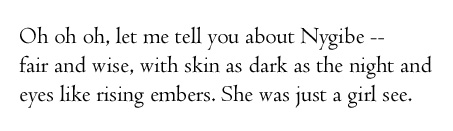
Voice can be tricky to spot in writing. It’s easiest to see in first person. Check out the first couple lines from Erin Cashier’s “Near the Flame”:

Do you hear that character? Do you already have a sense of them? When voice is working you’ll see them as a unique individual person. You’ll start to see their worldview and attitude. More importantly you’ll see them as a compelling person, someone you’re curious about.

Voice is there in third person narration too, and just as important. Voice is one of the things that makes the story unique. You can spot some authors just by the tone and voice of their work.

In Jen Waverly’s “An Organization Man in the Time Long After Legends,” we see a very different worldview and tone, even though the character isn’t narrating himself.

Is there any doubt that the two bits are two different characters? By two different authors?

So, again, what’s voice?

It’s hard to pin down, but it should be distinctive without being distracting. It should ring true without sounding boring.

Easy to say, hard to do, right?

Lot’s of new writers worry about finding their voice. Honestly, don’t worry about it. I’ll give you some hints below to avoid weak voice, but really, the more you write, the more your voice will just come out naturally.

Here’s a secret: Voice is an element of style. “Style” is really just how each of us chooses to solve our writing problems. We try to interest the reader, to convey image and feeling and mood through these little black marks on paper. I might choose a casual tight voice, you might go for dense flowery speech. How we solve those communication and visualization problems becomes our style and, to an extent, our voice. We can’t help it.

That said, here’s three steps toward finding your own voice (and avoiding weak voice.)

Learn the basics

Sure, we all say there are only guidelines in writing and you can break the rules of grammar … but learn them first. Read Strunk and White, learn about passive sentence construction, make your junior high teacher proud.

Learn the basics so you’re coming from a solid knowledge of how writing works. Then feel free to play with language, experiment and see what works best for you.

Write strong and tight

Practice saying only what you need to say. Use only words that exactly convey what you’re saying. Look at your verbs. Are they exact? Are they strong and specific?

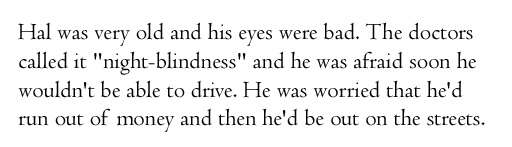
Look at these two paragraphs, which reads more compelling?

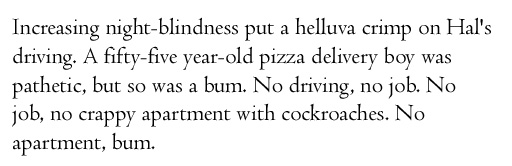
Sure, there’s information’s there. But do you really have any sense of Hal as a person? How about this instead:


In the second version, do we have more of a sense of how Hal see’s the world? Or the narrator? Or both?

No matter how you choose to convey your story to your reader, make sure you are doing so with clarity. Choose language as much for its effect as for what it says directly.

Learn, but don’t emulate. And while you’re at it, don’t try so darn hard

You come from somewhere with a local dialect. Your parents gave you their speech patterns, so did your school, and friends. There’s no such thing as right or wrong voice, so have faith that if you’re writing directly, truthfully, and with confidence your voice will compel. Don’t feel like you have to make everyone speak in stilted strange language, but do make sure your characters talk like someone.

So, what is strong voice? It’s writing that walks a balance between directness and confidence and subtlety and uniqueness. It’s loose and playful enough to sound unique, but grounded enough so as not to throw us out of your story.

In a way, having strong voice comes from learning all the rules you can, learning from everyone you read … and then letting yourself relax and just write with energy and spontaneity. The balance is in learning enough that you can forget it all and just write.

Does it still sound hard to write with strong voice? Then write. Write a whole bunch, garner your own set of skills and problem solving tricks, your own unique balance.

Keep on learning from the best, but don’t try to copy their voice. We don’t want to hear a new Ursula Le Guin, we want to hear you.

Review: Shades of Milk and Honey

Shades of Milk and Honey

by Mary Robinette Kowal

There are some books you never expect to steal your heart; the first time I tried to read Pride and Prejudice, I found it a terrible bore. Perhaps I was too young, for the second time I picked it up, it latched onto me. Shades of Milk and Honey latched on from the first chapter and didn’t let me go.

The sisters Ellsworth are two sides of a coin: one beautiful and one not, one skilled in glamour and one not. While Melody basks in the attention of young men, Jane is seemingly content to better learn the craft of glamour, weaving art throughout their world. At twenty-eight, Jane knows her own chances at marrying are slim, but she begins to envy the path Melody is on.

Enter one Captain Livingston, young and dashing and home from the war; mix in the rakish Mr. Dunkirk; swirl with the surly Mr. Vincent. You have a pot that fairly seethes with intrigues and secrets, all tightly-wrapped of course, being that this is the proper Regency era where one was expected to mind one’s manners. Still, if you put a lid on a seething pot, what happens? Yes, Reader, it overflows.

Jane’s journey is one to enjoy, and what a delight to see women forming friendships and not sniping at one another. Yes, the relationship of Jane and Melody has its moments, but in the end they are sisters–Rossetti said it best: “there is no friend like a sister / In calm or stormy weather.” I’ve read “complaints” that the book is “light” and “airy,” but I don’t see how this could possibly be a failing. Sometimes, you don’t want a 1000-page doorstop of a book, do you? Sometimes, light and airy and magical is precisely what your brain calls for.

You can tell Kowal enjoyed writing this; the pages fairly seem to glow with happiness–Shades of Milk and Honey has a glamour all its own.