Guest Post: How Not To Deal With Rejection

Hi everyone,

First, let me quickly introduce myself. I’m Silvia Moreno-Garcia, publisher of Innsmouth Free Press, a Lovecraftian zine which, in addition to other types of content, releases three yearly issues of fiction. We’ve had people like Nick Mamatas, Mary Robinette Kowal, Ekaterina Sedia and Charles R. Saunders in our virtual pages.

Today we are going to talk about dealing with rejection. First of all, rest assured that despite how good your work is, you’ll be rejected at some point by a publication. It might make you angry. Anger can be a good thing because it can spur you to try harder. Sometimes it turns into writer’s rage, which can take a couple of noxious forms:

Scenario 1: Bargaining Through E-Mail

You receive your rejection. You then reply to the editor lambasting them for their lack of feedback. Why exactly, was this rejected? Can’t the editor take five second of her precious time to write a few lines on the story that took your five months to write in your own blood?

Stop. Don’t ask for feedback. If a magazine doesn’t give it, there’s a good reason behind this policy and asking to bend the rules is not going to work. Let it be.

But wait. What if there is feedback? Then it is a chance to quarrel about every single, helpful point that the editor made and end the e-mail with a disdainful “I didn’t even want to be published by you.”

We are not at the market stall, bargaining over tomatoes. Your reply to the editors will not make them suddenly change their minds. It is a waste of time for you and them if you decide to engage in an e-mail quarrel. Resist the impulse to reply to rejections. I won’t even discuss the use of profanity in your correspondence because: no. Just don’t.

Scenario 2: Putting It Up On Your Blog

So you’re smart enough not to type an e-mail saying “eat caca, you squid-head” and hit reply. But you type “eat caca” on your blog, trying to vent your frustrations. Next day, I see it.

No, I’m not Sauron with the all-seeing eye. Neither are most editors. But many of us have a Google Alert and your comments will arrive in big, bold type. If we don’t have Google Alerts, then people will tell us (small world!). Does this mean we’ll ban you and never buy your stuff? Speaking for myself, no. But do you really want me to recognize you the next time I see your stuff in the slushpile as the smart writer who almost had it right or that writer who called me smelly publisher?

Rejection hurts. But if you are going to vent about it, I recommend phoning your friend rather than airing it all on the Internet.

Sure, it may seem that in an age when we Tweet about what we ate today (Greek salad and chicken, by the way), such rants would be kosher. But they’re not. Trust me on this.

Scenario 3: There Is No Complaint Department

I’ve had this happen. So I’m putting it out there: don’t e-mail the publisher to tell them that the editor is an ass who rejected their wonderful story, and then offer it to the publisher for their perusal.

At Innsmouth, Paula R.Stiles is the editor-in-chief. But we both read slush. We also have a policy of not buying anything if we don’t both agree on it. This sometimes means we don’t take a story because one of us has reservations. Rest assured, if Paula didn’t buy it, I won’t.

E-mailing the publisher to complain about perceived slights accomplishes nothing. Don’t try to badmouth the slush readers or editorial staff and expect an acceptance letter in return.

Move On

What’s the best way to deal with rejection? Absorb it (was there some useful information I can use?), then move on. Send it to other markets and start working on something new. After all, you’ll get plenty of rejection even if something is accepted and published, because then (gasp!) someone might read it and give you a bad review. And you probably shouldn’t do what Anne Rice did when that happened, which was to go on a flame war on Amazon.com. So start dealing positively with rejection, right now. Because the only way to avoid the pain of rejection is never to submit.

Short Stories Are Not Novels!

There’s tons of information on-line about how to submit novels, but relatively little about submitting short stories. I think this has led to the misunderstanding that the novel-submitting process is identical to the short story submitting process. While there is overlap, this is actually not as true as you’d imagine.

For novels, the basic idea is to write a query letter and a summary of your book and to send it to your carefully-researched list of agents and/or editors. Sending a query or manuscript to multiple people is called “simultaneous submission” and is generally okay at that stage in the process. Many novel submitting guides offer techniques to catch an agent or editor’s interest and quickly build a rapport with them.

So that’s novels.

But short stories are different. Unless the guidelines specify otherwise, there’s no need to summarize your story, simultaneous submission is not okay, and you don’t have to work quite as hard to catch our eye with your cover letter. While every short story magazine has its idiosyncrasies, those are the general guidelines. They’re certainly true for Shimmer.

A summary of your story is unnecessary and generally not desired.

Why?

Novels are LONG (70,000 words and up), and the slush pile is deep. There isn’t time to read everything. Agents and editors aren’t only looking to find out if your book is good, they want to know if it’s the right kind of book for them. A summary tells them the arc of a long work before they read it. It lets them know which books to read, and which are simply not right for their line.

But in the short story world, we’ll find out about your story when we read it, and honestly we get a better read going in without any foreknowledge besides the title (just like a reader picking up the magazine.) Summaries are hard to write and often make your story look less cool than it actually is. Let us judge your story, not your summary-writing skill.

More importantly, submitting a correct cover letter gives the editor confidence that you understand common submission process.

But here’s a wrinkle specific to Shimmer.

Our guidelines state that we prefer works of 5000 words or less. Many markets have a firm maximum word-count and don’t want to see anything above it, but we say, “but [if] you believe we would love it, please send us a query briefly describing the story along with the first page…”

Huh, that’s kind of like the novel submission process, isn’t it?

Yep, that’s because we get a lot of manuscripts to read every month, A LOT, but also because it’s less likely that we’ll buy a story over 5000 words, we want a short summary to know if it’s a story we’re interested in before we put in the time to read it.

Sim Subs

Check the guidelines; most magazines don’t allow simultaneous submissions.

It usually takes Shimmer from one to four weeks to get back to writers about their submissions. This may seem like a long time, but it’s actually pretty fast for the industry. This can get complicated and messy when a story is at multiple markets, so we ask that you wait until we’ve given you an answer till you send it somewhere else.

Do you need to catch our eye with a flashy cover-letter?

Nah, a quick hello is often the best policy.

It can be hard to build rapport with people you don’t know, and it’s often better to just go for simple and professional. Tell us the name of your story, how long it is, and if you have previous sales, mention the best three. I have some example cover letters on my personal blog, and you can read Shimmer’s take on cover letters earlier in this series.

So that’s it!

Format your story correctly, put it in the e-mail with a short, polite cover-letter (the cover-letter should go in the body of the email) and hit send! We’ll do the rest. Get back to
writing!

Got any questions or war stories? Leave ’em in the comments section below.

13 Lucky Questions with Mary Robinette Kowal

Mary Robinette Kowal
Mary Robinette Kowal. Photo © 2010 Annaliese Moyer

Mary Robinette Kowal, Art Director Emeritus for Shimmer, is never still for very long. She works as a professional puppeteer and voice actor, is the Vice President of Science Fiction and Fantasy Writers of America, and now has her first novel gracing bookstore shelves everywhere. Mary took time out of her busy schedule to talk with Shimmer about that new novel, Shades of Milk and Honey (Tor, 2010), “the fantasy novel that Jane Austen might have written.”

1. Shades of Milk and Honey has been described as Pride and Prejudice with magic. What drew you to the Regency timeframe?

I love Jane Austen and at the time I was reading Persuasion. I wondered why no one was writing these intimate family dramas in fantasy.

2. Can you explain some about the process of selling your first book? Was this the first book you wrote and tried to sell?

This is the fourth book I’ve written and the second one I’ve tried to sell. Mostly it involves a lot of waiting. I got very lucky and have a wonderful agent who does all the hard work of actually sending it out. With the first novel, I was sending it to publishers on my own and that takes forever.

3. One of your short stories (“First Flight“) involves a time machine. If you could travel back in time to the Regency period, what would you do? Where would you go? Who would you seek out?

First of all, I’d disguise myself as a man. Ladies had better clothes but not enough freedom of movement for my taste. Since I’ll still sound like a modern American, I’ll study with an local acting teacher first to try to blend in. Once I feel comfortable there, I’ll do a tour of the continent. In particular, I’d like to see the shadow puppeteer Seraphin in Paris.

4. Did working with Shimmer and getting a behind the scenes look at how a magazine comes together impact your approach to your own fiction?

Absolutely. Reading slush helped me understand what editors mean when they say things like a story “doesn’t rise above.” There are a lot of stories that are unflawed but also not doing anything more than telling a competent story. It’s still an elusive idea, but time reading the slush pile definitely helped with that.

5. Puppetry, travel, vice president of the SFWA…how do you balance everything you do and still make time for writing?

Honestly? Structured procrastination. It’s much easier to justify putting something off if there’s another thing that is more pressing. If you manage them right, generally it’s possible to use the urge to flee to get everything done.

6. Finish the sentence: “I wish I could _____.”

I wish I could take a nap, now.

7. What is the best piece of writing advice you’ve been given? Alternatively, what’s the worst?

Kristine Kathryn Rusch said that the manuscript is the tool with which you are telling the story in your head. Sometimes, you’ve picked the wrong tool. The problem is with the manuscript and it is not a precious thing. The worst advice was to put all five senses on every single page. I wound up with a story that was incomprehensible and put my instructor, who’d told me to do that, to sleep.

8. What favorite book do you wish you could forget, so you could have the pleasure of reading it for the first time again?

The Sparrow by Mary Doria Russell.

9. What was the most frustrating thing about writing Shades of Milk and Honey?

When I realized that the plot had taken a wrong turn and that I’d need to throw out 20,000 words. Bear in mind that I’m an outliner, and yet still. I needed to toss those chapters and re-outline based on what I was discovering as I was writing.

10. What do you know now that you didn’t know before the writing and publication of Shades of Milk and Honey?

The word “check” only means “stop” in 1814. So it wouldn’t be used in the sense of “I shall check on the strawberries” since that would mean “I will stop the strawberries.”

Mary's Favorite Royal

11. Among your collection, which is your favorite typewriter? Or, is there one out there that you love but haven’t yet been able to acquire?

I have a Duotone Royal that has a sans serif font. It’s a beautiful maroon and black machine. The one that I’m still looking for is the typewriter I let get away. It was a Corona #3, folding typewriter, in Oxblood red.

12. Pride and Prejudice or Sense and Sensibility?

Sense and Sensibility.

13. When can readers expect the sequel, Glamour in Glass, to hit shelves? Any sneak peeks?

It comes out in early 2012. Here are the opening lines, “There are few things in this world which can simultaneously delight and dismay in the same manner as a formal dinner party. Finding oneself a guest of honour, only increases the presentiment of unease, should one be disposed to such feelings.”

Mary Robinette Kowal, Art Director Emeritus for Shimmer, is never still for very long.

She works as a professional puppeteer and voice actor, is the Vice President of Science

Fiction and Fantasy Writers of America, and now has her first novel gracing bookstore

shelves everywhere. Mary took time out of her busy schedule to talk with Shimmer about

that new novel, Shades of Milk and Honey.

If you would like to catch the author and her novel in person, look for her at:

KGB Bar Fantastic Fiction, 85 E. 4th Street, New York, NY, 10003: Wednesday

August 18th, 7-8pm. SF IN SF AT VARIETY THEATER 582 Market Street @

Montgomery (1st floor of The Hobart Bldg), San Francisco, CA 94104: Saturday August

21st, 6-7pm. Tsunami Books 2585 Willamette St. Eugene, OR 97405: Tuesday August

24th, 5-6pm.

13 Lucky Questions with Mary Robinette Kowal

by E. Catherine Tobler

1. Shades of Milk and Honey has been described as Pride and Prejudice with magic.

What drew you to the Regency timeframe?

I love Jane Austen and at the time I was reading Persuasion. I wondered why no one was

writing these intimate family dramas in fantasy.

2. Can you explain some about the process of selling your first book? Was this the

first book you wrote and tried to sell?

This is the fourth book I’ve written and the second one I’ve tried to sell. Mostly it

involves a lot of waiting. I got very lucky and have a wonderful agent who does all the

hard work of actually sending it out. With the first novel, I was sending it to publishers

on my own and that takes forever.

3. One of your short stories (“First Flight”) involves a time machine. If you could

travel back in time to the Regency period, what would you do? Where would you

go? Who would you seek out?

First of all, I’d disguise myself as a man. Ladies had better clothes but not enough

freedom of movement for my taste. Since I’ll still sound like a modern American, I’ll

study with an local acting teacher first to try to blend in. Once I feel comfortable there,

I’ll do a tour of the continent. In particular, I’d like to see the shadow puppeteer Seraphin

in Paris.

4. Did working with Shimmer and getting a behind the scenes look at how

a magazine comes together impact your approach to your own fiction?

Absolutely. Reading slush helped me understand what editors mean when they say things

like a story “doesn’t rise above.” There are a lot of stories that are unflawed but also not

doing anything more than telling a competent story. It’s still an elusive idea, but time

reading the slush pile definitely helped with that.

5. Puppetry, travel, vice president of the SFWA…how do you balance everything you

do and still make time for writing?

Honestly? Structured procrastination. It’s much easier to justify putting something off

if there’s another thing that is more pressing. If you manage them right, generally it’s

possible to use the urge to flee to get everything done.

6. Finish the sentence: “I wish I could _____.”

I wish I could take a nap, now.

7. What is the best piece of writing advice you’ve been given? Alternatively, what’s

the worst?

Kristine Kathryn Rusch said that the manuscript is the tool with which you are telling

the story in your head. Sometimes, you’ve picked the wrong tool. The problem is with

the manuscript and it is not a precious thing. The worst advice was to put all five senses

on every single page. I wound up with a story that was incomprehensible and put my

instructor, who’d told me to do that, to sleep.

8. What favorite book do you wish you could forget, so you could have the pleasure

of reading it for the first time again?

The Sparrow by Mary Doria Russell.

9. What was the most frustrating thing about writing Shades of Milk and Honey?

When I realized that the plot had taken a wrong turn and that I’d need to throw out 20,000

words. Bear in mind that I’m an outliner, and yet still. I needed to toss those chapters and

re-outline based on what I was discovering as I was writing.

10. What do you know now that you didn’t know before the writing and

publication of Shades of Milk and Honey?

The word “check” only means “stop” in 1814. So it wouldn’t be used in the sense of “I

shall check on the strawberries” since that would mean “I will stop the strawberries.”

11. Among your collection, which is your favorite typewriter? Or, is there one out

there that you love but haven’t yet been able to acquire?

I have a Duotone Royal that has a sans serif font. It’s a beautiful maroon and black

machine. The one that I’m still looking for is the typewriter I let get away. It was a

Corona #3, folding typewriter, in Oxblood red.

12. Pride and Prejudice or Sense and Sensibility?

Sense and Sensibility

13. When can readers expect Glamour in Glass to hit shelves? Any sneak peeks?

It comes out in early 2012. Here are the opening lines, “There are few things in this

world which can simultaneously delight and dismay in the same manner as a formal

dinner party. Finding oneself a guest of honour, only increases the presentiment of

unease, should one be disposed to such feelings.”

Mary Robinette Kowal, Art Director Emeritus for Shimmer, is never still for very long.

She works as a professional puppeteer and voice actor, is the Vice President of Science

Fiction and Fantasy Writers of America, and now has her first novel gracing bookstore

shelves everywhere. Mary took time out of her busy schedule to talk with Shimmer about

that new novel, Shades of Milk and Honey.

If you would like to catch the author and her novel in person, look for her at:

KGB Bar Fantastic Fiction, 85 E. 4th Street, New York, NY, 10003: Wednesday

August 18th, 7-8pm. SF IN SF AT VARIETY THEATER 582 Market Street @

Montgomery (1st floor of The Hobart Bldg), San Francisco, CA 94104: Saturday August

21st, 6-7pm. Tsunami Books 2585 Willamette St. Eugene, OR 97405: Tuesday August

24th, 5-6pm.

13 Lucky Questions with Mary Robinette Kowal

by E. Catherine Tobler

1. Shades of Milk and Honey has been described as Pride and Prejudice with magic.

What drew you to the Regency timeframe?

I love Jane Austen and at the time I was reading Persuasion. I wondered why no one was

writing these intimate family dramas in fantasy.

2. Can you explain some about the process of selling your first book? Was this the

first book you wrote and tried to sell?

This is the fourth book I’ve written and the second one I’ve tried to sell. Mostly it

involves a lot of waiting. I got very lucky and have a wonderful agent who does all the

hard work of actually sending it out. With the first novel, I was sending it to publishers

on my own and that takes forever.

3. One of your short stories (“First Flight”) involves a time machine. If you could

travel back in time to the Regency period, what would you do? Where would you

go? Who would you seek out?

First of all, I’d disguise myself as a man. Ladies had better clothes but not enough

freedom of movement for my taste. Since I’ll still sound like a modern American, I’ll

study with an local acting teacher first to try to blend in. Once I feel comfortable there,

I’ll do a tour of the continent. In particular, I’d like to see the shadow puppeteer Seraphin

in Paris.

4. Did working with Shimmer and getting a behind the scenes look at how

a magazine comes together impact your approach to your own fiction?

Absolutely. Reading slush helped me understand what editors mean when they say things

like a story “doesn’t rise above.” There are a lot of stories that are unflawed but also not

doing anything more than telling a competent story. It’s still an elusive idea, but time

reading the slush pile definitely helped with that.

5. Puppetry, travel, vice president of the SFWA…how do you balance everything you

do and still make time for writing?

Honestly? Structured procrastination. It’s much easier to justify putting something off

if there’s another thing that is more pressing. If you manage them right, generally it’s

possible to use the urge to flee to get everything done.

6. Finish the sentence: “I wish I could _____.”

I wish I could take a nap, now.

7. What is the best piece of writing advice you’ve been given? Alternatively, what’s

the worst?

Kristine Kathryn Rusch said that the manuscript is the tool with which you are telling

the story in your head. Sometimes, you’ve picked the wrong tool. The problem is with

the manuscript and it is not a precious thing. The worst advice was to put all five senses

on every single page. I wound up with a story that was incomprehensible and put my

instructor, who’d told me to do that, to sleep.

8. What favorite book do you wish you could forget, so you could have the pleasure

of reading it for the first time again?

The Sparrow by Mary Doria Russell.

9. What was the most frustrating thing about writing Shades of Milk and Honey?

When I realized that the plot had taken a wrong turn and that I’d need to throw out 20,000

words. Bear in mind that I’m an outliner, and yet still. I needed to toss those chapters and

re-outline based on what I was discovering as I was writing.

10. What do you know now that you didn’t know before the writing and

publication of Shades of Milk and Honey?

The word “check” only means “stop” in 1814. So it wouldn’t be used in the sense of “I

shall check on the strawberries” since that would mean “I will stop the strawberries.”

11. Among your collection, which is your favorite typewriter? Or, is there one out

there that you love but haven’t yet been able to acquire?

I have a Duotone Royal that has a sans serif font. It’s a beautiful maroon and black

machine. The one that I’m still looking for is the typewriter I let get away. It was a

Corona #3, folding typewriter, in Oxblood red.

12. Pride and Prejudice or Sense and Sensibility?

Sense and Sensibility

13. When can readers expect Glamour in Glass to hit shelves? Any sneak peeks?

It comes out in early 2012. Here are the opening lines, “There are few things in this

world which can simultaneously delight and dismay in the same manner as a formal

dinner party. Finding oneself a guest of honour, only increases the presentiment of

unease, should one be disposed to such feelings.”

Mary Robinette Kowal, Art Director Emeritus for Shimmer, is never still for very long.
She works as a professional puppeteer and voice actor, is the Vice President of Science
Fiction and Fantasy Writers of America, and now has her first novel gracing bookstore
shelves everywhere. Mary took time out of her busy schedule to talk with Shimmer about
that new novel, Shades of Milk and Honey.

If you would like to catch the author and her novel in person, look for her at:

KGB Bar Fantastic Fiction, 85 E. 4th Street, New York, NY, 10003: Wednesday
August 18th, 7-8pm. SF IN SF AT VARIETY THEATER 582 Market Street @
Montgomery (1st floor of The Hobart Bldg), San Francisco, CA 94104: Saturday August
21st, 6-7pm. Tsunami Books 2585 Willamette St. Eugene, OR 97405: Tuesday August
24th, 5-6pm.

13 Lucky Questions with Mary Robinette Kowal
by E. Catherine Tobler

1. Shades of Milk and Honey has been described as Pride and Prejudice with magic.
What drew you to the Regency timeframe?
I love Jane Austen and at the time I was reading Persuasion. I wondered why no one was
writing these intimate family dramas in fantasy.

2. Can you explain some about the process of selling your first book? Was this the
first book you wrote and tried to sell?
This is the fourth book I’ve written and the second one I’ve tried to sell. Mostly it
involves a lot of waiting. I got very lucky and have a wonderful agent who does all the
hard work of actually sending it out. With the first novel, I was sending it to publishers
on my own and that takes forever.

3. One of your short stories (“First Flight”) involves a time machine. If you could
travel back in time to the Regency period, what would you do? Where would you
go? Who would you seek out?
First of all, I’d disguise myself as a man. Ladies had better clothes but not enough
freedom of movement for my taste. Since I’ll still sound like a modern American, I’ll
study with an local acting teacher first to try to blend in. Once I feel comfortable there,
I’ll do a tour of the continent. In particular, I’d like to see the shadow puppeteer Seraphin
in Paris.

4. Did working with Shimmer and getting a behind the scenes look at how
a magazine comes together impact your approach to your own fiction?
Absolutely. Reading slush helped me understand what editors mean when they say things
like a story “doesn’t rise above.” There are a lot of stories that are unflawed but also not
doing anything more than telling a competent story. It’s still an elusive idea, but time
reading the slush pile definitely helped with that.

5. Puppetry, travel, vice president of the SFWA…how do you balance everything you
do and still make time for writing?
Honestly? Structured procrastination. It’s much easier to justify putting something off
if there’s another thing that is more pressing. If you manage them right, generally it’s
possible to use the urge to flee to get everything done.

6. Finish the sentence: “I wish I could _____.”
I wish I could take a nap, now.

7. What is the best piece of writing advice you’ve been given? Alternatively, what’s
the worst?
Kristine Kathryn Rusch said that the manuscript is the tool with which you are telling
the story in your head. Sometimes, you’ve picked the wrong tool. The problem is with
the manuscript and it is not a precious thing. The worst advice was to put all five senses
on every single page. I wound up with a story that was incomprehensible and put my
instructor, who’d told me to do that, to sleep.

8. What favorite book do you wish you could forget, so you could have the pleasure
of reading it for the first time again?
The Sparrow by Mary Doria Russell.

9. What was the most frustrating thing about writing Shades of Milk and Honey?
When I realized that the plot had taken a wrong turn and that I’d need to throw out 20,000
words. Bear in mind that I’m an outliner, and yet still. I needed to toss those chapters and
re-outline based on what I was discovering as I was writing.

10. What do you know now that you didn’t know before the writing and
publication of Shades of Milk and Honey?
The word “check” only means “stop” in 1814. So it wouldn’t be used in the sense of “I
shall check on the strawberries” since that would mean “I will stop the strawberries.”

11. Among your collection, which is your favorite typewriter? Or, is there one out
there that you love but haven’t yet been able to acquire?
I have a Duotone Royal that has a sans serif font. It’s a beautiful maroon and black
machine. The one that I’m still looking for is the typewriter I let get away. It was a
Corona #3, folding typewriter, in Oxblood red.

12. Pride and Prejudice or Sense and Sensibility?
Sense and Sensibility

13. When can readers expect Glamour in Glass to hit shelves? Any sneak peeks?
It comes out in early 2012. Here are the opening lines, “There are few things in this
world which can simultaneously delight and dismay in the same manner as a formal
dinner party. Finding oneself a guest of honour, only increases the presentiment of
unease, should one be disposed to such feelings.”Mary Robinette Kowal, Art Director Emeritus for Shimmer, is never still for very long.

She works as a professional puppeteer and voice actor, is the Vice President of Science

Fiction and Fantasy Writers of America, and now has her first novel gracing bookstore

shelves everywhere. Mary took time out of her busy schedule to talk with Shimmer about

that new novel, Shades of Milk and Honey.

If you would like to catch the author and her novel in person, look for her at:

KGB Bar Fantastic Fiction, 85 E. 4th Street, New York, NY, 10003: Wednesday

August 18th, 7-8pm. SF IN SF AT VARIETY THEATER 582 Market Street @

Montgomery (1st floor of The Hobart Bldg), San Francisco, CA 94104: Saturday August

21st, 6-7pm. Tsunami Books 2585 Willamette St. Eugene, OR 97405: Tuesday August

24th, 5-6pm.

13 Lucky Questions with Mary Robinette Kowal

by E. Catherine Tobler

1. Shades of Milk and Honey has been described as Pride and Prejudice with magic.

What drew you to the Regency timeframe?

I love Jane Austen and at the time I was reading Persuasion. I wondered why no one was

writing these intimate family dramas in fantasy.

2. Can you explain some about the process of selling your first book? Was this the

first book you wrote and tried to sell?

This is the fourth book I’ve written and the second one I’ve tried to sell. Mostly it

involves a lot of waiting. I got very lucky and have a wonderful agent who does all the

hard work of actually sending it out. With the first novel, I was sending it to publishers

on my own and that takes forever.

3. One of your short stories (“First Flight”) involves a time machine. If you could

travel back in time to the Regency period, what would you do? Where would you

go? Who would you seek out?

First of all, I’d disguise myself as a man. Ladies had better clothes but not enough

freedom of movement for my taste. Since I’ll still sound like a modern American, I’ll

study with an local acting teacher first to try to blend in. Once I feel comfortable there,

I’ll do a tour of the continent. In particular, I’d like to see the shadow puppeteer Seraphin

in Paris.

4. Did working with Shimmer and getting a behind the scenes look at how

a magazine comes together impact your approach to your own fiction?

Absolutely. Reading slush helped me understand what editors mean when they say things

like a story “doesn’t rise above.” There are a lot of stories that are unflawed but also not

doing anything more than telling a competent story. It’s still an elusive idea, but time

reading the slush pile definitely helped with that.

5. Puppetry, travel, vice president of the SFWA…how do you balance everything you

do and still make time for writing?

Honestly? Structured procrastination. It’s much easier to justify putting something off

if there’s another thing that is more pressing. If you manage them right, generally it’s

possible to use the urge to flee to get everything done.

6. Finish the sentence: “I wish I could _____.”

I wish I could take a nap, now.

7. What is the best piece of writing advice you’ve been given? Alternatively, what’s

the worst?

Kristine Kathryn Rusch said that the manuscript is the tool with which you are telling

the story in your head. Sometimes, you’ve picked the wrong tool. The problem is with

the manuscript and it is not a precious thing. The worst advice was to put all five senses

on every single page. I wound up with a story that was incomprehensible and put my

instructor, who’d told me to do that, to sleep.

8. What favorite book do you wish you could forget, so you could have the pleasure

of reading it for the first time again?

The Sparrow by Mary Doria Russell.

9. What was the most frustrating thing about writing Shades of Milk and Honey?

When I realized that the plot had taken a wrong turn and that I’d need to throw out 20,000

words. Bear in mind that I’m an outliner, and yet still. I needed to toss those chapters and

re-outline based on what I was discovering as I was writing.

10. What do you know now that you didn’t know before the writing and

publication of Shades of Milk and Honey?

The word “check” only means “stop” in 1814. So it wouldn’t be used in the sense of “I

shall check on the strawberries” since that would mean “I will stop the strawberries.”

11. Among your collection, which is your favorite typewriter? Or, is there one out

there that you love but haven’t yet been able to acquire?

I have a Duotone Royal that has a sans serif font. It’s a beautiful maroon and black

machine. The one that I’m still looking for is the typewriter I let get away. It was a

Corona #3, folding typewriter, in Oxblood red.

12. Pride and Prejudice or Sense and Sensibility?

Sense and Sensibility

13. When can readers expect Glamour in Glass to hit shelves? Any sneak peeks?

It comes out in early 2012. Here are the opening lines, “There are few things in this

world which can simultaneously delight and dismay in the same manner as a formal

dinner party. Finding oneself a guest of honour, only increases the presentiment of

unease, should one be disposed to such feelings.”
You Are Awesome

You are awesome. I mean that in a completely honest way. You, composer of sentences, sender of query letters, super-writer extraordinaire, are awesome.

Before I continue telling you how amazing you are, let me give you some background into why I’m saying this.

I’m very new at Shimmer, having started a mere two (or is it three?) months ago. First and foremost, I’m a writer. In fact, I think most of the staff at Shimmer are writers, which brings me to the first reason why you, personally, are awesome.

1. We think you are awesome because we love writers. We are writers, after all, and even though publishing can be an incredibly competitive atmosphere, at the end of the day, we are all on the same side. Especially writers, who commiserate through rejections, help one another with gnarly plot problems, offer a helping hand or a shoulder to cry on, and tell you when to gut your story (or blog post) of clichés.

The other thing you should know about me is that I work. In particular, I work part-time and attend university the rest of the time, so I’m basically reading slush whenever I can sneak it in. When I write, it’s either very late at night or very early in the morning. And this brings me to the second reason why you are awesome.

2. We think you are awesome because you are writing, editing, and submitting your stories when you probably have fifty billion other things you need to be doing at any given point in time. Let’s face it: life is not kind to artistic types, and time is in short supply. The fact that you’re making time for your art is truly awe-inspiring. After all, there are plenty of wishers and wannabe writers, but what separates them from you is that you are out there working towards your goals.

The last thing you should know about me is that I love slush. I love it tons. Every single letter is like opening a present. Of course, sometimes you get socks instead of the latest Nintendo game – but that’s not to say that I indiscriminately dislike socks. No, there are definitely some days when I’d love to get a present consisting of nice, thick, Dumbledorean socks. (The Christmas after I moved up to the wintry north comes to mind.) So even if, one day, a story filled with metaphorical socks doesn’t strike my fancy, a couple weeks down the road, I could find a sock-filled story and adore it.

And this brings me to my last reason why you are awesome.

3. We think you are awesome because you send the query letters. Being on submission is an incredibly nerve-wracking process. I know I’ve been there. Most of us have, as a matter of fact, been in the same shoes as you’re wearing right now. They’re tough shoes to wear. They pinch your toes. You take the risk and put yourselves out there, essentially letting a bunch of strangers pass judgment on a piece of art that’s intensely personal. That is an admirable thing you are  doing, my friend. Keep up the good work.

You are awesome.

So, What’s A Slush Wrangler?

Hi, Shimmer reader and writers.

My name is Sean, and my job at Shimmer is SLUSH WRANGLER. When you submit a story to Shimmer, it comes into our gmail account with all the other slush. It’s my job to go through every submission and make sure of such things as: is there a story attached? Is the attachment in an acceptable format? Is the story under 5,000 words (as stated in the guidelines)?

If the stories are good to go, then I assign them to our associate editors. Another name for an associate editor is a slush reader, except at Shimmer, the associate editors have a voice in regards to buying or passing on a story.

Does every magazine work this way?

Nope. Every magazine is a special snowflake, and while some may have similar organizational structures to that of Shimmer, others are run in completely different ways. As such, you should do your research, and check out the submission guidelines before submitting to any magazine.

If you follow the submission guidelines, a slush wrangler gets his wings.

It’s easy when things work like they’re supposed to, and the writers submitting slush to Shimmer follow the guidelines.

So what happens to the stories that are incorrectly submitted? I’ll ask the author to try again.

Don’t feel bad; everyone makes mistakes. But if you continually abuse the guidelines, and make me intervene to remind you to check the guidelines, your name gets flagged, and I like you a lot less.

Does it actually impact your chances of getting your story read by an editor, if I need to constantly remind you to format your story correctly, or to query for stories over 5,000 words? Not really. I’ll still pass your story along when and if you submit it correctly.

But remember this: I’m married to the Editor in Chief. What do you think we talk about over dinner? 😉

I’m an author and I want to help you get your wings, WHAT DO I DO?

Send me a coupon for a free pizza. J/k. Bribes don’t really get you anywhere.

It’s true what beginning authors are told: the cream rises to the top… of the slush pile. A good story is all you need to break into a magazine. Easier said than done, I know from experience.

But here’s what you can do to help yourself.

First and foremost, read the guidelines. You’d be surprised how many people don’t bother with this step: enough that just the simple act of following the guidelines when you submit bumps your story into the top half of the slush pile. It’s so simple, yet is something I’ve seen many authors overlook.

Next, inform yourself. Become a part of the speculative fiction community, online and in person. Here are some things you can do:

And finally? Why not start interacting now? Be part of the Shimmer community. Leave a comment here and tell me, are you a beginning writer? Was this post helpful? I hope that it was. When your little slush baby arrives in my pile, I’m the first person who sees it. I’m rooting for you: it’s so much fun to see a great story go from slush pile to publication.

Questions?

Leave ‘em in the comments section. I’d love to answer them.

Advice for Very New Writers: Mastering the Cover Letter

The time has come, the Walrus said.

You’ve finished your story, you’ve done your market research, and you’ve found a place you think the story will fit. Your chosen market is Shimmer–quite smart, indeed! You’re ready to properly format your document as per the guidelines (.doc or .rtf), and submit. But before you do, have you written your cover letter?

When a market accepts electronic submissions, you may not think a cover letter is essential to your submission. It’s just a casual email, right? Wrong.

A cover letter is helpful for many reasons. As an editor, I like to know whose story I’m reading. I like to get a feel for the person beyond the story. I don’t like having stories simply thrown at me, which is what it feels like when an author doesn’t include a cover letter.

Your cover letter, or lack thereof, is often the first impression an editor will have of you. You want to present yourself as professional–even if you don’t have any publishing credits. You want the editor to look at the submission and say “this is someone I could work with.” Your story will stand on its own, beyond your cover letter, and plenty of editors don’t read cover letters first, but you’re much better off with a few words there than a gaping, blank space.

So, what’s good in a cover letter and what’s not so good?

Good: Market research. If you’ve researched the market enough to believe your story is a good fit, you should also take the time to explore the staff page. Who edits this publication? To whom are you sending your story? You aren’t simply tossing it into an abyss from which a pale hand will emerge to catch your pages. A real person is on the receiving end of your submission. If a submission comes into Shimmer and it’s addressed “Dear Sir,” you probably haven’t looked at much of the website. “Dear Editors” is perfectly acceptable, as Shimmer has a variety of editors on staff. It’s also okay to address a specific editor, especially if they had your last submission.

Good: The essentials. “Please find my 2000-word story, ‘Mad Monkey Robots on Mars’ attached for your consideration. Signed, Me.” Even if that’s the whole of your cover letter, it’s delightful. Word count, title, your name.

Bad: Do not believe that you can sneak a longer story in by simply not including the word count in your cover letter. If you submit a 10,000 word story, when 5,000 is our upper limit, we’re still going to notice.

Good: Introducing yourself. Include a few credits if you have them. If you don’t, don’t stress. We all started with a blank slate. “My fiction has appeared or will soon appear in X, Y, and Z.” If you are part of writers organizations, you can certainly mention that, too; likewise if you have attended Clarion, Odyssey, or another writing workshop.

Bad: Jokes, summaries, or jokes about your summary.

Good: A closing. Thanking the editor for their time, and signing your name. Always include your name. If you write under a pseudonym, juggling names can be a feat, but there’s an easy way to handle it. Always sign your cover letter with the name you’d like to be called. (You can also make this clear on your manuscript–legal name in the upper left corner, pseudonym on the byline.)

Bad: attaching more than one file to your submission. At this point in the process, we don’t need an outline, a summary, an individual bio sheet, or anything beyond your cover letter (email) and your story.

Good: We look forward to reading your stories–and your cover letters!

Now it’s your turn…

How do you approach cover letters? Like them? Hate them? Have questions that weren’t covered here? Tell us what you think in the comments.

Advice for New Writers: On Guidelines

About This Series

Once or twice a month, I get questions from new writers about how to submit fiction. Good for them for doing their research – but that tells me is a lot of new writers have questions about things I take for granted.

For those writers (and for all the writers in my slush pile who clearly never researched the subject at all!) we’re kicking off a series of blog posts, offering helpful information to newcomers, in bite-sized chunks. It takes some effort to learn the rules, and we’d like to help.

Let’s start with guidelines.

If you’re like most new writers I know, you may not look at much in the guidelines besides the pay rate and response time. Those are the most important things, right? And the rest is boring and arbitrary stuff that’s just there to make writers jump through hoops, isn’t it?

Not at all. Even a relatively modest magazine like Shimmer gets hundreds of submissions a month. It’s in your best interest to make sure your story stands out because of the writing, not because you didn’t respect us enough to follow our guidelines.

Without further ado, the three things editors wish you’d pay attention to in the guidelines:

Submission Mechanics.

If you don’t follow the submission directions, your story may not even be read. For example, Shimmer has a distributed staff and we do all our reading online. If you send us a print submission, we just can’t process it, and it will be rejected. Similarly, if you don’t use the subject line we specify, there’s a good chance your submission will get diverted into spam and lost forever. Or if you send us a WordPerfect file instead of the .doc or .rtf we require, we simply can’t open it. Do yourself a favor: make sure we can read your story.

Manuscript formatting.

Unless otherwise directed, use standard manuscript formatting.  (Some magazines have other requirements; they’ll be spelled out in their guidelines. Be sure to follow them!)

Why? What does it matter? Who cares about font?

That’s simple: A double-spaced manuscript in 12-point font is much easier to read than a manuscript in single-spaced 8-point Comic Sans. When you’re reading hundreds of submissions a month, formatting really matters. Make it easy for us to read your words. Don’t tempt us to dismiss you before your story has had a chance to charm us!

Editorial taste.

Often, editors let you know what kind of stories they’re looking for. Shimmer says “We’re most drawn to contemporary fantasy, and seek out stories with a strong emotional core. We like unusual stories with a fluid and distinctive voice, with specific and original images.”

On the other hand, Analog wants stories in which the science is an integral part of the story.

Now, you can’t overthink this and talk yourself out of submitting. When in doubt, send it in! But at the same time, why would you send Asimov’s a story with no science? Or send Shimmer a space opera story? Let the guidelines guide you.

Your Turn

What do you think about guidelines? Got any questions? Tell us in the comments!

Shimmery Summer Sale!

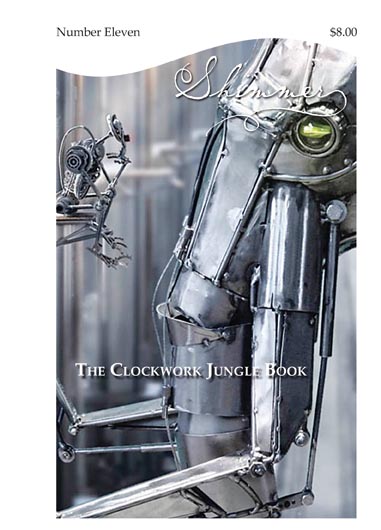
Issue 11: The Clockwork Jungle Book

Gentle Readers,

Team Shimmer is gearing up to release Issue 12. I can’t wait for you to see this issue: it’s spectacular.

But first, I need to make room for the new issue at Shimmer Headquarters. That means: it’s time for a sale.

Everything’s on sale.

Everything. Print copies. Electronic copies. Even 4-issue subscriptions. It’s all 20% off. Just enter the code ShimmerVacation (it’s case-sensitive) when you check out, and stock up on a summer’s worth of delicious Shimmery tales.

One week only!

This sale ends on Thursday, July 6, 2010 — so act now.

Author Spotlight: James L. Cambias

James L. Cambias
James L. Cambias

This is the final installment in our Clockwork Jungle Book author reading series. I hope you’ve enjoyed getting to know the authors a little better!

Our final author is James L. Cambias, who reads from his marvelous Teutonic steampunk story “The Wolf and the Schoolmaster.” Victorious but conflicted wolves on unicycles!

An excerpt:

When I returned to Totenburg after three months in the hills, the changes astonished me. Most of the damage of the War of Restoration was gone. Where there had been blocks of ruins, machines were digging foundations for new towers of glass and steel.

I steered my steam unicycle through the streets, hoping for enough pressure to make the climb to the castle. As I chugged past a group of old women bringing baskets back from the city market, I gave them a nod and salute. “Good morning, Citizens!”

They stared at me, a little fearful. I didn’t mind. Before the restoration they would have cowered in terror, and they would have been right to do so. The Baron Von Tod occasionally turned us wolf troopers lose on civilians when he thought they looked rebellious, or when he was in a bad mood, or just bored.

Click here to listen to James read. (21mb, MP3) And read our interview here.

Want to read the rest of the issue? And see the brilliant woodcut from Rhiannon Rasmussen-Silverstein which illustrates it? We’ve got 19 more fantastic stories!

Author Spotlight: Blake Hutchins

Blake Hutchins and Badger

Blake Hutchins offers this delightful story of a Jackdaw whose project becomes a little more than he imagined. I love the Badger; Jackdaw’s lucky to have her in his life — and we’re lucky to have “The Jackdaw’s Wife” in the Clockwork Jungle Book.

Click here to listen to Blake’s reading (2mb, MP3).

An excerpt:

“A galvanic heart,” Jackdaw breathed, hardly believing his luck. “Advanced etheric science. Complicated. Rare.”

“Humph.” Badger tilted her head and took the cheroot from her mouth, holding it delicately between two black claws. “What’s it good for?”

“What’s it good for? What’s it good for?” Jackdaw jumped up and down in a frenzy. “Maker love us, it gives things life. Life!” He forced himself to stop and preen. When he felt calmer, he added, “A power source to animate matter with spirit.” The mantle between his shoulders flufed with excitement.

Badger tapped ash off her cheroot. “This means another project, I suppose.”

Want to read the rest of the issue? We’ve got 19 more fantastic stories!

Speculative fiction for a miscreant world

Powered by eShop v.6