
Mary Toft, First Part
 Mary Toft is in the garden on an August morning rich with bees. Five months along, her belly presses against the rough linen of her skirt while one hand curves protectively around it, half support, half caress. She thinks: This time next year, what will she be? And after that? In the corner of her eye she glimpses a child—like a ghost, or a prefigure—running through the morning from the kitchen door to the garden wall.
She makes her way toward a field the mowers cut three days before. On the way she meets Margaret, and together they walk to their day’s labor. The mowers are already at work, crossing another field with the regular sweep of their scythes, the second load of the season. Mary and Margaret row the hay already cut and left flat to dry.
It is Mary who disturbs the rabbit, with no ill intention. An hour earlier the doe had fled the mowers, her heart wild and her eyes rolling white, and hidden among the fallen grass of the field now being rowed. Her breast and her tail are brightly white, and it’s the whiteness that stops Mary, as much as the movement, so she is first to look up and see the creature break for the edge of the field, speeding through the stubble and the brittle grass, her rear legs sliding from side to side in fear.
Mary watches the rabbit leap for the ditch. She cannot see it, but she knows—how does she know?—the rabbit stops, listening for those terrors above who would hunt her to earth, who would tear her to pieces and eat her, dragging her heart and stomach out through a rent in her belly. The other women return to their work, but Mary watches, and finds her mind returned to an earlier afternoon, some autumn when she was a child and her father brought home the bloody carcasses of three rabbits, their eyes blank in their sockets, and their paws limp. Mary watched her mother dismantle their bodies and consign them to the pot, their bones enriching a sauce of thyme and rosemary, their blood and livers added at the end to thicken. She remembered the slender and furless paws, the tiny feet, the delicate ivory bones broken in the dish, the sharp edge where her father’s knife, her mother’s cleaver, had split the powerful thigh bone, or shattered the ribs. How, taking a mouthful of the stew, she had also taken a mouthful of bone, and the points had scratched inside her cheek.
She can taste rabbit on her tongue, the fear and ferrous of its blood, or perhaps that is the taste of her own, where the bones pierced her cheek. She knows the rabbit still hides—white-eyed—in the ditch.
At that moment the child leaps like a rabbit in her womb. She returns to work, one hand often caressing her belly.
That night her labor begins, and what emerges is not a human child, not exactly. It is unsexed, its eyes sealed, its skin dark gray, like a hairless rabbit kitten, with an open pocket that runs from breastbone to privates, and its lungs and liver hanging outside its body.
In the light of a guttering taper it seems to Mary that the child draws one breath, but perhaps it does not. Perhaps his singular moment on earth was—like the morning’s prefigure—only a dream.

The Egg From Whence Hatched the World
In the beginning there was only water, and then the egg. The egg might be, for example, the product of a dove descending on the deep. From the egg might hatch a number of different entities, depending on the context. The universe itself might float from that original albumen. Or it might be a man, creeping from the shell on which a raven knocks to waken him. Or no creature at all might escape the cosmic egg, but rather the substance of reality itself, called by some ylem: the original material, the primeval atom.
In at least one instance it was Gaea who crept out of the world-egg, who conceived—with the aid of the waters—her son-lover Ouranos, with whom she populated the world.
The Monstrous Egg, First Part
New Mexico and the Trinity Test Site. In July, a young man climbs a hundred-foot ladder to where the Gadget, armed, awaits its early-morning detonation. He has been assigned babysitting duties in case of sabotage, though he is not sure what he is meant to do if anyone tries to approach his tower. The summer night seems to have arranged its own defense, anyway, and a storm blows in all thunder-struck, lightning-hatched. He spends the night alone, reading by the light of his TL-122-A, the dull yellow center of its beam illuminating half a page at a time, first one comic book then another, until—long before dawn—its narrow circle dims. After that it is only in sudden lightning strikes that he sees the whole page at once: the Human Torch, Captain America, Superman defeating fascists. All back-issues he’d picked up in the commissary.
 Outside in the darkness and storm—so dark he cannot see the ground, only the wild and disordered air—the Gadget broods; it seems to him gravid and still, except when a high wind causes the whole tower to groan and sway and another handful of rain drenches the window, its drops caught in freeze-frame flash by lightning.
He is excruciatingly aware of the Gadget, and what lies within it, what chain reactions, what potential. It might be an entirely new world. Or an end to the old world. Or nothing at all, an empty egg, unviable despite their best intentions.
Mary Toft, Second Part
Mary buried the inside-out child. Once, she looked up from its little grave to see rabbits watching in the first rain of September, a flicker of drops across a bright sunset in a slate-colored sky. Her glance scattered the rabbits, and they peeled away from the gravesite where she had set a little bunch of cottage flowers—clove pinks, richly scented, from the warm corner beside the front door.
She thought of rabbit stew and early morning rabbits startled among the lettuces of her little garden. She thought of their white bellies flickering, as had flickered the belly of that rabbit who fled the mowers and haymakers, who had—in a flash of light—quickened within her. She thought: Perhaps the womb is transparent, like water, and perhaps the flash of light from a rabbit’s white stomach can quicken within, as the word of God quickened in Mary’s own womb.
She felt something move, a creature she could not name, and who knows what shape it took? From a smear of blood to a cluster of bones, from a frog to a hairless rabbit kit, to a monkey to a man, to the shape made by certain underground roots that scream when they are torn from the earth. Something moved in that internal darkness, enclosed by the shell of her belly.
The second pregnancy was easier than the first, and the tiny, flickering creature moved within her wild and skittish, so she wondered if she had not one, but a litter of kits inside.
The Prophetess Hen
In August of 1819, in a village outside of Manchester, a farmer announces the advent of a miraculous hen. She lays eggs of remarkable beauty that bear—in copperplate letters—words of hope and advantage: Love your Savior, says one egg. Fear God, says another. Hellfire Awaits.
The hen dies suddenly. The village doctor preserves the remaining eggs. It was not until 1837 that the Farmer—on his death bed—admits what many suspected: that he had written those messages on newly-lain eggs. When the ink dried he re-inserted them into the hen—well, into multiple hens, but the Prophetess of Manchester was the only one who survived the process more than twice—and waited for the mystery to reveal itself in his chicken coop.
Gaea and Ouranos
Together Gaea and Ouranos conceived Briareos, Kottos, and Gyes, lovely and powerful creatures with fifty heads and fifty arms each. While Gaea loved them for their strength and beauty, Ouranos was troubled by their perfection—their enormous shoulders, their great height, their hundred exquisite eyes. Rather than allowing their power to challenge his own, he pushed them back inside Gaea, who was also the Earth, locking them in the underground of Tartaros, which was also Gaea’s womb.
 Gaea, she cried out in pain, as her sons dragged their fifty arms against the interior of her womb, which was also the deep region beneath the earth. She felt them return, also, to an earlier posture, since Ouranos’s violence twisted them into fetal creatures, their fifty arms wrapped around their bodies and their knees drawn up to meet the foreheads of their fifty heads. She felt each kick they made in defiance of her stony womb, each flip and turn as they sought some comfort in the tiny space their father had allowed them. She wept at both the pain and the perversion, and whispered to them: You will live in the air again; you will grow into your final form and you will be free.
Gaea and Ouranos continued to conceive children, and—once born—Ouranos returned them to their mother, until her whole body was occupied, womb and bowels, with creatures waiting to be reborn. With each child her body grew larger, the shell of her belly harder, and she could not move with the weight of them. She would burst, she thought, she would rupture, and all her children would run back out into the world again through her torn navel.
Where Children Thus Are Born With Hairy Coats Heaven’s Wrath Unto the Kingdom It Denotes
Monstrous births are prefigures.
In Towton, Yorkshire, in 1461 a child was born hairy from crown to foot, with a head made entirely of barking dogs. The child rose from the bloody sheets in which his mother lay, said Fear the flames! and expired. The dogs that constituted his head barked and whimpered a moment longer; then they, too, were still.
The obvious question is: What horror filled his mother’s eye or ear or mouth when he—enwombed—was still in flux, a protean creature awaiting his final form? The child’s shape is, of course, uncertain until the moment of birth, vulnerable to any number of outside forces. A vision of rabbits. A moment of insight. An internment camp. A refugee trail. A fat man or a little boy. A cigarette. A miraculous gadget. A sudden fright. A new passion. The presence of a beautiful man. The taste of honey. The uninvited touch of a stranger while one is walking through the grocery store minding one’s own business. The evil eye. The epigenetic triggers of famine and warzone. Fallout and trace mercury.
 Elizabeth Johnson observed the First Battle of Bull Run with her sister, unaware that she had just conceived a child with her now-absent husband, a Confederate officer. Captain Johnson died in the battle, and although she did not observe his death by shrapnel, she did watch a man beheaded by a cannonball. Nothing might have come of it, had he not looked up the hillside in the moment of his decapitation, to where Elizabeth and her sister stood watching.
Should we wonder, then, that Elizabeth gave birth to a headless child in 1862? He lived for three years, and though his body grew, he was never physically competent, could neither walk nor crawl, and made only a whistling, mewling noise. Elizabeth remained a devoted mother to the end, dripping spoon after spoon of warm cream into the gaping sphincter of her son’s neck.
Mary Toft, Third Part
Dr. Graves, the man-midwife who attended the birth and death of Mary’s inside-out rabbit-child, wrote an account of the new sort of creature that scratched its way from her womb, part man, part Leporidae.
Dr. Graves did not subscribe to the old discourse of marvels and prefigures. He was a rational man, interested in the science of birth, particularly maternal impression, and not the mythology. He was pleased that a mystery had fallen in his lap, and he observed Mary’s symptoms with care, nodding sagely when he felt the fever on her brow and ignoring her rambling talk about the flash of a rabbit’s belly in the August morning, and the shadow of a little girl running to the bottom of the garden.
“Yes, yes, my dear, now you must rest,” he said. Her urgency did not trouble him.
The next day Daniel Toft sent word by way of his sister, Margaret, that Mary was again in labor. Dr. Graves arrived in time to see the aftereffects: the blood-soaked sheets, the fragments of pearly bone and tooth. The creature expelled was like the others, but more clearly a rabbit now, as though some progress had been made since she birthed its litter-mates. Dr. Graves took it away and sketched it: its delicate legs, the short ears, the tiny padless paws. If it were not for the blood, its belly would have been white. Not hairless like the earlier kits, this creature was small, but its eyes were open, its claws splayed and bloody in death.
Such well-developed claws must have scratched, he thought, on leaving the maternal seat. He could not determine how it died, but was not surprised at the death of a creature so unsuited to either human or natural worlds.
Dr. Graves combined his account of the birth, his sketches of the rabbit-child of Mary and Daniel Toft, his conjecture on the nature of maternal impressions, and sent them to an acquaintance at the Royal Society. He was gratified to receive a response within the week, an invitation to bring the Tofts to London for observation. Mary’s belly was swollen with her seemingly unending pregnancy, and she often talked of her desire for rabbit stew, of rabbits she often saw now, in dreams, fleeing from her, their white bellies flashing. When Dr. Graves examined her, a thick stench emerged from her womb, and there seemed, under the skin, some angry red distemper that spread down her thighs and up toward her navel. Her skin was hot to the touch, and she never seemed to sleep, only to lapse into unconsciousness.
 The trip to London was painful for everyone. Mary gave birth to two rabbits on the road, attended by her husband. They sent these children back home with Margaret Toft, Daniel’s sister, to be buried with their siblings.
Mary did not know where she was, even when they told her “London.” She stayed in dark, closed rooms, refusing light as though it might pierce her, and when the blade of the sun did penetrate her darkness, she shrieked so that Dr. Graves relented, and examined her by the near-darkness of a candle. He touched her belly, and saw the torn skin of her secret parts, scratched as by claws, or broken bones, as though the creatures had not been born in a gush of blood, but had been dragged by rear foot from the womb, leaving the route of their egress written on her purpled flesh.
Mary was not often conscious. Her fever was high, and her eyes fluttered wildly in her sockets, as though she were troubled by constant, terrible dreams. When, in a temporary state of wakefulness, two gentlemen of the Royal Society interviewed her, she told them about a hay field, about the flash of a doe’s belly through the newly-turned rows, how the doe had gone to ground in a ditch, and Mary had watched her and—for a moment—felt herself akin to that creature, driven in fear from her home burrow when the mowers passed with their scythes. She described a terrible wildness of spirit, though the two gentleman were not clear if this was her own, or the doe’s. Mary asked them: Where was she now? Had she found her way back? She held onto their hands, as the tremors shook her belly. No one could answer her.
“Maternal Impression, a very definite case of it,” one gentleman said. “We’ll present it at the next meeting. Can you arrange for an inspection? Perhaps several—a number of our members will want to see it.”
“Yes,” said Daniel. “You tell us when, and we’ll have Mary ready. She’ll like to hear so many people are interested.”
Dr. Graves nodded sagely, and offered to let them read his recent treatise on the subject, as they withdrew, leaving Mary to her darkness, where—wriggling within her—the rabbits formed and died, formed and died, and she endured their birth and their return. In her half-waking state she saw not her husband, but a hulking and ancient devil who could not bear to see children born into the world, and so returned them to her after each bloody labor.
It was the landlady who found them out, when Margaret Toft visited the kitchen and asked her for a very small rabbit—dead or alive—the smallest she could find. When examined, Margaret wept and refused to speak. It was Daniel who admitted the deception, and Mary Toft began her long, slow recovery.
The Monstrous Egg, Second Part
 This is an ancient recipe, not so much invented, as rediscovered in eras of dread: the Terror, the Year of Five Emperors. It flickered in popularity after the Trinity Tests.
Take two dozen eggs. Take a pig’s bladder, or similarly round, watertight mold. From here, execution will vary by era and taste: Do you prefer chicken or duck or ostrich? Do you prefer a wild boar’s bladder or the more delicate skin-sack of a loveable piglet or a huge egg-shaped mold from a Tupperware party? Some recipes call for yolks and whites to be separated, the yolks set first in a spherical mold, then removed to the bladder, after which the whites are poured over the top and set in simmering water. These differences are cosmetic. What matters is the idea: the monstrous egg that, once cracked, spills its contents across the dining table.
(Monstrous Eggs can occur naturally, as was the case in 1862, in Antietam, when a languishing hen refused to lay. When butchered, she was revealed to be hoarding one of these creatures in her oviduct, so large it killed the hen.)
In the 1950s the Monstrous Egg appeared in the guise of a celebratory centerpiece for a summer buffet, recommended in a least one issue of Woman’s Life Weekly where it was sponsored by Jell-O and called the Delicious Gadget. The recipe required four packages of lime Jell-O cast in an egg-shaped mold, swirled with layers of sour cream and grated carrot, and, floating in its green depths, boiled eggs—the yolks like pupils—staring as they waited to spill like a secret onto an unsuspecting diner’s plate. This was recommended as a centerpiece dish for buffets and barbecues, with a garnish of marshmallows.
In all cases, the appearance of such recipes prefigures a monstrous birth of another kind. That thing your hostess has placed at the center of the buffet, garlanded with marshmallows and water chestnuts? It is, in fact, the alchemical egg from which cracks the new and terrible world. No one knows if these eggs were ever eaten, or if they watched over the table like a prefigure of doom, l’oeuf monstrueux. The Delicious Gadget sits in the center of the suburban barbecue, awaiting detonation.
Mary Toft Had a Daughter
I have heard that there is, somewhere, a complex wherein these marvels, monsters, and prefigures are stored, or recorded, if their bodies have been destroyed. There are rooms full of jars in which float the pickled bodies of dog-headed children, and moon-calves, and mouse-eared cats. Beyond these nameable creatures, there are stranger bodies, which seem to our eyes incompletely imagined, interrupted at some mid-stage of development, neither man nor beast nor angel. There are diagrams on the walls, and books of two-headed flowers and insects with thirteen wings, and other early attempts to record the marvel of conception as it intersects with history. There are bodies stretched on pins in beds of wax, the remains of vivisected creatures, labeled by origins—mother and supposed father(s)—location, and date. The dates are significant: The children of plagues as well as comets find their resting places here; the children of Bikini Atoll, and the children of Trinity, the children of the Dutch famine of 1945, and children of the Gulag.
It was to this secret archive—the Museum Clausum—that Mary Toft’s surviving child was consigned by Dr. Graves’s machinations. Graves was present at this, her last birth—before Daniel Toft confessed—and had whisked the little rabbit-daughter away when he found her among the refuse of half-rabbits that Daniel and Margaret Toft had pushed into the birth canal.
 Mary Toft’s daughter was a weak creature and smaller than the rest of her litter. The plan was for vivisection, so they might compare her anatomy to both rabbit and human models while still in action. At least two gentlemen of the Royal Society were eager to begin work, to slice open her belly and see, for a moment, her heart beat in the living air.
But rabbits are clever, and their hearts are wild. Dr. Graves left the child on the hearth in the Museum’s ante-chamber, and held an impromptu meeting about who would author the resulting paper, and where they would seek publications, and what the book might be called when it was done.
While they spoke, the new thing—part Mary, part rabbit, product of a flash of light, conceived in the intersecting glances of woman and doe—escaped from her basket and onto the warm hearth. She smelled formaldehyde and vivisectionists, and though her eyes were newly opened, some knowledge must have been inherited by her infant mind, as though the circumstances of her birth had written into the code of her being a profound fear of men like Dr. Graves and his company.
She crept from hearth to door, a creature so tiny she might be missed, this palm-sized daughter, this rabbit-homunculus. Her skin was liver-colored, dark enough to fade into the carpet. When a late-comer opened the door, she hid rabbit-still in the shadows and saw her chance. She darted with all the speed of her wild mother. This was a happy ending: a second birth for Mary Toft’s unnamed daughter.
A new creature quickens. A prefigure cracks the shell of the world: monstrous, miraculous, dog-headed, rabbit-bodied, conceived by the flash of a white belly in the dawn, the methylated DNA of a woman in duress, carrying her child through a famine or along a refugee trail from the flooded coast to higher land—from this crack will emerge something entirely new.
You might try to return it to its shell, but this time I do not think it will comply.

 Rebecca Campbell is a Canadian writer and academic. Her work has appeared in publications that include The Year’s Best Science Fiction and Fantasy, The Year’s Best Dark Fantasy and Horror, The Magazine of Fantasy and Science Fiction, and Beneath Ceaseless Skies. NeWest Press published her novel, The Paradise Engine, in 2013. You can find her online at whereishere.ca.
published January 2018, Issue #41, 3900 words

More Miraculous Births
Fallow, by Ashley Blooms
They find the bottle in the barn. There are a lot of things there, whole piles of things: tractor-part things, tire things, cutting things and bolting things, all tired things, slowly fading toward the same color of rusty brown. The inside of the barn smells of stale hay and beer. Misty picks the bottle that is the least broken and William holds it between two fingers and lets the water drain from its open mouth onto the packed-earth floor.
Hare’s Breath, by Maria Haskins
It’s Midsummer’s Eve, and even this close to midnight there’s no darkness, only a long, translucent dusk that will eventually slip into dawn. Britt and I are fifteen, and she has just come back from That Place, the one the adults won’t talk about even when they think I’m not listening. Something’s happened to her there, but I don’t understand what it is, and she can’t find the words to tell me.
The Atomic Hallows and the Body of Science, by Octavia Cade
A spear breaks its blade upon ribs and punctures hearts. It shines with ice-coated needles in the salt air, over breakfast. “I’ve had a letter,” says Lise to her nephew. He’d come to visit for the holidays so she wouldn’t be alone in the cold country of her exile. “I’ve had a letter and I don’t know what to make of it.” She thinks she might be worried.

 This was the bleak world in which Jude Ostermann was living when he did it. When he read the slip of paper and gave himself nightmares for weeks. Which makes sense, honestly. Bleakness breeds bleakness.
 See, in Jude’s painfully ordinary, painfully drizzly town, there was one odd thing. Every evening at sundown, it passed. You could stand on your front porch and observe as it went by, and most people did. There were some who stood outside every evening to watch it pass. But you were by no means obligated to. Many people, in fact, did not. Some eyed it through their windows. Some made a game of it, trying to predict the exact moment it would approach. The time differed slightly day by day, but not by much. You could gamble in mere seconds, it was so precise.
 But sometimes, very rarely, Jude would find himself wondering, Is this nice? And…what was that thing? He’d scratch idly at his temple, hardly even noticing he was doing it. Thinking. What was that thing?
 Phil grunted again, and said nothing.
 It was three days later when Jude did it. Approached the shadow and asked for his bottle. You could do that. Everybody knew you could. Everyone in the town had their own, and you could ask for it any night when the thing passed your house. You just walked up to it and held out a hand. You didn’t need to say anything. It knew you. It knew everybody. And everyone knew that. Didn’t know how, but they didn’t feel the need to ask either. Nobody actually approached the shadow, though. They all figured, “Why the hell would you want to?”
 Then he laughed.
 The dog barked harder. Struggled forward. Jude glanced down, tugged at the leash. When he looked back up, the thing was gone.
 See, they did it when you were ten. They had a big day in April where everyone wrote essays on what they wanted to be when they grew up. What you truly wanted to be. You wrote it in history class, which was somewhat ironic, honestly. The history teachers, smiling, encouraged their students to be as ridiculous and as horribly truthful as they could. So the essays were all about astronauts and paleontologists, movie stars and world travelers. Every ten year-old in the entire town did this. Explained what their beautiful, ridiculous lives were going to be. Their craziest, truest, out-of-this-worldest dreams. Then they were filed into the gym, where they spent the rest of the day waiting their turn. They sat in the bleachers, clutching their essays, murmuring. They glanced anxiously towards the small white tent in the corner of the gym. They were called, one by one. And one by one, they went into the tent.
 As if knowing it might be for the last time, Phil said, “Weather.”
 Chant words after Jun, with Jun, words that can’t be spelled or written down, and yet she reads them from a book in her lap. Her book is filled with drawings and paintings, and you can never find the same one twice. Once you saw a page and read the drawing; there was a burst of light, and a small creature appeared, like an oviraptor, feathered and colorful but the size of a hummingbird. That was the day Jun said it looked like you were a witch of time. You’re still learning what that means. The oviraptor is named Magda and lives on your porch for most of the year. You take her for walks. You should take her for more walks. No one would notice.
 Angela is quiet a long time, staring at Mason. It’s got to be a lot to take in, skipping twenty-odd years of society and tech and life and then bam, your grown-up kid, Mason, not much younger than Angela is probably, Mason with his long black braid, big worried eyes lined with black, tattoos crawling over his bony shoulders and under his shirt. Mid-nineties life versus grown-up Mason now must be battling it out in Angela’s brain, but during the silence I realize we pulled Angela from before she got pregnant. Maybe before she met Mason’s dad. And Angela’s working out what all that means.
 “Then why?” Joseph asks.
 “Gimme,” I say, and unlock it. Magda chirps. Without looking, Joseph puts a hand up for her to jump on, and I wait for the inevitable question—
 “We went to the moon!” I protest.
 “After this, maybe we should go our separate ways.”
 Andrea Corbin lives in Boston. Her work has appeared in Crossed Genres Magazine, Sub-Q, The Sockdolager, and Recompose. Her interactive fiction, design work, and the occasional blog post can be found on her website. She talks a lot of nonsense on Twitter as @rosencrantz. She’s working on her magic powers, mostly so she doesn’t have to wait for a delayed train ever again.
 The letter is from Otto Hahn. She slits it open with nails grown sharper than knives.
 This is how she first hears of it.
 (When he lays his hands against the rock, he can’t tell which is flesh and which is stone.)
 Charlotte has communication embedded in her flesh, her fingertips crowned like typebars with little metal letters, but these keys aren’t always sufficient and she has to use others. The metals catch as they move together.
 She’s used up the last of the nail polish on them. This is not a time for subtlety.
 In 1939 he walks like a man carrying something too heavy for him, too heavy to be answered. He sees the coming war, and he sees the German bomb. It weighs him down, makes him mumble-footed, and he places each foot carefully, as if stepping into a future full of green-fused sand and spears.
 The waste land represents a hope and danger both, he says, and he cannot fathom one without the other.
 Dorothy sits at a desk behind the door at 109 East Palace Avenue: There’s a heavy wood lintel set into stone, thick calcimined walls to keep out the sun and hollyhocks in the courtyard.
 What is a dandelion? says Dorothy, of Edward. It’s something coarse and in need of kicking up, before presence turns to supplantation. A weed. A curse.
 Kitty Oppenheimer
 A turtle is caught, a leather-beaked monster that sees better in water than out of it and tastes best of all in soup—but Robert pleads for clemency; pleads with a slow turtle-vision of his own to lift it from the pot and into life. It’s as if he sees himself in everything now, contaminating: all the information of his life’s work welling up under his fingertips and dropping into the simmering broth, an alphabet soup of suns and slaughter.
 Octavia Cade has a PhD in science communication and loves writing about oceans and science history. She once backpacked around Europe with so much telescope in her pack there was hardly any room for clothes. Her stories have appeared in Asimov’s, Clarkesworld, and Apex, and a poetry collection on the periodic table, Chemical Letters, has recently been nominated for an Elgin. Her latest novella –not about science at all!–is the highly disturbing Convergence of Fairy Tales, because when she’s not messing about with seagrass or dead scientists she’s having fun with all the horror she can get her hands on.

 Lucia Iglesias has taught English in Germany, packed produce at the farmers’ market, cared for other humans’ cats, and modeled for art students. She travels widely and often. Though she grew up in California, she suspects she is a changeling and is still searching for her real home. Her first publication appears in this issue of Shimmer and she is still beaming.
 Fixer senses the coil inside him uncoiling. He retrieves the key from the chest pocket of his coveralls and thumbs its engraving: Wind yourself in the Welder’s name. He inserts the key’s end in the hole at the side of his neck and winds himself up. In the Welder’s name.
 I remember when we voiced this pipe organ together, every flue, every reed, so it could breathe with your truth. Now everything is rusty and old. Falling. And apart.
 Our eyes are dry and our wrists hurt. They hurt so much we wish we could take them off, and the coil inside us slowly unwinds.
 And we will sweep the floor around our other bodies, and we will polish every part of the machines, every piston, every cog. We will keep this shop like we would our home, and then we will look up and we will close our eyes and we will open our mouths and we will wait for the Singer’s voice to fill our insides, and it will be as if we have swallowed a piece of the sun with sharp, rusty edges that catch on our tongue, and even the rust will be good, and so we will praise the Great Welder in the sky who made the sun and the moon and the stars.
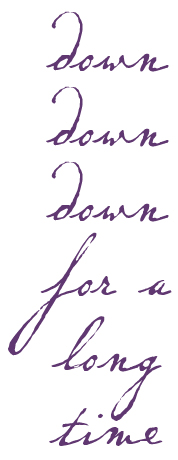 Off he goes. Down, down, down, for a long time.
 The organ’s voicing is as complete and perfect as it is ever going to be without you. You made me well, but you did not make me to last forever, did you? Because, now, wouldn’t that be cruel?
 Natalia Theodoridou is the World Fantasy Award-winning and Nebula-nominated author of over a hundred stories published in Nightmare, Uncanny, Clarkesworld, Strange Horizons, F&SF, and elsewhere. Find him at
  In the heat of the afternoon, La Bruja beetles her way along York Boulevard. The children outside the corner store shout “Bruja! Bruja!” and drop their Popsicles and soda cans on the sidewalk. They sprint for their bikes and race down the alleyway, daring to look back only when they are blocks away. There is no point, after all, in taking chances or pretending to be brave. If she were to lift her veil, La Bruja could freeze you to the spot with a single glance. You’ll stand there, stone still, until a perfect stranger walks around you three times, counter-clockwise, and says “wake up, wake up, fly away home.” If you are careless enough to let your shadow cross hers, she can snatch it in her hand and claim your soul. She’ll slip into your dreams at night and make herself at home, rummaging through your memories, your fears, your guiltiest secrets. Once she’s there you can never make her leave, no matter how many candles you light at St. Dominic’s or how many Hail Marys you say. That’s a simple fact. Everyone says so.
 “Chk-chk-chk,” she beckons as she moves through the entry and into the living room. The home is immaculately clean; you’d scarce believe anyone lived here at all. Everything looks expensive and uncomfortable. Lots of heavy glass and wrought iron. Lots of hard surfaces. No comfy armchairs to fall into, no plump ottoman to rest your feet on.
 They run all the way home. They say nothing and try desperately to think of nothing, choking back the terror and the tears until they are each safe in their beds where they will sob all night into their pillows and wake in the morning wishing it was all a horrible dream. Not one of them ever says anything about the boy. Each is sure the others will do the right thing, the brave thing, and tell their parents or phone the police.
 The radio plays a song by Paul McCartney & Wings. The one about Venus and Mars: red lights, green lights, strawberry wine… The boy finds himself drifting into sleep again. Funny, he can’t even remember why he left home in the first place. It’s not like things were ever that bad. Still, give them a little more time to worry before heading back. One more day should be enough.
 “Ballocks, Connolly. She was a whore. An adulteress, and her man caught her at it—he pinned her down in the bog to punish her, see?” We could see the leather twisted into the silver-black of her flesh when he pointed it out, tanned as foxily as her hair and tight as a garrote. He scratched a little at the peat over her breast, carving the butter-black sod away: it was not bone arching under his fingers, above her ribcage, but slim withies of some water-stiffened wood. “Tell me that’s an honor, dumping a pretty girl like a sack of shite out in the middle of this mire. He had to hate her. He couldn’t bring himself to break her face, but he made damn sure not another man’d see it after him. Cut another yard and we’ll find the man she did it with, I know that.”
 I tried not to think unkindly of her. The lovers of mine who had known me entirely, I could count on the two fingers I gave the rest of God’s earth for wanting me to be one thing or the other, like the flick of a switch of an electric light. Katharine Morgan was expressive and affectionate and she did not stint herself in desire; she was a cleverer woman than she advertised with her wide, apple-green eyes and a sadder one than she liked to let me see; she never asked me a question beyond my employment and my health and the next time we should see one another, if a man of the world could find enough to say to a woman of her house, content in her quiet life. All the times she heard me say that I loved her, I was not lying. When I left, I did not think she would tell stories of me.
 When I dreamed of the peat girl, she was always dead, though she walked out of the bog at night to meet me. Her skirt was patterned in bilberry-blue, her shawl red as cranberries, and the garment next her skin looked most like a sheepskin with the fleece side in, but her face and her arms and her ankles above the leather lacings of her shoes were as opaque as old silver, her tied-back hair a springing mat of rust. Her nails were tawny parings, translucent as horn. Open between their metallic lids, her eyes were honey-amber, their pupils ochre lights.
 He was not beautiful. The bog had not had the centuries to work its alchemy on him, tightening him to the leather of himself: he was loose on his bones, and dingy, and soft and slack as meal when we hauled him up, swearing at the rank sluice of liquids that poured from his rusted tweeds, the flopping cavity of his body, his bonelessly dangling bare feet. His eyes were too soft for amber. His teeth were hard in the gape of his mouth, peat-flecked porcelain ringing the sky. His head rolled like a kicked-in football. All of his pockets had been sewn closed and stuffed full of stones.
 I saw Katharine Morgan, a dry-eyed weeping girl, with the sloe stains of bruises around her cheekbones and her hair hanging half-plaited as she knelt beside a man’s body, the oil-light glimmering on the dark pool that haloed him, smooth as a mirror of spilled ink. I saw his bursting face and his stone-blue tongue, his torn shirt and his slashed, empty hands. Reflected by the lantern, Katharine’s own face eddied in her husband’s blood, a marsh-fire fetch from the other side of death’s glass. Her hands left bog-black smears on the knees of her nightdress, her bare shoulders set as taut and fragile as wings.
 Sonya Taaffe’s short fiction and poetry can be found mostly recently in the collection Ghost Signs (Aqueduct Press) and in the anthologies Heiresses of Russ 2016: The Year’s Best Lesbian Speculative Fiction, The Museum of All Things Awesome and That Go Boom, and An Alphabet of Embers: An Anthology of Unclassifiables. She edits poetry for Strange Horizons, lives in Somerville with her husband and two cats, and once named a Kuiper belt object.
 He started the code in a south Texas drawl. “‘Three things shine before the world and cannot be hidden.’”
 “We make it four or five years, I’d bet we can afford some place that doesn’t crack with every tremor. Six years: maybe it’s even green.”
 At least Dan had gone down for something big. They’d gotten Sonia in her sleep between drops; she hadn’t had a thing on her.
 Victoria Sandbrook is a fantasy writer, freelance editor, and Viable Paradise XVIII graduate. Her work appears or is forthcoming in Swords & Steam Short Stories and Cast of Wonders. She is an avid hiker, sometimes knitter, long-form talker, and initiate baker. She often loiters around libraries, checking out anything from picture books to monographs. She spends most of her days attempting to wrangle a ferocious, destructive, jubilant tiny human. Victoria, her husband, and their daughter live in Brockton, Massachusetts. She reviews books and shares writerly nonsense at victoriasandbrook.com and on Twitter at @vsandbrook.
 think they are deserving of something merely by fact of being born, while you understand existence does not equal right.
 Not why they send them. That motivation is easy enough to parse. They think the sacrifice will appease you, keep you from the rage and destruction and the evil of their own hearts that they see reflected in your beastly skin.
 For proof of paternity, he buried his cloak and his sword in a secret place that he said only a male heir could find. As if a penis were to prove a dowsing rod. At least then it would have some use, I suppose.
 You turn them each away, gently or roughly as the case calls for it, but still, sometimes, you wonder.
 What I really hungered for was glory and fame. Whenever a community had a problem with serpents that spoke in riddles, or two-headed fish with fangs, or dogs who walked like men, I wanted them to call for me. I wanted the entire world to see what I was, and beg for me, and only me, to save them.
 One of your humans carves constellations in their piece of wall. Maps of the infinite sky. You like to imagine them glinting, glowing, warm.
 “Wait!” my confederates called after me. “You’ll be lost. We must block off each tunnel one by one.”
 Heather Morris is a cyborg librarian living in North Carolina. Her work has appeared in Strange Horizons, Apex, and Daily Science Fiction, among other places. You can find her on Twitter @NotThatHeatherM.