You are awesome. I mean that in a completely honest way. You, composer of sentences, sender of query letters, super-writer extraordinaire, are awesome.
Before I continue telling you how amazing you are, let me give you some background into why I’m saying this.
I’m very new at Shimmer, having started a mere two (or is it three?) months ago. First and foremost, I’m a writer. In fact, I think most of the staff at Shimmer are writers, which brings me to the first reason why you, personally, are awesome.
1. We think you are awesome because we love writers. We are writers, after all, and even though publishing can be an incredibly competitive atmosphere, at the end of the day, we are all on the same side. Especially writers, who commiserate through rejections, help one another with gnarly plot problems, offer a helping hand or a shoulder to cry on, and tell you when to gut your story (or blog post) of clichés.
The other thing you should know about me is that I work. In particular, I work part-time and attend university the rest of the time, so I’m basically reading slush whenever I can sneak it in. When I write, it’s either very late at night or very early in the morning. And this brings me to the second reason why you are awesome.
2. We think you are awesome because you are writing, editing, and submitting your stories when you probably have fifty billion other things you need to be doing at any given point in time. Let’s face it: life is not kind to artistic types, and time is in short supply. The fact that you’re making time for your art is truly awe-inspiring. After all, there are plenty of wishers and wannabe writers, but what separates them from you is that you are out there working towards your goals.
The last thing you should know about me is that I love slush. I love it tons. Every single letter is like opening a present. Of course, sometimes you get socks instead of the latest Nintendo game – but that’s not to say that I indiscriminately dislike socks. No, there are definitely some days when I’d love to get a present consisting of nice, thick, Dumbledorean socks. (The Christmas after I moved up to the wintry north comes to mind.) So even if, one day, a story filled with metaphorical socks doesn’t strike my fancy, a couple weeks down the road, I could find a sock-filled story and adore it.
And this brings me to my last reason why you are awesome.
3. We think you are awesome because you send the query letters. Being on submission is an incredibly nerve-wracking process. I know I’ve been there. Most of us have, as a matter of fact, been in the same shoes as you’re wearing right now. They’re tough shoes to wear. They pinch your toes. You take the risk and put yourselves out there, essentially letting a bunch of strangers pass judgment on a piece of art that’s intensely personal. That is an admirable thing you are doing, my friend. Keep up the good work.
My name is Sean, and my job at Shimmer is SLUSH WRANGLER. When you submit a story to Shimmer, it comes into our gmail account with all the other slush. It’s my job to go through every submission and make sure of such things as: is there a story attached? Is the attachment in an acceptable format? Is the story under 5,000 words (as stated in the guidelines)?
If the stories are good to go, then I assign them to our associate editors. Another name for an associate editor is a slush reader, except at Shimmer, the associate editors have a voice in regards to buying or passing on a story.
Does every magazine work this way?
Nope. Every magazine is a special snowflake, and while some may have similar organizational structures to that of Shimmer, others are run in completely different ways. As such, you should do your research, and check out the submission guidelines before submitting to any magazine.
If you follow the submission guidelines, a slush wrangler gets his wings.
It’s easy when things work like they’re supposed to, and the writers submitting slush to Shimmer follow the guidelines.
So what happens to the stories that are incorrectly submitted? I’ll ask the author to try again.
Don’t feel bad; everyone makes mistakes. But if you continually abuse the guidelines, and make me intervene to remind you to check the guidelines, your name gets flagged, and I like you a lot less.
Does it actually impact your chances of getting your story read by an editor, if I need to constantly remind you to format your story correctly, or to query for stories over 5,000 words? Not really. I’ll still pass your story along when and if you submit it correctly.
But remember this: I’m married to the Editor in Chief. What do you think we talk about over dinner? 😉
I’m an author and I want to help you get your wings, WHAT DO I DO?
Send me a coupon for a free pizza. J/k. Bribes don’t really get you anywhere.
It’s true what beginning authors are told: the cream rises to the top… of the slush pile. A good story is all you need to break into a magazine. Easier said than done, I know from experience.
But here’s what you can do to help yourself.
First and foremost, read the guidelines. You’d be surprised how many people don’t bother with this step: enough that just the simple act of following the guidelines when you submit bumps your story into the top half of the slush pile. It’s so simple, yet is something I’ve seen many authors overlook.
Next, inform yourself. Become a part of the speculative fiction community, online and in person. Here are some things you can do:
Go to conventions. There are hundreds. Check out this list for one in your neck of the woods. .
Read widely and often, especially the magazines you want to submit to. It’s a good idea to familiarize yourself with the kinds of stories a particular magazine is looking for.
And finally? Why not start interacting now? Be part of the Shimmer community. Leave a comment here and tell me, are you a beginning writer? Was this post helpful? I hope that it was. When your little slush baby arrives in my pile, I’m the first person who sees it. I’m rooting for you: it’s so much fun to see a great story go from slush pile to publication.
Questions?
Leave ‘em in the comments section. I’d love to answer them.
You’ve finished your story, you’ve done your market research, and you’ve found a place you think the story will fit. Your chosen market is Shimmer–quite smart, indeed! You’re ready to properly format your document as per the guidelines (.doc or .rtf), and submit. But before you do, have you written your cover letter?
When a market accepts electronic submissions, you may not think a cover letter is essential to your submission. It’s just a casual email, right? Wrong.
A cover letter is helpful for many reasons. As an editor, I like to know whose story I’m reading. I like to get a feel for the person beyond the story. I don’t like having stories simply thrown at me, which is what it feels like when an author doesn’t include a cover letter.
Your cover letter, or lack thereof, is often the first impression an editor will have of you. You want to present yourself as professional–even if you don’t have any publishing credits. You want the editor to look at the submission and say “this is someone I could work with.” Your story will stand on its own, beyond your cover letter, and plenty of editors don’t read cover letters first, but you’re much better off with a few words there than a gaping, blank space.
So, what’s good in a cover letter and what’s not so good?
Good: Market research. If you’ve researched the market enough to believe your story is a good fit, you should also take the time to explore the staff page. Who edits this publication? To whom are you sending your story? You aren’t simply tossing it into an abyss from which a pale hand will emerge to catch your pages. A real person is on the receiving end of your submission. If a submission comes into Shimmer and it’s addressed “Dear Sir,” you probably haven’t looked at much of the website. “Dear Editors” is perfectly acceptable, as Shimmer has a variety of editors on staff. It’s also okay to address a specific editor, especially if they had your last submission.
Good: The essentials. “Please find my 2000-word story, ‘Mad Monkey Robots on Mars’ attached for your consideration. Signed, Me.” Even if that’s the whole of your cover letter, it’s delightful. Word count, title, your name.
Bad: Do not believe that you can sneak a longer story in by simply not including the word count in your cover letter. If you submit a 10,000 word story, when 5,000 is our upper limit, we’re still going to notice.
Good: Introducing yourself. Include a few credits if you have them. If you don’t, don’t stress. We all started with a blank slate. “My fiction has appeared or will soon appear in X, Y, and Z.” If you are part of writers organizations, you can certainly mention that, too; likewise if you have attended Clarion, Odyssey, or another writing workshop.
Bad: Jokes, summaries, or jokes about your summary.
Good: A closing. Thanking the editor for their time, and signing your name. Always include your name. If you write under a pseudonym, juggling names can be a feat, but there’s an easy way to handle it. Always sign your cover letter with the name you’d like to be called. (You can also make this clear on your manuscript–legal name in the upper left corner, pseudonym on the byline.)
Bad: attaching more than one file to your submission. At this point in the process, we don’t need an outline, a summary, an individual bio sheet, or anything beyond your cover letter (email) and your story.
Good: We look forward to reading your stories–and your cover letters!
Now it’s your turn…
How do you approach cover letters? Like them? Hate them? Have questions that weren’t covered here? Tell us what you think in the comments.
Team Shimmer is gearing up to release Issue 12. I can’t wait for you to see this issue: it’s spectacular.
But first, I need to make room for the new issue at Shimmer Headquarters. That means: it’s time for a sale.
Everything’s on sale.
Everything. Print copies. Electronic copies. Even 4-issue subscriptions. It’s all 20% off. Just enter the code ShimmerVacation (it’s case-sensitive) when you check out, and stock up on a summer’s worth of delicious Shimmery tales.
One week only!
This sale ends on Thursday, July 6, 2010 — so act now.
It was easy enough to lose a child by accident. To do so on purpose was nearly impossible.
The child slid his fat, slick fingers into her hand. Hung on for dear life. He rubbed his face on the seat of her skirt and hooked his arm into her purse’s glossy leather strap. Meanwhile, people passed by without a glance, their hands full of drooping cotton candy and oversized stuffed dogs with weak seams or shrill whistles shaped like birds. Aggressively unattractive parents wooing their children with sweets and grease and cheap toys. Fran pressed the fingers of her free hand to her mouth and choked down bile.
The child stumbling next to her hip was not her own. This child, with his thick lips and the watery squint of dull eyes, was her lover’s child. Or, more specifically, her lover’s wife’s child.
If a child was an anchor on a good man’s soul, Fran reasoned, if it kept him from daily loving his love, would it not be better if such a child disappeared?
Children disappear every day. Just watch the news.
Swings, by Angie from Sawara, Chiba-ken, Japan
When Fran was fourteen, she took her little sister to the park. The little girl flew higher and higher on the swing—lace bobby socks, black Mary Janes, a dress lined with crinoline flapping about her spindly legs like white and pink wings—while Fran leaned against the elm tree and let Jonah Marks slide his hand into her shorts. Let him hang on tight.
“Watch me,” the little girl cried, “Watch me.” Her voice bounced against the basketball court, rustled the leaves, floated on the breath of Jonah Marks, on his wet lips and insistent tongue. Watch me.
When she turned, the little girl was gone. The swing still arced back and forth, a memory of her body. “She flew away,” she told her mother, her father, the social worker, and the police. “I heard the rustle of lace and the flapping of wings. I heard a voice echo within, around and above. She flew away.”
And she may have done. Really, who’s to say?
But Fran’s little sister was a pretty child. No one ever snatches the ugly ones.
Fran’s lover’s son was not a pretty child. He whimpered and wheezed. He chortled and pleaded. An endless litany of wants.
Grant me a snow cone.
Grant me a foot-long.
Grant me a deep-fried candy bar on a stick.
Fran tried to dash away at the restroom, but the child appeared like magic at the doorway and grasped the hem of her skirt. Fran tried to dodge him in the haunted house, but he kept close to her heels in the dark. He hid in her pocket. He slid into her shoes. The pendulous weight of him swung from side to side. She heard him flapping and flying. Watch me!
Fran sent the child to the top of the giant slide hoping for an opening, but a convention of officers gathered to look appraisingly at the hordes of ugly children hurtling down the yellow humps, their faces lit with misplaced love. She couldn’t slip away.
The child at the top of the slide—her lover’s wife’s child—shivered and shook. He gripped the burlap sliding sack the way a skydiver hangs onto his defective parachute before his final bounce upon a pitiless ground. Fran looked up. Felt her shoulders hemmed in by police.
She flew away, she wanted to say to the cop on her right. Children disappear every day, she nearly said to the cop on her left, especially the pretty ones. It isn’t my fault that the boy is hideous.
The ugly child peered down at Fran, held her gaze. She imagined him in black Mary Janes. Bobby socks with lace at the ankle. The wind lifted his pale hair, like the crinoline lining of a fluttering skirt. Watch me! He swayed and swayed and Fran found herself swaying too.
Grant you feathers, murmured her lips.
Grant you wings.
Grant you light and wind and helium.
Grant you cloud and moon and star. The vacuum of space. The infinite distances between love and lover and love.
The child sat on his burlap and pushed off.
And somewhere inside, Fran grew wings.
She flew away.
2. Margaret
Red lips invite trouble, when trouble requires an invitation. Which it usually doesn’t. Margaret knew that trouble hid under dirty rugs and scratched coffee tables. It lurked behind heavy drapes like a vampire in an old movie. It gathered in great clouds like pollen in the spring and fall and settled like dust in between.
Margaret stood in front of the mirror painting black around the eyes, muting acne scars and pustules with muddy makeup, and crafting a false beauty mark at the hollow where her chin met her neck.
She wore pink lips to school, black lips to visit her grandparents, and red lips for everything else. She wiped Vaseline across her small, white teeth to prevent stains—like blood on crisp new sheets. The color of the lip is significant, Margaret knew. The color matters. Ask anyone you like.
A teacher, for example, is terrified by a red lip. He pulls at his earth-tone tie again and again until his face goes red, then purple, then green. He stammers and hesitates before shooing a girl away.
Pink, though. Pink was a different story.
Two weeks with pink lips. Only two. By then he was weak and trembly, his fingers fluttering gently as they grazed her neck.
They found him the next day. Heart attack. Hard-on. Pink lips. Really, who’s to say? Margaret offered no opinion.
♥
Her mother snored in the next room, her new boyfriend—also snoring —at her side. The room stank of liquor and love, and Margaret wrinkled her nose as she slipped inside.
♥
Now originally, Margaret had intended the black lips for her grandfather, but her grandmother, somewhere between the tuna casserole and the Cool Whip surprise, ran her fist through the porcupine spikes of her black and white hair. She shivered.
“I was a Girl Scout once, did you know?” her grandmother asked. Margaret curved her black lips into a grin. She slipped her supple fingers into her grandmother’s rice paper hand, felt the old woman’s soul leak out in a long, slow sigh as she leaned inexorably in.
When they found the old woman the next day, oven mitts still on the hands resting above her heart, her blackened lips still puckered in a sigh, they shook their heads.
Borrowed time, people said.
♥
Margaret crawled in between her mother and her mother’s boyfriend. Her mother slept open- mouthed, wet breath catching in her throat.
♥
“It’s only a matter of time,” her mother had said earlier that day as she checked the fit of Margaret’s new bra. Her thumbs lingered on the dense, round breasts as though checking for freshness. “Every Tom’s Dick’ll want a taste. A kiss I mean.”
The boyfriend leaned in the recliner, his hands occupied by a cigarette and an icy highball glass. But his fingers itched. Margaret could tell.
“A kiss is a dangerous thing,” the boyfriend said. “I feel sorry for the poor son of a bitch. Won’t know what’s hit him until it’s too late. Still,” he said, dragging deep on his cigarette, “not a bad way to go.” He gave Margaret a full-handed smack on her rear as she passed.
♥
Purple Lips, by snowkei
Margaret leaned over, placed her hands beside his shoulders, peered into his sleeping face.
“Too late for you,” she whispered in the dark. His face was calm, his jowls slack. The stubble on his chin stood at attention. His lips were full and slightly parted, the corners twitching with each breath. He was both beautiful and foul—the infinite beauty of a finite life. Margaret marveled at each liquor laden breath as it pooled and luxuriated in his damp mouth. And, without meaning to, she licked her lips.
Too late.
She licked her lips again. Tasted musk and cinnamon, and oh god, salt, sweat and lemon juice, and oh god, grass and wheat and meat and milk. Tasted birth and youth and decay.
She licked her lips again. Felt her body shudder and buck. What is it, she wondered, about dying that makes us feel so alive?
3. Estelle
Reginald curled his body up the long radiator pipe. Winked one yellow eye. Winked the other. He tested the air with a quick flick of the tongue.
“Mind your own business,” Estelle said, returning the gesture, though she knew he wouldn’t notice.
Estelle sat at a desk with one hundred and two different file folders on the surface—all color coded, labeled and stacked neatly according to year. Receipts here. Earnings reports there. This is what she had been told to do when the audit loomed: to prepare. They don’t look out for your best interests, so don’t expect it, they said. They care about numbers and procedures and forms. They care about quotas. If it were up to them, they’d swallow you whole.
“They can try,” Estelle chuckled, as she pulled Andrew and Arnold out from their hiding place in the bottom drawer and draped them heavily on the ground. They lifted their flat heads and gave her twin looks of indignation before sliding across the floor and under the upholstered chair.
The young man appeared in the doorway. He had long, white hands, tapered fingers, and narrow hips. A blue suit and a blue tie and a haircut both severe and modern.
“I see you’ve been busy, Ms. Russo. I appreciate your work, but I assure you it was not necessary. I’m top in my field.”
He remained in the doorway. From his position on the radiator pipe, Reginald tasted the air. He leaned closer and unhooked his jaw.
“No, no,” Estelle said firmly. Reginald pulled back, chastened.
“Oh, yes, I assure you I am,” the young man said. “May I come in?”
“Please do,” she said, winking one yellow eye.
He sat on the upholstered chair, resting his briefcase on his knees. Estelle stood. Her body was long and supple. She slid like oil across the room to the chair opposite the young man. Gave a slow, mesmerizing grin. Flicked her tongue.
Corn Snake, by goingslo
Arnold unfurled from underneath, elevating hungrily behind the chair. Robin, Mae, and Chavez peeked their heads from the grooves of the couch cushions.
“No, no,” Estelle said again.
“I’m sorry?” said the young man.
“Nothing,” Estelle said, winking her other eye. Arnold sniffed and slumped to the floor, while the other three retracted without commentary. The young man glanced at the floor, but saw nothing.
“Look,” he said, “it doesn’t really matter what you have organized in what file. I’ve already seen it. How you’ve slid under the radar this long is a mystery to me, but it doesn’t matter now. There’s consequences.”
“Nibble, nibble, little mouse,” Estelle said. “Always nibbling on the things that aren’t yours.”
“The government,” he said primly, “is not a mouse.”
The new brood woke and came tumbling out of the hole in the wall. At a hand signal from Estelle, they fell upon one another and played dead, as they were trained. Diana, Elizabeth, and Eleanor glided in through the open door and moved regally towards the guest. Their golden eyes glittered like crowns. Estelle breathed deeply through her nose, flicked her tongue once again. The young man smelled green and young. Tight fiddleheads before they leaf. The budding of spring. The tang of green apple again and again on the tongue.
“Who said anything about the government?” Estelle said, “I’m talking about you.” She leaned in. “Little mouse.” She unhooked her jaw.
Gagged.
Gulped.
Swallowed him whole.
4. Annabelle
“My father says I can’t play with you anymore.”
Annabelle shrugged. “He’s not the boss of me.”
“He says your mother isn’t raising you right.”
“Could be,” she said, squatting on the ground. She spat on the bare dirt. Drew with her finger.
“He says you’ll grow up just like her. He says the neighborhood doesn’t need another one.”
Annabelle drew a picture of a house with a sun and a heavy cloud. She drew a man inside with a woman. The man was on his knees. The woman had her head tossed back.
“He says you’re all the same. He says I’m not supposed to chase a dirty skirt.”
Annabelle drew heavy drops coming out of the cloud. She drew a flood that bent beams and rotted floors. She drew swollen banks and ruptured dykes and water that would not be bound. She drew a broken house, tumbling down the river and floating off to sea.
She washed the land clean with the back of her hand.
“Um.” He kicked at a clump of weeds with his sandal. “Do you know where my dad is?”
“With my mom. At my house.” She looked up and smiled. “They floated away.”
He bent down, rested his rear on his heels. Annabelle drew a boy and a girl in limitless space. She gave them wings. The boy arched his back as though it itched.
“Can I go with you then?”
“Suit yourself,” she said. She took his hand. Hung on tight.
They flew away.
———-
Kelly Barnhill
Kelly Barnhill’s first novel, THE MOSTLY TRUE STORY OF JACK — a lyrical fantasy for Middle Grade readers — is set for a Spring 2011 release by Little, Brown. She’s ridiculously excited about it. She also writes short stories, which have appeared in Fantasy, Weird Tales, The Sun, Clockwork Phoenix, and a bunch of other places. She’s been known to apply her penchant for all things Odd, Strange, and Downright Disgusting, in producing high-interest non-fiction books for kids. She’s published 13 so far. You can find out more about Kelly at her web site.
Hey! Did you get here from a link from a friend or Twitter? This story is a special bonus we’re giving out to people who sign up for our mailing list. Sign up here free, and don’t miss any news and treats!
Kelly Barnhill
4657 31st Avenue South
Minneapolis, MN 55406
kelly@kellybarnhill.com
Dreadful Young Ladies
Kelly Barnhill
1. Fran
It was easy enough to lose a child by accident. To do so on purpose was nearly impossible.
The child slid his fat, slick fingers into her hand. Hung on for dear life. He rubbed his face on the seat of her skirt and hooked his arm into her purse’s glossy leather strap. Meanwhile, people passed by without a glance, their hands full of drooping cotton candy and oversized stuffed dogs with weak seams or shrill whistles shaped like birds. Aggressively unattractive parents wooing their children with sweets and grease and cheap toys. Fran pressed the fingers of her free hand to her mouth and choked down bile.
The child stumbling next to her hip was not her own. This child, with his thick lips and the watery squint of dull eyes, was her lover’s child. Or, more specifically, her lover’s wife’s child.
***If a child was an anchor on a good man’s soul, Fran reasoned, if it kept him from daily loving his love, would it not be better if such a child disappeared?
Children disappear every day. Just watch the news.
When Fran was fourteen, she took her little sister to the park. The little girl flew higher and higher on the swing—lace bobby socks, black Mary Janes, a dress lined with crinoline flapping about her spindly legs like white and pink wings—while Fran leaned against the elm tree and let Jonah Marks slide his hand into her shorts. Let him hang on tight.
“Watch me,” the little girl cried, “Watch me.” Her voice bounced against the basketball court, rustled the leaves, floated on the breath of Jonah Marks, on his wet lips and insistent tongue. ***Watch me.
When she turned, the little girl was gone. The swing still arced back and forth, a memory of her body. “She flew away,” she told her mother, her father, the social worker, and the police. “I heard the rustle of lace and the flapping of wings. I heard a voice echo within, around and above. She flew away.”
And she may have done. Really, who’s to say?
But Fran’s little sister was a pretty child. No one ever snatches the ugly ones.
Fran’s lover’s son was not a pretty child. He whimpered and wheezed. He chortled and pleaded. An endless litany of wants.
***Grant me a snow cone.
***Grant me a foot-long.
***Grant me a deep-fried candy bar on a stick.
Fran tried to dash away at the restroom, but the child appeared like magic at the doorway and grasped the hem of her skirt. Fran tried to dodge him in the haunted house, but he kept close to her heels in the dark. He hid in her pocket. He slid into her shoes. The pendulous weight of him swung from side to side. She heard him flapping and flying. ***Watch me!
Fran sent the child to the top of the giant slide hoping for an opening, but a convention of officers gathered to look appraisingly at the hordes of ugly children hurtling down the yellow humps, their faces lit with misplaced love. She couldn’t slip away.
The child at the top of the slide—her lover’s wife’s child—shivered and shook. He gripped the burlap sliding sack the way a skydiver hangs onto his defective parachute before his final bounce upon a pitiless ground. Fran looked up. Felt her shoulders hemmed in by police.
***She flew away, she wanted to say to the cop on her right. ***Children disappear every day, she nearly said to the cop on her left, especially the pretty ones. It isn’t my fault that the boy is hideous.
The ugly child peered down at Fran, held her gaze. She imagined him in black Mary Janes. Bobby socks with lace at the ankle. The wind lifted his pale hair, like the crinoline lining of a fluttering skirt. **Watch me! He swayed and swayed and Fran found herself swaying too.
**Grant you feathers, murmured her lips.
Grant you wings.
Grant you light and wind and helium.
Grant you cloud and moon and star. The vacuum of space. The infinite distances between love and lover and love.
The child sat on his burlap and pushed off.
And somewhere inside, Fran grew wings.
***She flew away.
2. Margaret
Red lips invite trouble, when trouble requires an invitation. Which it usually doesn’t. Margaret knew that trouble hid under dirty rugs and scratched coffee tables. It lurked behind heavy drapes like a vampire in an old movie. It gathered in great clouds like pollen in the spring and fall and settled like dust in between.
Margaret stood in front of the mirror painting black around the eyes, muting acne scars and pustules with muddy makeup, and crafting a false beauty mark at the hollow where her chin met her neck.
She wore pink lips to school, black lips to visit her grandparents, and red lips for everything else. She wiped Vaseline across her small, white teeth to prevent stains—like blood on crisp new sheets. The color of the lip is significant, Margaret knew. The color matters. Ask anyone you like.
A teacher, for example, is terrified by a red lip. He pulls at his earth-tone tie again and again until his face goes red, then purple, then green. He stammers and hesitates before shooing a girl away.
Pink, though. Pink was a different story.
Two weeks with pink lips. Only two. By then he was weak and trembly, his fingers fluttering gently as they grazed her neck.
They found him the next day. Heart attack. Hard-on. Pink lips. Really, who’s to say? Margaret offered no opinion.
###
Her mother snored in the next room, her new boyfriend—also snoring —at her side. The room stank of liquor and love, and Margaret wrinkled her nose as she slipped inside.
###
Now originally, Margaret had intended the black lips for her grandfather, but her grandmother, somewhere between the tuna casserole and the Cool Whip surprise, ran her fist through the porcupine spikes of her black and white hair. She shivered.
“I was a Girl Scout once, did you know?” her grandmother asked. Margaret curved her black lips into a grin. She slipped her supple fingers into her grandmother’s rice paper hand, felt the old woman’s soul leak out in a long, slow sigh as she leaned inexorably in.
When they found the old woman the next day, oven mitts still on the hands resting above her heart, her blackened lips still puckered in a sigh, they shook their heads.
Borrowed time, people said.
###
Margaret crawled in between her mother and her mother’s boyfriend. Her mother slept open- mouthed, wet breath catching in her throat.
###
“It’s only a matter of time,” her mother had said earlier that day as she checked the fit of Margaret’s new bra. Her thumbs lingered on the dense, round breasts as though checking for freshness. “Every Tom’s Dick’ll want a taste. A kiss I mean.”
The boyfriend leaned in the recliner, his hands occupied by a cigarette and an icy highball glass. But his fingers itched. Margaret could tell.
“A kiss is a dangerous thing,” the boyfriend said. “I feel sorry for the poor son of a bitch. Won’t know what’s hit him until it’s too late. Still,” he said, dragging deep on his cigarette, “not a bad way to go.” He gave Margaret a full-handed smack on her rear as she passed.
###
Margaret leaned over, placed her hands beside his shoulders, peered into his sleeping face.
“Too late for you,” she whispered in the dark. His face was calm, his jowls slack. The stubble on his chin stood at attention. His lips were full and slightly parted, the corners twitching with each breath. He was both beautiful and foul—the infinite beauty of a finite life. Margaret marveled at each liquor laden breath as it pooled and luxuriated in his damp mouth. And, without meaning to, she licked her lips.
***Too late.
She licked her lips again. Tasted musk and cinnamon, and ***oh god, salt, sweat and lemon juice, and ***oh god, grass and wheat and meat and milk. Tasted birth and youth and decay.
She licked her lips again. Felt her body shudder and buck. ***What is it, she wondered, about dying that makes us feel so alive?
3. Estelle
Reginald curled his body up the long radiator pipe. Winked one yellow eye. Winked the other. He tested the air with a quick flick of the tongue.
“Mind your own business,” Estelle said, returning the gesture, though she knew he wouldn’t notice.
Estelle sat at a desk with one hundred and two different file folders on the surface—all color coded, labeled and stacked neatly according to year. Receipts here. Earnings reports there. This is what she had been told to do when the audit loomed: to prepare. ***They don’t look out for your best interests, so don’t expect it, they said. They care about numbers and procedures and forms. They care about quotas. If it were up to them, they’d swallow you whole.
“They can try,” Estelle chuckled, as she pulled Andrew and Arnold out from their hiding place in the bottom drawer and draped them heavily on the ground. They lifted their flat heads and gave her twin looks of indignation before sliding across the floor and under the upholstered chair.
The young man appeared in the doorway. He had long, white hands, tapered fingers, and narrow hips. A blue suit and a blue tie and a haircut both severe and modern.
“I see you’ve been busy, Ms. Russo. I appreciate your work, but I assure you it was not necessary. I’m top in my field.”
He remained in the doorway. From his position on the radiator pipe, Reginald tasted the air. He leaned closer and unhooked his jaw.
“No, no,” Estelle said firmly. Reginald pulled back, chastened.
“Oh, yes, I assure you I am,” the young man said. “May I come in?”
“Please do,” she said, winking one yellow eye.
He sat on the upholstered chair, resting his briefcase on his knees. Estelle stood. Her body was long and supple. She slid like oil across the room to the chair opposite the young man. Gave a slow, mesmerizing grin. Flicked her tongue.
Arnold unfurled from underneath, elevating hungrily behind the chair. Robin, Mae, and Chavez peeked their heads from the grooves of the couch cushions.
“No, no,” Estelle said again.
“I’m sorry?” said the young man.
“Nothing,” Estelle said, winking her other eye. Arnold sniffed and slumped to the floor, while the other three retracted without commentary. The young man glanced at the floor, but saw nothing.
“Look,” he said, “it doesn’t really matter what you have organized in what file. I’ve already seen it. How you’ve slid under the radar this long is a mystery to me, but it doesn’t matter now. There’s consequences.”
“Nibble, nibble, little mouse,” Estelle said. “Always nibbling on the things that aren’t yours.”
“The government,” he said primly, “is not a mouse.”
The new brood woke and came tumbling out of the hole in the wall. At a hand signal from Estelle, they fell upon one another and played dead, as they were trained. Diana, Elizabeth, and Eleanor glided in through the open door and moved regally towards the guest. Their golden eyes glittered like crowns. Estelle breathed deeply through her nose, flicked her tongue once again. The young man smelled green and young. Tight fiddleheads before they leaf. The budding of spring. The tang of green apple again and again on the tongue.
“Who said anything about the government?” Estelle said, “I’m talking about you.” She leaned in. “Little mouse.” She unhooked her jaw.
Gagged.
Gulped.
Swallowed him whole.
4.Annabelle
“My father says I can’t play with you anymore.”
Annabelle shrugged. “He’s not the boss of me.”
“He says your mother isn’t raising you right.”
“Could be,” she said, squatting on the ground. She spat on the bare dirt. Drew with her finger.
“He says you’ll grow up just like her. He says the neighborhood doesn’t need another one.”
Annabelle drew a picture of a house with a sun and a heavy cloud. She drew a man inside with a woman. The man was on his knees. The woman had her head tossed back.
“He says you’re all the same. He says I’m not supposed to chase a dirty skirt.”
Annabelle drew heavy drops coming out of the cloud. She drew a flood that bent beams and rotted floors. She drew swollen banks and ruptured dykes and water that would not be bound. She drew a broken house, tumbling down the river and floating off to sea.
She washed the land clean with the back of her hand.
“Um.” He kicked at a clump of weeds with his sandal. “Do you know where my dad is?”
“With my mom. At my house.” She looked up and smiled. “They floated away.”
He bent down, rested his rear on his heels. Annabelle drew a boy and a girl in limitless space. She gave them wings. The boy arched his back as though it itched.
“Can I go with you then?”
“Suit yourself,” she said. She took his hand. Hung on tight.
Welcome to Shimmer Magazine! We publish contemporary fantasy short stories, with a few ventures into science fiction or horror, and the stories tend to be tinged with sorrow (though we’re not averse to the occasional funny tale). Our stories have been reprinted in Best American Fantasy 3 and Rich Horton’s Year’s Best Fantasy and Science Fiction.
Shimmer 18, cover art by Kurt Huggins
Fabulous Reviews!
“There is a particular mood to the magazine, like you’re walking alone along a foggy road at midnight with only the sound of your breath echoing against the mist.” –Beth Cato
“Unfailingly well written, which gives hope for the future of the genre. … Read this issue of Shimmer to get a look at the future giants of the field.”–Tangent Online
Coming Soon: Issue 19!
Shimmer #19 boldly goes where no other issue of Shimmer has gone before, blazing new paths into the speculative fiction community we love so well. We are excited about this new direction, and hope you will join us! CLICK HERE TO CHECK OUT OUR PREVIEW
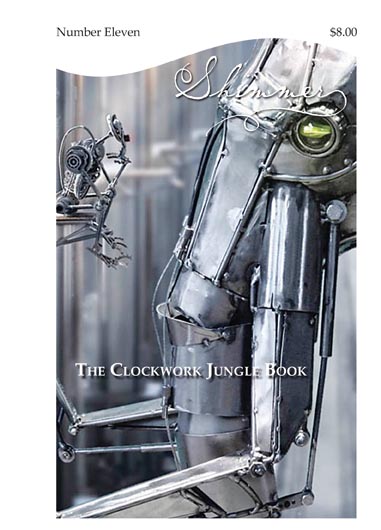
This is the final installment in our Clockwork Jungle Book author reading series. I hope you’ve enjoyed getting to know the authors a little better!
Our final author is James L. Cambias, who reads from his marvelous Teutonic steampunk story “The Wolf and the Schoolmaster.” Victorious but conflicted wolves on unicycles!
An excerpt:
When I returned to Totenburg after three months in the hills, the changes astonished me. Most of the damage of the War of Restoration was gone. Where there had been blocks of ruins, machines were digging foundations for new towers of glass and steel.
I steered my steam unicycle through the streets, hoping for enough pressure to make the climb to the castle. As I chugged past a group of old women bringing baskets back from the city market, I gave them a nod and salute. “Good morning, Citizens!”
They stared at me, a little fearful. I didn’t mind. Before the restoration they would have cowered in terror, and they would have been right to do so. The Baron Von Tod occasionally turned us wolf troopers lose on civilians when he thought they looked rebellious, or when he was in a bad mood, or just bored.
Want to read the rest of the issue? And see the brilliant woodcut from Rhiannon Rasmussen-Silverstein which illustrates it? We’ve got 19 more fantastic stories!
Blake Hutchins offers this delightful story of a Jackdaw whose project becomes a little more than he imagined. I love the Badger; Jackdaw’s lucky to have her in his life — and we’re lucky to have “The Jackdaw’s Wife” in the Clockwork Jungle Book.
“Humph.” Badger tilted her head and took the cheroot from her mouth, holding it delicately between two black claws. “What’s it good for?”
“What’s it good for? What’s it good for?” Jackdaw jumped up and down in a frenzy. “Maker love us, it gives things life. Life!” He forced himself to stop and preen. When he felt calmer, he added, “A power source to animate matter with spirit.” The mantle between his shoulders flufed with excitement.
Badger tapped ash off her cheroot. “This means another project, I suppose.”
Susannah Mandel’s contribution to the Clockwork Jungle Book was this lovely Victorian romance. “The Monkey and the Butterfly” tells the tale of a melancholy Monkey and his love for the Cat across the square. Will the Monkey find a way to win her heart? Or will she rip it apart with her claws?
An excerpt:
In the home of a certain Gentleman on the other side of the square lived a Monkey. He was a melancholy Monkey, with a serious cast of mind, and he spent the greater part of his days considering deep questions. He was happiest pondering philosophical difficulties, or tinkering with the smaller kind of mechanical object, such as music boxes or the Gentleman’s misplaced pocket-watches (he misplaced a good many).
The Monkey liked to establish himself near one of the apartment’s windows and observe the passage of life outside in the square. This habit — he had some difficulty acknowledging, even to himself — had become much more regular since the day he had observed the Cat sitting in an opposite window. Most afternoons now he ascended to his perch to find her there, curled in splendor on an elegant cushion of lace and satin, framed regally by the curtains like the portrait of a queen. Some days she slept; others she would pounce and tear at a bit of ribbon or yarn, giving the curious impression of a young girl’s gaiety blent with the ruthlessness of a tiger. The Monkey found her, always, beautiful.