All posts by Beth

Reader’s Choice Winner

A little while ago, we asked our readers to vote for their favorite story from Issue 13.

And the winner is . . .

Poor Mojo's Giant Squid

Four Household Tales (As Told by the Giant Squid), by Poor Mojo’s Giant Squid.

Once upon a time there did travel two monks: a wise Giant Squid and his student, Abram Lincoln. Long did the two wander throughout the lands, delivering to the common folk such limited enlightenment as might pass through meager human sensory faculties to sear itself into the spongy grey matter stifled in their shallow brain pans.

Click here to cast your optically imperfect gruntchimp eyes upon the tale.

Our sincere congratulations and thanks to the Giant Squid.

Runners Up

The voting was very close. In second place by a mere one vote was All the Lonely People, by E. C. Myers. In third place, only two votes behind the winner, was Bullet Oracle Instinct, by K. M. Ferebee.

Congrats to the top 3, and huge thanks to everyone who voted.

Issue 13: Reader’s Choice Survey

Gentle Readers!

Shimmer 13 Cover
Shimmer 13

We want to know what you think about Issue 13, so we set up a quick survey. It should take you less than a minute to complete.

Here’s the fun part: whichever story gets the most votes? We’ll work with that story’s author to put the whole story up online so everyone can read it. Help your favorite author get his or her story the readership it deserves!

We’ll also randomly select one responder to get a free copy of the issue of their choice — just give us your email address in the last question so we can get in touch with you if you’re the lucky winner.

Click here to take the survey! Votes accepted until midnight Mountain time, June 30.


Stay True to Rodney

There’s a particular kind of story that shows up in my slush pile with depressing regularity. It’s characterized by the ending. Here’s an example (and pretty bad one, at that!):

Rodney aimed his gun at the betentacled horror that loomed over him. The creature roared at him in a voice that sounded like that of his beloved wife, Sheila.

“No, Rodney, no!” the foul creature roared.

But Rodney was not fooled. His beautiful Sheila was gone, long gone; she had been transformed by unspeakable eldritch powers into this drooling, ravenous beast. He pulled the trigger. The creature shrieked in agony and then died.

As Rodney stood over the body, panting, his vision seemed to clear, and he was aghast. It was Sheila laying at his feet, not a creature from the abyss! Oh no! He dipped his finger in her blood and wrote a message on the wall.

Then he raised the gun to his temple, and squeezed the trigger.

* * *

“Ewww,” said the cop, a rookie who had never worked a homicide before.

“Seen it a million times,” said his partner, a grizzled veteran. “Just don’t puke on the evidence.”

“You mean evidence like that message written in blood on the wall? That says ‘I KILLED THE MONSTER FROM THE ABYSS. I AM NOT CRAZY. REALLY.'”

“Yup,” said the veteran. “Tragic, ain’t it? Guy reads Lovecraft, goes insane, kills his wife, then himself. Yep, that’s what happened here. You can tell because she’s dead, and he’s crazy. That’s what happened. Saddest damn thing.”

Then they went to the old cop’s retirement party.

THE END

OK, see why that sucks? (I mean besides the clumsy prose, clichéd characters, and the tired reworking of Lovecraft.)

It’s insulting. I am smart enough to figure out that Rodney killed his wife and himself without the cop explaining it. Really.

It’s disengaging. Any time you shift POV in a short story, you risk losing the reader. You’re interrupting the connection I’ve formed with the character, and it takes a lot of skill to bridge that interruption so that the reader is transported easily. How much more disengaging is it when I’ve spent the entire story in Rodney’s head, watching with horror and empathy as his world disintegrates around him, only to find myself abruptly shoved off to two new characters that I don’t know about or care about?

It’s unnecessary. If the body of the story has done its work, you don’t need an extra scene to explain. If you find that your critique group is confused by your story, the answer is not to tack on an explanation, but to strengthen and clarify the main story so that your intent is unambiguous.

It’s oversimplified. Lots of stories create tension by ambiguity throughout–is Rodney insane? Or are there really eldritch forces at work? It’s Rodney’s story, and it’s his vision of the events. Don’t betray poor Rodney’s vision by replacing his experiences with a quick summary by a bored cop at the end. Stay true to Rodney.

It’s insecure. Have faith in your story and your skill and your audience.

Shimmer: Behind The Scenes!

“Laws, like sausages, cease to inspire respect in proportion as we know how they are made.” — John Godfrey Saxe

Luckily, there is nothing sausage-like about the Shimmer Fiktionwerks, so a good behind-the-scenes peek can only delight the reader; and the more you know about how the industry works, the better off you are. Thus we are thrilled to present this pictorial tour of our processes.

Slush Ore

The Shimmer Fiktionwerks fabrication process begins with the delivery of unprocessed slush ore. This ore is mined from ventures all over the world, wrested from the earth by the pure strength and daring of skilled miners. Several tons of it are delivered to the Fiktionwerks plant each day. Our team of highly-trained orphans picks through the slush ore, selecting only the finest pieces for further attention.

Selecting Ore

The Sorting Room

The ore is sent to the sorting room, where it is crushed into small pieces. Pure essence of fiction is extracted from these fragments and sent deeper into the bowels of the Fiktionwerks.

Sorting through the ore

The rest is sent to the rejection plant, where it becomes an ingredient in patent remedies. Each tone of ore yields less than an ounce of fiction-essence.

What Happens to Rejected Fiction Ore

Editing

In the editing process, the essence of fiction is spun into tales, sure to delight, terrify, and amuse. Any remaining impurities are stripped away, and the individual threads come together to create a pleasing whole. A complete issue requires eight to ten ounces of spun essence. The threads are so finely spun that they would reach all the way from your house to the moon–and halfway back!

The Editing Process

Layout and Design

The next step is to lay out the tales. Skilled typesetters, master of the dark arts of presentation, prepare the issue for the printer. They convert the gossamer threads of spun tales into a pleasing arrangement of text and images, that may easily be read by all, using all 26 letters of the alphabet, plus a dozen compelling letters of their own design.

The Dark Art of Layout

Printing

Now it’s time to print the tales! Each issue requires fifteen gallons of squid ink to print.

Printing

Distribution

Finally, an issue of Shimmer is complete! It leaves the Fiktionwerks and begins its long journey to homes all over the world, hand-carried by urchins to destinations as far away as Australia.

Distributing Shimmer

Thank you for joining us on this tour of the Shimmer Fictionwerks plant. Please exit through the gift shop. If you have any questions, leave them in the comment box below.

2010 In Review

‘Tis the season for looking back at the fading year, and looking ahead to the fresh new year. What did Shimmer do in 2010? What are we dreaming up for 2011?

First, the numbers

We received over 1800 submissions in 2010, which seems like an astonishing number. Of those, just over a hundred, or 6%, were passed on to me for further consideration. We accepted only 14 stories in 2010, a tiny fraction of a percentage of the total submissions. I offer my sincere thanks to everyone who submitted to us, giving us such a rich wealth of stories to choose from! Keep ’em coming; our responses are fast and friendly.

I can’t tell you what percentage of submissions were from women vs men; we haven’t tracked that information, and there’s no reasonable way to sort out 1800 submissions now! But I can tell you that our acceptances were exactly equal: 7 women, 7 men. However, I think only two authors are from outside the US. I’d surely welcome more international submissions in 2011.

Next, the staff

We were sad to say good-bye to Managing Editor/Copy Editor Anne Zanoni, and Copy Editor Cheryl Walton. Both worked with Shimmer for several years, and made countless contributions to the quality of each issue. I know they’re having fabulous new adventures now!

And we were delighted to welcome three new staffers: Associate Editor Sophie Werely, Copy Editor Sän Inman, and Managing Editor Stacey Janssen.

My thanks to all Shimmery people, past and present, for everything you do to help us shine.

Accomplishments

We’ve put a lot of effort into polishing up our web site this year, and put more energy into blog posts — check out our Wednesday series of Advice to Very New Writers.

We started our free mailing list. Sign up today and get a cool bonus story from Kelly Barnhill, as well as our monthly newsletter. It’s the best way to get more Shimmery treats, find out about sales, and get news on the status of our issues and the slush pile. Get stuff and stay informed!

And we released one delicious issue, the glorious #12.

Looking Ahead

We’ve got big things planned for next year.

In 2011, we’re on track to release three issues. Revitalization! Renewed enthusiasm! We’re still working on our exact calendar, but plan to have issues out around February, June, and October of next year. Woo!

(And they’ll be awesome, too. I promise.)

2011 will also be the year we master additional electronic formats. We’ll be available for Kindle and other formats, making it even easier and more convenient for you to read Shimmer.

We’re also dreaming up our next special issue: Young Adult. We’ll let you know all the juicy info about this issue soon. It’s going to be wonderful.

Thank you!

Thanks for being part of Shimmer in 2010; and I’m looking forward to our journey through 2011.

Issue 12 Reviews!

First up, Lois Tilton weighs in at Locus in her short fiction review. Monica Byrne’s “Five Letters from New Laverne,” a “moving story of love and loss,” garnered the coveted Recommended. The other stories also fared well — check out the full review to see what else Lois thought.

And over at the Fantastic Reviews blog, Aaron really liked Erin Cashier’s “Near the Flame.”  He says Shimmer is “…one of the best (and best looking) semiprozines in the market.” and “Near the Flame” is a memorable tale featuring a powerful narrative voice. Erin Cashier is a subtle author, yet the nuances of her writing never distract from the story.”

Thanks, Lois and Aaron!

Find out more about Issue 12 here.

Nicky Drayden reads “You Had Me At Rarrrgg”

Today’s the official release date for Shimmer‘s 12th issue! To celebrate, we’re kicking off our author reading series with this gem from Nicky Drayden. Her story, “You Had Me At Rarrrgg,” instantly charmed me. In the video below, read and illustrated by the author, you’ll get a taste of why.

To find out what happens next, and to read the rest of the issue, buy your copy today.

Advice for New Writers: On Guidelines

About This Series

Once or twice a month, I get questions from new writers about how to submit fiction. Good for them for doing their research – but that tells me is a lot of new writers have questions about things I take for granted.

For those writers (and for all the writers in my slush pile who clearly never researched the subject at all!) we’re kicking off a series of blog posts, offering helpful information to newcomers, in bite-sized chunks. It takes some effort to learn the rules, and we’d like to help.

Let’s start with guidelines.

If you’re like most new writers I know, you may not look at much in the guidelines besides the pay rate and response time. Those are the most important things, right? And the rest is boring and arbitrary stuff that’s just there to make writers jump through hoops, isn’t it?

Not at all. Even a relatively modest magazine like Shimmer gets hundreds of submissions a month. It’s in your best interest to make sure your story stands out because of the writing, not because you didn’t respect us enough to follow our guidelines.

Without further ado, the three things editors wish you’d pay attention to in the guidelines:

Submission Mechanics.

If you don’t follow the submission directions, your story may not even be read. For example, Shimmer has a distributed staff and we do all our reading online. If you send us a print submission, we just can’t process it, and it will be rejected. Similarly, if you don’t use the subject line we specify, there’s a good chance your submission will get diverted into spam and lost forever. Or if you send us a WordPerfect file instead of the .doc or .rtf we require, we simply can’t open it. Do yourself a favor: make sure we can read your story.

Manuscript formatting.

Unless otherwise directed, use standard manuscript formatting.  (Some magazines have other requirements; they’ll be spelled out in their guidelines. Be sure to follow them!)

Why? What does it matter? Who cares about font?

That’s simple: A double-spaced manuscript in 12-point font is much easier to read than a manuscript in single-spaced 8-point Comic Sans. When you’re reading hundreds of submissions a month, formatting really matters. Make it easy for us to read your words. Don’t tempt us to dismiss you before your story has had a chance to charm us!

Editorial taste.

Often, editors let you know what kind of stories they’re looking for. Shimmer says “We’re most drawn to contemporary fantasy, and seek out stories with a strong emotional core. We like unusual stories with a fluid and distinctive voice, with specific and original images.”

On the other hand, Analog wants stories in which the science is an integral part of the story.

Now, you can’t overthink this and talk yourself out of submitting. When in doubt, send it in! But at the same time, why would you send Asimov’s a story with no science? Or send Shimmer a space opera story? Let the guidelines guide you.

Your Turn

What do you think about guidelines? Got any questions? Tell us in the comments!

Shimmery Summer Sale!

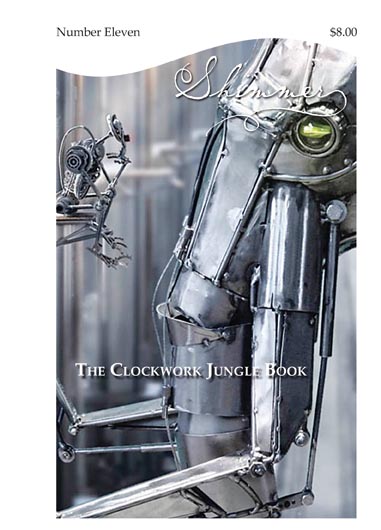
Issue 11: The Clockwork Jungle Book

Gentle Readers,

Team Shimmer is gearing up to release Issue 12. I can’t wait for you to see this issue: it’s spectacular.

But first, I need to make room for the new issue at Shimmer Headquarters. That means: it’s time for a sale.

Everything’s on sale.

Everything. Print copies. Electronic copies. Even 4-issue subscriptions. It’s all 20% off. Just enter the code ShimmerVacation (it’s case-sensitive) when you check out, and stock up on a summer’s worth of delicious Shimmery tales.

One week only!

This sale ends on Thursday, July 6, 2010 — so act now.

Author Spotlight: James L. Cambias

James L. Cambias
James L. Cambias

This is the final installment in our Clockwork Jungle Book author reading series. I hope you’ve enjoyed getting to know the authors a little better!

Our final author is James L. Cambias, who reads from his marvelous Teutonic steampunk story “The Wolf and the Schoolmaster.” Victorious but conflicted wolves on unicycles!

An excerpt:

When I returned to Totenburg after three months in the hills, the changes astonished me. Most of the damage of the War of Restoration was gone. Where there had been blocks of ruins, machines were digging foundations for new towers of glass and steel.

I steered my steam unicycle through the streets, hoping for enough pressure to make the climb to the castle. As I chugged past a group of old women bringing baskets back from the city market, I gave them a nod and salute. “Good morning, Citizens!”

They stared at me, a little fearful. I didn’t mind. Before the restoration they would have cowered in terror, and they would have been right to do so. The Baron Von Tod occasionally turned us wolf troopers lose on civilians when he thought they looked rebellious, or when he was in a bad mood, or just bored.

Click here to listen to James read. (21mb, MP3) And read our interview here.

Want to read the rest of the issue? And see the brilliant woodcut from Rhiannon Rasmussen-Silverstein which illustrates it? We’ve got 19 more fantastic stories!