Category Archives: Fiction

We Take the Long View, by Erica L. Satifka

The snow crunches under our boots as us-in-Devora and us-in-Mel trace our way through the Forest-That-Thinks. We pause, waiting for directions.

That way.

Sunlight pierces through the low-slung clouds. The Forest speaks again and there’s a picture in our minds of the Very-Big-Wrong and the image of a landing site appears in our head. We have not thought of landing sites for a very long time.

What do you think it is? Us-in-Mel asks, mind-to-mind.

Us-in-Devora shakes her head and shrugs. I do not know.

Is it food? Us-in-Mel scoops a pile of dead Leaves from the ground on which we stand and crams them into our mouth. That part of us is always hungry.

I. Don’t. Know.

Faster! screams the Forest, and we snap to attention.

As we sprint to the landing site, Us-in-Mel makes careful blazes in the Forest’s thick trunks. It wouldn’t do to wander off—not when there’s a Very-Big-Wrong somewhere, loose and so close.

Us-in-Devora is the first of us to stumble into the clearing to the landing site covered with a fine layer of snow. She-that-is-us paces around it, careful not to step on the pieces of us that were broken off at the Wrong. Our nose wrinkles.

Smelly, she says, her mind-speak betraying her disgust.

It’s… Mel grasps for a word, but can’t come up with a better one. Smelly. Yes.

We pick up a stick, a stray dead part of us, and poke the thing in the clearing. It stirs.

26 January 2564

Today we enter the outer fringe of the Horsehead Nebula, a dismal little planet called Fleming-7, where two standard years ago we lost communication with sixty-five Terran colonists. A recovery team has been rallied to recover what we can from the ill-fated mission, laying to rest the suspicions and fears of their families.

I know I shouldn’t question the motivations of Central Control, but this is a fool’s errand. It’s a waste of time to hunt about for dead bodies on some lousy backwater. With any luck we’ll find what we’re looking for quickly, and I will be home soon to my precious Bianca, waiting for me in stasis, unwilling to lose our life together to such a distant journey.

At least I’ll get overtime, if we’re lucky.

End transmission,
Gabriel

We poke at the not-us on the ground for a good long time, until it turns over, coughs, and sits up, rubbing its face with its hands. It blinks, looking at us as we look at it.

“You’re alive?” It reaches for something at its waist, then reels back its hand.

“Of course we’re alive,” us-in-Mel says in the mouth-voice, Leaves falling from our lips. “Are you alive?”

“Am I alive?” The not-us scoots back.

“That’s what we asked,” says Devora. “You don’t have to answer now if you don’t know.”

The not-us stands and scrambles back to the site of the Wrong. It pulls out a little black box and pushes a button on the side. “I’m going to have to call this in. Just…stay there. Stay right there.”

Silly it-thing! we think. Where else would we go, if not the Wrong? Because it is wrong, and because it lies at the heart of the Forest-That-Thinks, we can’t exactly leave it alone.

While we wait for the not-us to finish with its black box, we play one of our favorite games. Devora ducks behind one of the huge trunks, while the us-who-is-Mel scampers behind another.

Marco, Devora thinks.

Polo, Mel thinks.

And we think as one, and because of this, we are happy.

gen_illo_top

8 February 2564

Unexpected complications have arisen. Several of the doomed colonists are alive, though badly traumatized from their experiences. Spectral analysis performed remotely aboard the ship has determined the overabundance of unusual compounds in the heartwood of the trees.

Aside from the trees and the colonists, there is no other life.

The survivors of the crash will be briefed, decontaminated, and brought aboard the ship. The properties of the planet must be investigated as well, for their usefulness and potential profit to Central Control.

I do wonder if there’s a way to spin this to my advantage. The euphoric, almost childlike state of the colonists leads me to believe that the alien compounds might fetch a good price on Terra. We’ll run tests, of course. Still, how fortunate it would be to return a rich man. That would almost make these months of isolation worth it, both for me and for Bianca.

End transmission,
Gabriel

We are in turmoil.

The Very-Big-Wrong, the it-thing from the landing site, has invaded the settlement, the place where the we-that-are-mobile gather to speak, to screw, and to eat of Leaves and body-food. We begged and pleaded at it and asked the Forest-That-Thinks to give us permission to use force to repel the intruder.

No, said the Forest.

But why? asked us-in-Devora.

He is of use. And then the Forest-That-Thinks did the cruelest thing it can ever do, shutting us off from it, so that Devora and Mel could only speak mind-to-mind in whispers, and they couldn’t hear the others of us very much at all.

Sometimes, we do not like the Forest-That-Thinks.

The intruder strode into the settlement with great bounce in its step. It is no longer afraid of us. And because we don’t want to be forever shut off from the Forest-That-Thinks by fighting back, it has no reason to be afraid of us.

We are powerless.

It has been here for seventeen cycles of the light that shines behind the cloud cover: seventeen dusks, sixteen darks. Refusing to eat either our food or the sap of the forest, it lacks Understanding. It will not speak with us except through the mouth, and only a few of us retain that primitive method of communication. Those who do are resentful at having to translate everything for the Wrong.

It is Wrong, after all! We are Right! Why has the Forest-That-Thinks forsaken us?

Forest has reasons, us-in-Devora says. Her real voice is barely a whisper compared to the ugly mouth-voice.

You trust too easily, us-in-Mel replies.

Maybe, she says, eyeing the intruder. It is breaking off one of our Branches, and our heart catches at the pain. Maybe not.

15 February 2564

Through observation and conversation with the other members of the crew, I’ve determined that the compounds secreted by the sap of the native trees seem to induce a weak telepathic ability in the stranded colonists. It’s a little scary to know how easily they can talk behind my back. If they weren’t so subservient, I might start to get paranoid.

Physically, the colonists are weak as kittens. The sap that opens their minds to one another betrays the body, and as a result the colonists are completely spotted with tumors of all sizes, making them look a bit like bags of rocks with faces. It brings to mind the terminal form of that ancient disease, cancer.

The other day, I caught a colonist eating his own tumors, using his thick fingernails to slice open the epidermis and ferret the tumor from his body. Then he popped it in his mouth like a cherry. I shuddered when I saw that. Must investigate further.

The crew sends cans of food down the elevator, but they won’t come down themselves, the big babies. Certainly, my bravery will earn me special mention from Central Control when we get back to Terra.

I hope so, anyway.

End transmission,
Gabriel

The intruder wears a mask around its mouth now and swathes its body in linens dropped from the ship in the sky. It doesn’t fear us, but it fears the Understanding.

To be fair, a few days ago, some of the us-that-are-mobile did try to put the sap in its mouth. And it did roar mightily about that with its mouth-voice, and it did hit several of us. The one-that-was-Mel died.

And yet, the Forest-That-Thinks remains silent. Help us, you who are also us!

But we will not stray, we will not allow the individual desires and hungers that once ruled us like iron fists to dictate our actions now. To do so would remove us from the grace of our Forest.

That would be suicide.

The intruder set up its camp at the edge of our settlement. There it stays, crouching, waiting. For what, we do not know. It speaks into its little black box with its horrible mouth-voice. It eats from silver cans. Its bright orange inflatable hut is like its ugly mind, a shield that hides it from the Community. When it questions us, which is often, it forces us to speak with our mouth voices, because it cannot yet speak the true language.

It laughs at us. It thinks we-who-are-mobile have forgotten the way we used to be. “I could fix you. Cut out those tumors, synthesize an agent to work against the tree sap.”

“No,” one of us says. “Not that.”

It lowers its eyes. “I could make you.”

We flinch when it says that. We have seen the power in the intruder, the way it cast us-in-Mel aside. We don’t want to be cast aside to die. Even though we are but instances of the Community, each of us still clings stubbornly to our own facet of life.

“Please don’t,” we say. “Please.”

It just laughs some more, that hideous noise smearing the perfect silence of our world.

Us-in-Devora travels often to see the intruder. She watches it from the bushes near its camp, and through her eyes, we see it too. At first we could see it brightly, as if with our very own eyes. Now, we can barely see it at all. We-who-are-mobile are very worried about us-in-Devora.

28 February 2564

The crew grows impatient. Ever since I came down they’ve been requesting a departure timetable. I know my faithless crew is reading these entries, so here’s your timetable: we’ll go when I say we go.

Jerks.

I have studied the sap of what they call the “forest that thinks” more in depth, and have determined that it is indeed highly carcinogenic. Why these people are alive, I have no idea. Nor do I know what triggers the telepathic sense. In all my weeks here, I haven’t felt a trace of the “mind voice.” Surely it must be controlled by the sap, or the tumors the sap generates.

Sometimes I wish I could taste it.I have made contact with a local. Research into the ship’s manifest reveals her to be one Devora Mikelski, a first-year xenobiology student undoubtedly chosen more for her looks than her grades. She displays no real curiosity about the properties of the forest that surrounds most of this snow-covered world. Like a little puppy, she follows me when I go out to study the trees, though she looks away when I take core samples from the thick, fibrous trunks. She allows me to palpate her many tumorous growths and take photographs. (See attached.) When I am around her, I wear a form-fitting mask, in case she tries to slip a bit of sap into my mouth or nostrils. She hasn’t tried recently. She obeys me utterly.

It’s quiet here, so very quiet. Sometimes, just to break the silence, I sing Bianca’s favorite songs at the top of my lungs, those awful jazz-rock hits she liked to listen to on the infobursts. The colonists cower, like I’m hurting them. But I’m not hurting them, right?

So what if I am? I’m lonely.

Transmission over,
Gabriel

Devora washes the intruder’s spare masks and linens. We arrange its tins of food. We sweep the small inflatable dwelling with a soft-bristled brush, and try not to shudder when the intruder strokes our mounds of body-food and calls us “beautiful, in your own way.”

We grit our teeth. We remind ourselves that eventually, it will see the truth. We take the long view.

“It hurts,” us-in-Devora says through her mouth. The resentment we feel when we look at the intruder is as vast as the silver belly of its ship.

The intruder looks up from its mutilation of a branch plucked from the Forest, a piece still alive when it was severed. “What hurts, honey?”

We shake our head, thinking of us-in-Mel, the instance of the Community that Devora had cared for most. Our head glistening with blood and sap, our limbs shattered. “Nothing.”

Devora looks no more at the silent Forest-That-Thinks. We close our minds to the rest of us. We practice the unfamiliar pronoun which the intruder forces us to say.

“She,” says the intruder, jabbing at Devora’s body-food with a scalpel. “She. She.”

And it is a he, and to the intruder this means something profound.

She-is-Devora doesn’t bother listening to the rest of us anymore. Our voices are too faint to hear. She takes the medication the intruder provides and lets it rip the voice-giving structures right out of her body. She gazes into the mirrored pool outside the intruder’s inflatable hut, and retches.

It’s time. “When can we leave for Terra?” she asks, affecting her best traumatized-survivor impersonation.

The Wrong, it grins.

4 March 2565

Departure is nigh. I have only one week to pack my meager belongings and finish up my anthropological notes. Unfortunately, it would take several lifetimes to give justice to all I’ve experienced here.

Only one of the doomed colonists will accompany me back to Terra: Devora Milkelski, my little assistant. She has allowed me to remove the tumors from her body, though she cried when I did it. I tried to comfort her, but it didn’t help.

I’ve taken my last samples of sap and of bark, and while the colonists certainly did complain about it, I only had to sing one of Bianca’s songs to make them flee in terror at the shattering of their silence. How fast they fall, how weak they are in this environment. Even if they wanted to return to Terra, I’m not sure they could withstand the gravity or rapid pace of life. Only Devora seems excited to see her home planet after so many years away.

I asked her how much she remembered.

“Not very much,” she responded, running her hands over her fixed body. “The forest took so much from us, but you have restored it.”

Isn’t that wonderful? I’m her hero. And heroes deserve a reward, and I have been away from Bianca for a long, long time.

End transmission,
Gabriel

gen_illo_bot

She-is-Devora watches us through a wall of frosted glass, one only she can tell is there. We send our thoughts and emotions to her, but they patter against the glass like the flying creatures we vaguely remember from Terra.

Goodbye, says us-in-Malik.

Farewell, says us-in-Qin.

The voices are so far-away, like transmissions through a shattered ansible, the Community must open their mouths and speak the words to she-is-Devora through our little-used larynxes. The voices come out ugly, nails on rusted steel. At the edge of the camp, the Wrong’s face crumples.

She-is-Devora responds in tears.

She packs her rucksack from the corner one of the inflatable pods the members of the Community abandoned when they landed, before they were the Community, before they had known such love. In the depths, she places a package wrapped in a layer of Leaves, and covers it with the clothing the intruder insists she wear.

Boots crunching through the snow, she returns to the invader, to the it-him. Her nutrient-stripped body is swathed in his castoff linens. Her hand encloses a sachet of sap.

“Take me back.”

We watch behind the wall only she-is-Devora can see, and we mourn. The loss of any of us is a loss beyond measuring. However bad it is for us, it is worse for Devora. Locked away from Understanding, one is but a shadow, a Branch broken from its Trunk.

Devora slips the sachet of sap between her teeth. As the elevator starts to rise, the intruder sweeps her up into his arms, tongue reaching down into the very depth of her-the-former-us.

Devora doesn’t say no.

The intruder’s eyes widen as we welcome a new member into the Community. When he falls from the elevator we are there to receive him. Receive us.

Our Bianca,

We must report that our return to Terra is permanently cancelled. We have found a place that surpasses even the pleasures of Terra, which disappears in our estimation as a shooting star disappears over the farthest horizon.

The body in which this instance of we resides can no longer stand, no longer walk to commune with the Forest-That-Thinks. It is no matter. We carry us wherever we wish to go. We carry us to the river, we carry us to the lake of snow and to the clearing where we can see the Very-Big-Wrong, the “landing site” that was once so important to us, but is no longer.

Sometimes, when us-in-me lies in this frozen body, as gobbets of body-food are pushed into our mouth by the other pieces of us, we think of you similarly frozen in your stasis chamber, and wish that you could experience all that we do. How dreadful it is to be alone! How unnatural!

Us-in-Me have no way of sending this transmission, it is but a thought projected into the minds of all who share the Understanding. We hope you-who-are-not-us are happy, wherever you are. And now we will think no more of you, for such things are irrelevant.

We remain,
Us-in-Gabriel

She-is-Devora is painfully alone, in a way she hasn’t been since arriving on the planet the crew calls Fleming-7, but that she only knows as home.

Two of the crew members say she-is-Devora pushed the one named Gabriel from the elevator, while three say it was an accident. But after she puts a little sap in their first-cycle coffee, it doesn’t matter. In the greenhouse, she buries the fist-sized Seeds she hid in her rucksack for future transplant.

It takes longer for the tendrils of the crew’s minds to reach outwards and entangle with one another and with hers. It takes weeks for them to become us. With so few people, it’s not the intense Understanding of the world swiftly slipping away through layers of black space, but it’s a start.

She-us is no longer alone.

“How many people live on Terra now?” Devora asks them-us.

“Much the same as when you left,” they reply. “Seventeen billion.” Devora’s heart soars to think of so many people joined in the mind-voice. She knows they feel the same.

When the first body-food is ripe, she-us shows them-us how to harvest it.

It will take years for Terra to become a true Community, all members knit together in harmony. Without the Forest-That-Thinks to boost the mind-voice, it will take even longer. But we will wait for the Understanding to take root, for all to think as one. It is a thing worth waiting for.

After all, we take the long view.

fin

Erica L. Satifka’s fiction has appeared in Clarkesworld, Ideomancer, and Daily Science Fiction, among others. She lives in Portland, Oregon with her husband Rob and too many cats. Visit her online at www.ericasatifka.com.

Erica Satifka
Erica Satifka


Buy Shimmer #21 | Subscribe to Shimmer | Interview with Erica L. Satifka

Dream of the Fisherman’s Wife, by A.C. Wise

The fisherman’s wife breathes out, and tendrils of smoke curl around her. She listens to the tide inside and out — salt sea and salt blood, eroding shores of sand and making a hollow space within her skin and bones. She listens, and the ebb and flow tells her what she does not want to hear.

She needs no doctor to know: When the moon swells to full, she will bleed again.

A sigh laced with more smoke. This time, for just an instant, the tendrils thicken, become solid. One brushes her cheek, chasing salt slipped from within to without, aching to join to sea. The fisherman’s wife starts, but doesn’t move, holding her body quivering-taut.

The touch does not withdraw. Cautious, she pulls on the pipe again, adding more smoke, more weight. The first tendril, more a tentacle now, is joined by a second and a third. One slips past parted lips; one traces the edge of her parted robe and curls around the swell of a breast that isn’t as full as she wishes.

Dive. She feels the word against her flesh, then the smoke is gone. She shudders, hairs rising, skin puckering tight.

It was a dream. Was it?

She draws her robe close, tucks her legs up, and waits for her husband to come home.

Below the pier where their hut crouches — all one room and no place to hide — waves surge, bringing the scent of green weeds wrapped around wooden piles. The fisherman’s wife raises her head from the drawn-up pillow of her knees. Through sleep-puffed eyes, she squints at the edge of the lowered shades. Still daylight. She didn’t mean to doze. Outside, seabirds call, squabbling over fish guts baked dry by the sun.

She rises as her husband steps through the door. The fish-stink on him is laced with sweat. It is his scent, her scent, the scent of their life together, and for a moment it breaks her. Her eyes sting, but no more salt falls.

The boards creak, the light changes as her husband shifts, uncertain, as though afraid of and for her until she folds into him. Her hands go to the nape of his neck, the small of his back. His fingers meet and lace together between her shoulder blades, pulling her close. There is black blood under her nails and his fingers are calloused from tying knots, casting nets, hauling lines. They are the hands of a fisherman and a fisherman’s wife. They fit together, two halves of a whole.

“No.” She murmurs the word against his throat, breathing in the salt-sweat of him, answering his unspoken question. It is the same answer she gave last month, and the month before. He softens a moment, before tightening his grip, fingers stroking her spine to soothe.

She shivers, reminded of…what? Should she tell him of the dream that wasn’t a dream, the word spoken into her jaw by a smoke-tentacle, caressing her tongue?

The fisherman draws back, concern in his eyes. “Wife? What is wrong?”

She shakes her head. “Only a chill wind from the sea.”

The fisherman’s wife rises. Is she sleeping still? If she glances back to the pool of moonlight holding her husband in their tangled sheets will she see herself lying beside him, chest moving steady with the in-out tide of breath? She steps outside, barefoot; from the pier to the sand, to the edge of the shore where the water traces a silver line against her toes.

She sheds her robe. The memory of poppy-smoke lies heavy on her tongue, slicks her throat, slows her blood. Could it be a vision? Must it be a dream? Salt-tinged breeze stirs her black hair, all loosed down her back. Cold slaps her skin as she steps into the waves. Deeper. Her hair spreads like an octopus’ legs, spilled ink on the sea.

Dive.

Underwater, she opens her eyes. It is bright as the noon day sun. There is so much life, color everywhere. Above-wave, the world is grey and increasingly dull, whether with poppy-sheen or age, the fisherman’s wife cannot say. She knows only that with each year that passes there is more emptiness. It is not just want of a child. She feels the changing of the world within her bones. It is drying up, falling silent. But underwater, armies march. Children play. A blind man sculpts coral into delicate figures with too many eyes. Women with shark skin and shark teeth tend kelp gardens. Buildings crumble and rise again. The world, drowned, is reborn.

A shape darts at the corner of her eye — smoke made solid. She reaches after it as it slips past. A tentacle coils around her wrist, strokes her palm.

This is and was and can be again. All you have to do is choose.

The fisherman’s wife blinks, disoriented. The current has tugged her, turned her; the many-limbed creature is gone.

The blind old man takes her hand. “Mother,” he says and kisses her cheek. Even below the waves, his lips are paper dry.

A little girl leaves the army march to press a bouquet of sea anemones into her hand. “Mother,” she says, before swimming away.

Silver bright fish form an aura around her. Their mouths open and close. “Mother,” they say.

Eels and sharks and starfish and whales join the chorus, repeating the word. It booms like thunder, a low, reverberating note rolling out from the epicenter of her being, stirring a tidal wave to wash away the land.

“I don’t understand,” she tries to say, but salt-water floods her mouth.

She kicks, chokes, her head breaks the waves, coughing up icy water and strands of seaweed that slick her skin until she claws them away. She thinks she sees her husband on the pier, waving. But when she wipes salt-heavy hair from her eyes, he is gone.

A tendril traces the arch of her foot, strokes her calf, beckoning.

“No.” The fisherman’s wife kicks free. “Not yet. It is too soon.”

She wakes, or she swims, long, powerful strokes carrying her back to the shore, back to her husband’s arms.

The fisherman’s boat rocks gentle as a lullaby. He would catch more with the other fishers, working together instead of alone. There is a woman who sings her catch into the boat without ever casting a line. There is a man who knots the full moon into his nets and lowers it to lure a large, flat fish like a flounder, but bigger than anyone has ever seen. It is the same fish every time, the man says, and the whole village gathers to make a fire on the beach, bright enough to light the darkened sky. They roast the fish on long wooden poles, then burn their fingers pulling flesh from bone as fast as they can. As the fish cools, the bones poison the flesh. If they don’t eat the fish fast enough it will kill them.

The fisherman has no patience for the company of others today. Last night, he thinks he woke in bed alone. He also thinks he woke with his heart thumping like the tide, his wife lying beside him, insubstantial limbs the hollow color of moonlight; his fingers would pass through if he tried to touch her. Both things are true. When he looked through the window, he saw his wife’s head break the waves, hair like ink against her sea-chilled flesh, swimming toward the shore. When he turned, she breathed beside him, troubled in her dreams.

He has been restless ever since. Afraid. So, in his smallest boat, painted white like a pearl, he drifts alone. A jar balanced in the boat’s prow brews salt-water tea with the heat of the sun. It tastes of squid ink and tears, but he has heard it is used for prophecy, and so he drains the last drop. It sears a word on his tongue.

Dive.

The word slams into him, sudden certainty. He must follow his wife down; he must find her under the waves. They must find each other. As the sun passes the apex of the sky, the fisherman strips and describes a perfect arc into the blue.

The water slices him open, steals his breath. Cutting knife-clean through the dark, he swims down and down. As a boy, he dove with his brothers for silver coins falling from rich men’s fingers. He could always go the longest without coming up for air. The fisherman’s chest is narrow, but his lungs are strong.

A tendril brushes his leg, an octopus’ arm or only a weed. An electric thrill, which is also panic. He kicks away, streaming bubbles like pearls. The shadow slips past him, ahead of him, ink darting in a jet of bubbles all its own. It pauses, turns as if knowing the fisherman watches. Its limbs bloom like ribbons of hair. The fisherman stops, suspended, rocked by the current. In the center of that tangle of limbs he catches a glimpse of his wife’s face, moon pale. Then the creature is gone.

Panic of a different kind — pulse beating a new rhythm of hope and desire, the fisherman gives chase. He dives deeper, fighting the aching cold in his legs, the pressure of breath in his lungs. He follows a smoke swirl here, an unfurling of ink there.

His chilled fingers grope. Fish nibble his calloused skin. He is almost there, even though he doesn’t know what he’s reaching for. A moment longer and he will allow himself to breathe.

There. The tip of one finger brushes a smooth curve, a perfect round. But sharp, the razor edge of a shell meets his skin, draws blood. He kicks, instinct shooting him to the surface. No! he thinks. I was almost there. It’s too soon.

His head breaks waves and he draws ragged, stinging air into wounded lungs. He shakes water-wet hair from his eyes. His little boat bobs beside him, patient and waiting. Stars prick the sky like a million eyes. Impossibly, the sun has set and the moon risen while the fisherman sought beneath the waves.

The hut is dark, but neither the fisherman’s wife nor the fisherman sleep. The walls smell of smoke and fish and salt. They hold a space of emptiness between them, an absence sharp-edged. Then, between one heartbeat and the next, they both decide. The wife reaches out, fingers seeking like a starfish across the vast gulf of the bed. Her husband’s hand is waiting.

“Wife,” he says. “I have dreamed.”

“Husband,” she answers, “I, too, have dreamed.”

Lips almost touching so the fearful words will not escape them, the fisherman and the fisherman’s wife whisper of what they have seen.

“Limbs like ink.”

“Smoke.”

“A song.”

“A pearl.”

“It is a prophecy, not a dream,” the fisherman’s wife says.

“What do we do?” the fisherman asks.

Fear curls and uncurls; a tide within and without.

“I don’t know,” the fisherman’s wife says. “Not yet. But I will soon.”

Sun draws sweat from the back of her neck as the fisherman’s wife bends to her work. Her legs cramp. Her hands are slick with blood, her little knife quick as she guts fish to hang on racks above the fire. The air around her stinks of offal. Below, the tide rushes in; she peers through the slats and she sees it, dizzying, fraught with secret glints of light.

gen_illo_top

Ropes of intestines fall through her hands, glittering green and black, slithering back into the sea. The scales and blood that catch on the wood and wink in the sun make a pattern, spelling the future. She half-closes her eyes, scrying, dreaming.

Her hands continue their steady rhythm of work. At the same time, she stands on the edge of what used to be a shore. The world is hollowed, the oceans and seas gone, all the secret places dried out and laid bare. The bones of vast creatures litter new-formed canyons. Wind stirs her hair, laden with the memory of salt. The sun, red-gold and low, peeks between withered pillars of stone, drags her shadow away from her heels, and tatters it across the sand.

There are cities in the skeletons of the drowned-in-air creatures — arching Temples of Whale, intricate Labyrinths of Squid, strong Fortresses of Turtle, and perfect, recursive Gardens of Nautilus and Conch. This is the world that might be.

There are buildings she recognizes, too — the Temple, the Market Square, her neighbors’ homes — all empty. This is the world that was.

Two futures fork away from her. It is for her and her husband to choose. Embracing one world forsakes another. The land or the sea. If one rises, the other must fall.

What is there for them here? The hope of a child that never comes? Poppy smoke and a village growing emptier every day. One day, the woman will not sing her catch from the sea; one day, the man will not net the moon so they can burn their fingers on flesh hot from the fire. Then it will be only her — the fisherman’s wife — and her husband. The world is moving on without them, drying up, blowing away like dust on the wind. But there is color and life below the sea, and if they will it, it will rise to meet them.

The fisherman’s wife glances down. A bundle lies cradled in her arms — delicate, moonlight-translucent bones, wrapped in a fine-woven net of silk; a fleshless, milk-tooth mouth held to her breast. With a shout, she opens arms. The bones tumble toward the sea floor and she shouts again, reaching too late to catch them.

She opens eyes never fully closed. Not yet, but soon, it will be time to choose.

The fisherman rises from the bed he shares with his wife. Is he dreaming? He dares not look back to see. Naked, he climbs the ladder at the end of the pier, down to his little boat, tied and bobbing on the waves. He rows, muscles bunching, following the path of moonlight laid across the sea.

The sky’s pearl is full tonight, swollen. Its twin lies beneath the waves.

Here.

The fisherman jumps, a needle threading the waves. He is blind, no sun tracing his descent. He gropes, hands outstretched, chasing the elusive thing that slipped from his grasp last time.

Shapes move around him, shadow-soft in the dark. A questing tentacle wraps around his leg, brushes belly, chest, and thigh. He shivers on the edge of ecstasy.

No, he thinks. Not yet. His wife must be with him. And he pulls away.

Stars burst behind the fisherman’s eyes. How long has he been underwater? Surely by now he must have drowned.

There, again, a tentacle brushes his leg, not a question this time, but a directive: Follow. Dive.

Touch, soft, strokes his cheeks, his back. The fisherman nearly weeps, already surrounded by the salt sea. It is still too soon. He pictures his wife crouched on the pier, her back aching, her hands bloody. He can’t leave without her.

The tentacles tap, lighter this time, relenting but still directing — here, here. The fisherman’s breath is running out. His hands sweep, frantic, and there, there, his fingers close.

They snatch. They pry. The sharp-edged shell draws blood again, but this time he doesn’t let go. Not until he has his prize.

Stars trail from his lips and blaze behind his eyes as he shoots upward. He breaks the surface as the sun climbs over the horizon, weeping, a pearl clutched in his hand.

“We could leave,” the fisherman’s wife says, but she doesn’t mean it. “Leave rather than choose.”

“The sea is our life,” the fisherman says.

He is here, but he is swimming through the dark at the edge of a vast continental shelf. She is here, but she is standing on a shore, willing the water to return and restore flesh to a city of squid carcass and whale bone. If he goes further, everything will drop from beneath him. He’ll be weightless, surrounded by water made of night, lit by drowned stars. If she opens her arms, she will no longer feel the dust-dry breeze and cradle wind-stripped bones. The world will call her mother, and she won’t be afraid.

They are choosing. They have already chosen.

“There is life in the sea,” the fisherman’s wife says.

“Yes,” the fisherman says. “But how…”

The fisherman’s wife closes her eyes. The memory of a tendril of smoke grown solid, a tentacle of ink and flesh chases across her skin. She opens her mouth, parts lips, breathes out a sound that is not quite a sigh.

“There is a song,” she murmurs, and lays moon-cool fingers against the fisherman’s skin. Thrum, from the point of contact — a note, shivering through both of them. The fisherman’s teeth clench tight a moment, the reverberation in his jaw, then he lets go.

“A song.”

The walls of the hut drop away, leaving them exposed to the wind and crashing waves.

Gentle, with net-abraded hands, the fisherman unties his wife’s robes. Beside the bed stands a bucket of fresh water drawn from the rain barrel outside. He dips a cloth and passes it over her skin, washing the sweat of the day’s work away.

Water beads, droplets catching the light. The fisherman’s wife trembles with the strength of her desire. As her husband moves the cloth, she snatches a moment here to unlace his shirt, there to undo his trousers. His clothes are salt-stiff and smell of fish; they resist when she pushes them to the floor.

The fisherman removes the pins from his wife’s hair. It spills around her, dark as limbs unfurling beneath the waves. She takes the washcloth and touches him as gently as he touched her. His chest and shoulders are beaten bronze from the sun, but from the waist-down he is fish-belly pale. She is the same. Only the nape of her neck is tan where the sun beats all day, and the tops of her feet where they peek from beneath her robes.

She drops the cloth into the bucket and watches it sink. It is a living thing, spreading limbs, darting away, then only cloth again.

The fisherman holds up the pearl, cupped in his palms — an unspoken question. By way of unspoken answer, the fisherman’s wife plucks the pearl from his hands and places it against his mouth. He accepts it with a curl of his tongue, and holds it cradled there. His skin glows.

The fisherman’s wife traces the light in her husband’s veins. It pulses in his belly, his groin, and the hollow of his throat. She chases the light with her fingertips—an underwater sea creature, a pilot fish leading her to delight and doom.

The fisherman groans, a soft sound. She follows her fingers with her lips. Her tongue. The fisherman tastes of brine — rainwater-washed — of sunlight and wind. Her fingers catch in the fisherman’s salt-stiff hair, the one place she did not wash. She pulls him close, urgent but not rough. Full of need.

Her lips press to his, drinking, crushing. His tongue passes the pearl into her mouth; its taste is nothing she can describe.

The fisherman’s hands are on her back, her buttocks, holding her close.

They drift in untold seas.

Their cheeks are wet with not-unhappy tears. She wants to swallow the pearl, but she’s afraid. She traps it between soft palate and tongue, pressing it against the roof of her mouth until it hurts. She is drowning on dry land.

The fisherman and the fisherman’s wife tumble into their narrow bed. The wind gusts over them, snapping the linens like sails. Crashing waves shake the pier and the entire house trembles, a ship spun upon the sea.

The pearl passes back and forth between them. It is in her mouth. It rests in his navel. She catches it between her fingers. He steals it with his tongue. Through shared motion, they press it between her legs.

Close, she thinks, so close. But not there. Not yet.

“Dive.” She sears the word against his lips with a kiss, and hears it echoed back to her from him.

She closes her eyes, opens her throat, and tries to replicate a song from her dreams.

They are here and they are now, but they are elsewhere and elsewhen, too. Smoke pours from the fisherman’s wife’s mouth and becomes a creature with many limbs. It unfurls down her body. She rises to meet it, mouth open, legs open.

It winds around her, singing of oceans rising to devour the world — birth of a different kind. Together they can call it, the water, the dark-limbed creature, to reclaim dry canyons, nautilus cities, temples of whale bone. A tendril, a tentacle, wraps round her tongue. Its motion teaches her a song.

gen_illo_bot

She is already singing it. Has always been singing it. She will sing it until the end of time.

There is life in the ocean’s pulse and swell. Her hands cradle her belly. She lets the music pull her down.

The fisherman clings to his wife. Beyond the horizon of her shoulder, it is midnight, or the sun is just now rising. The sun is sinking; it shines high overhead. Beneath them, wooden floorboards thrum with the surge of waves. Stars wheel overhead. He remembers the touch of ink-dark limbs guiding him through water only a shade lighter than themselves.

He chases them down.

“We have to go farther,” the fisherman’s wife says.

“Are you afraid?” the fisherman asks.

“Yes.” She takes his hand. Their fingers fit together as they always have—two parts of a whole. But they are not complete yet.

“So am I,” the fisherman says. “But not too afraid.”

The fisherman and the fisherman’s wife rise and walk together out onto the pier.

The waters will rise if they call them, but it is better than a slow-emptying village — the Market, the Temple, their neighbors’ houses abandoned one by one. There is so much color beneath the waves, so much life, and it will call them mother and father if they choose. It is not the child they once wanted; it is greater — the destruction of a dying village and the birthing of a whole new world.

Together, they sing.

Salt water washes around them, but they do not drown. Called by the notes thrumming from their bodies, the creature rises to meet them. Ink dark, everything they have ever dreamed. It is as small as their hopes and big as the world—a tangle of limbs the color of midnight, blue-black and glimmering with light. It lays the fisherman and the fisherman’s wife down on the wooden pier. Below them, the pulse of the waves matches the tide of their blood and their desire.

The fisherman’s wife turns toward her husband, their fingers still entwined.

“Are you afraid?” she asks.

“Not anymore.”

Legs part, hips rise. The creature knots between them, stroking hip, breast, thigh. It binds them. Swell of belly, swell of tide. Smoke made solid slips inside the fisherman’s wife. Her husband joins it. She sings.

Touch traces the fisherman’s spine, his legs. His body opens, responds. Ink fills him and he shudders in answer.

The fisherman kisses his wife’s lips, and kisses her lips. He savors her pearl, and savors their pearl.

The many-limbed creature flows between them. It twines and re-twines, a creation myth in reverse, stirring sea from the land.

On the pier, with the waves crashing beneath them, their bodies move to the rhythm of salt and blood. Their children swim around them, waiting to be born. Children with human faces and skin and teeth like sharks. Their smiles glow like moonlight among a tangle of hair like a multitude of limbs.

Yes, the fisherman thinks, rising to meet them.

Yes, the fisherman’s wife thinks, her body thrumming with song.

Together, they choose — a strange apocalypse of rising tide over the barren canyons of desolate buildings. They re-enflesh the drowned world of squid rot and whale bone, bringing back a new world, an old world, with a surge of the tide.

Together, the fisherman, the fisherman’s wife, and the creature of ink and smoke, sing.

fin

A.C. Wise hails from the land of poutine (Montreal) and currently resides in the land of cheesesteaks (Philadelphia). Her fiction has appeared in previous issues of Shimmer, Clarkesworld, Lightspeed, and the Best Horror of the Year Vol. 4, among other publications. In addition to her writing, she co-edits Unlikely Story. You can find her online at www.acwise.net and on twitter as @ac_wise

A.C. Wise
A.C. Wise


Interview with A.C. Wise | Shimmer #21 | Subscribe to Shimmer

Dharmas, by Vajra Chandrasekera

T he tuktuk driver spits a small fiery globule out of the side of his mouth. It spins as it flies, striated by angular momentum, and burns a hole in the street, burrowing instantly into the asphalt. I crane my neck outside the vehicle as the tiny, bubbling crater recedes into the distance, watching the curl of smoke until I have to duck back inside to avoid decapitation. Traffic is so loud we can only speak by shouting, but I still think I can hear the fireball hissing. And then gone, lost beneath and behind in the past, heading for the Mohorovičić discontinuity while the street moves on.

The tuktuk driver’s name is Piter, according to the worn label on the back of his seat. Piter is telling me a story about digging a hole to hell, which is also the story of his life, and I am trying to explain to him why his life is meaningless, while he does the same to me. We are locked in ideological struggle, because ideology is ontology and we cannot live in each other’s worlds. I can’t remember how long we’ve been arguing.

“In 1989, I was a student in Russia, interning at the Kola Superdeep Borehole project,” Piter says. All his stories start like this in the deeps of his past, beneath the crust of the mundane. “I was there when they dug the deepest, the day they decided to stop. Do you know why they stopped, brother?”

When I speak to him I address myself to the back of his head, a great dome imperfectly covered in oily curls; his scalp is unnaturally pale in contrast with his umber skin. He, meanwhile, does not catch my eye in the rearview mirrors but speaks to my disembodied voice as if I were a bourgeois ghost and not quite human, bruised and embodied on the rattling back seat of his deathtrap. Like every passenger he has ever driven, I have placed myself at serious risk of injury or death. He owes me a life, whether he takes mine or not. This is why I am compelled to undo his narrative.

“Snopes dot com,” I say, in triumph. “They say they dug a well to hell and heard the howling of the damned. It was a hoax.” I wave my phone at him where I have the page open.

gen_illo_top

He glances backwards, so quick I see no pupils, only a slice of his mad yellow sclera. “Who are you going to believe, the internet or an eyewitness? Anyway, that’s not the story.” Piter is always interrupting his own stories, shifting his weight like a boxer when I punch a hole in his defense. “I heard the other day that Putin is starting the project up again. They will open up the hole and send soldiers through. The Russians intend to capture a piece of hell.”

“Which hell?” I ask. I have long since lost count of such things. We learned the superstitions of our ancestors in school, handled safely with thick gloves and goggles, sanitized by Mahavamsa and Marx alike. “There are at least nine hells.”

“Twenty-one,” he says, disapproving. “Or twenty-eight. Pick your purana.”

“Which so?” I concede the point quickly. Never argue the Vedas with a Marxist. “Which one did you find?”

“The one under Russia, obviously,” Piter says, “I am not interested in sophistry.” This is the kind of thing Piter says when he engages in the rankest sophistry. “Soon people will be able to, literally, go to hell. Hell will become a territory that can be contested. Colonized.”

The tuktuk swerves alarmingly, bumping against a passing car and scraping its side. The noise is like something dying, and I smell paint and gasoline. Piter swears, and the car’s driver gives him the finger. We don’t stop. Nobody ever stops. Piter even speeds up a little.

A tuktuk is open on both sides, not aerodynamic. The wind tunnels directly into me in the backseat, the focus of all the drag, as if our headlong rush is actually an attempt to erode me away. The wind is hot and dry, a sirocco formed in concrete canyons blistering in the sun. My face feels dusty and abraded, the skin dry and hot. I am forgetting the story of my life.

Along with Piter’s name, the label on the back of his seat has a hotline number for complaints. AM I DRIVING SAFELY? it asks, disingenuously. I tell him I’m contemplating calling, and also that hell is not real. But this is a weak rejoinder.

“You don’t have a scientific mind,” Piter scoffs, deservingly contemptuous. “All territories are stories told by Empire. Otherwise a place is just stones and trees.”

“Our ancestors once worshipped stones and trees,” I say, automatically as if it were catechism. In a way it is, the catechism of curated history. This is what we are taught as children: in ancient days, our ancestors worshipped stones and trees, serpents and demons, before Buddha came. Then for a while they worshipped Buddha. Then Empire came, and for a while they worshipped Empire as well. Then came Nation, the horse-headed twins Marx and Market, and so many others, so many warring, swiving gods that heaven is crowded and our sins flow, uncountable like water. This is why our hells are so many they must be numbered: to follow any law we break many others. We exist only in violation, always on the cusp of being unmade. A new regime, a new revolution, a new philosophy, a new definition of what it means to exist: we might become hyperreal, like Piter, or almost unreal, like me. Argument is life, definition is survival.

He does not, Piter hastens to add, support Putin’s imperial ambitions. He merely sees them as an inevitable part of history’s machinations. “Empire is the means,” Piter says, “By which ontologically suspect entities, like Lanka or Russia or Hell, are transformed into territory. All the worlds are void and without form, until Empire moves over them.”

I am about to speak when Piter sticks his own head out of the tuktuk, looking back the way we came. His hands are steady, and the vehicle does not waver at first—but my heart does, and my counterargument is lost on my tongue. It tastes like salt. All I can wonder is whether his name is an error, a typo for “Peter,” and whether it looks the same on his birth certificate. That’s the hand of Empire, right there, the idea that his very name could be an error made real, so perhaps it makes sense that he thinks so much of it. How well both forms of the name suit him, though, their chthonic solidity, the suggestion of magma beneath his crust!

The vehicle begins to tilt alarmingly while Piter holds his pose, still looking backward while we speed up. I’m breathing fast but shallow. I don’t want to seem like I’m panicking, because that’s a cheap way to lose an argument. I try to think slow thoughts not of collision at high speed, not of dying in mangled metal.

gen_illo_bot

“What are you looking at?” I snap, finally. “How do you claim to know what Putin intends to do? Gods as witness, will you watch the ro—” And the rest of my words are lost in the roar of a truck overtaking us. I startle, jerking away and clutching at the sides of the vehicle. The smog of its exhaust in my face makes me cough.

“A snail crossing the street,” Piter says, facing forward calmly as if he had only been waiting for me to ask. He corrects the subtle drift of the vehicle out of our lane, away from certain death back into mere probability. “But too late, a car already has crushed it.”

“Why, you wanted to help it across?” I’m almost laughing in relief, but only almost. I must put as much scorn in my voice as possible. Piter has his entire vehicle and our deadly, unending motion to use as part of his argument. I have only voice and words. I have to remind myself that I can still feel my extremities, that I am flesh and blood. Without argument I am fading. In Piter’s world, I am not sure I exist. He wants to make me a ghost, one way or the other. Not a kin-demon or a hungry ghost or a dispossessed lumpenproletarian, but that bourgeois ghost with clanking imperial chains.

“It was an opportunity to do good,” Piter says. He sounds bitter at having missed it. I am piecing together his hierarchy of gods. Buddha over Marx, Empire as the mother of Nation, above them all the need to assert definition on the world. Call it Law, or Dharma: this last is the only way in which we are the same.

“Snails are stupid,” I say. At this he lapses into sullen silence, and I rejoice. But the argument is not yet settled in favour of his dharma or mine: the world is still in flux. Somewhere a little fireball, digging a hole deep into the earth; on the sea of magma under crust, continents in slow imperial drift. The ghosts of the chains growing heavier on my wrists, while my bones grow light and feverish.

“There are at least twenty-two hells,” I tell him. I’m dug in too deep now, too close to the magma. “Or twenty-nine, pick your purana. I mean, there is one more than they say.”

Piter twists his head completely around to look at me, swiveling like an owl. I fight the urge to scream at him again for not watching the road while driving. Instead I try to brace my feet more firmly against the floor, though I cannot get purchase. He doesn’t say anything for a long moment, during which time my heart stutters and speeds. I can’t meet his ember eyes because I can see the cars and buses and trucks in front of us swerving away to avoid an accident, the bleating horns growing frantic. I flinch at every scream of tearing metal. Piter is focused on me, and we’re moving faster than ever. My vision is narrowing to a tunnel focused on the inside of Piter’s mouth when he speaks, which is a hot, glowing red.

“What makes you think this world is a hell?” Piter says, finally. He does not seem angry, only interested.

“Because the snail,” I say. We’ve drifted into the wrong lane and I’ve given up on even the pretense of calm, both arms extended to grasp the frame of the tuktuk. “We are meat for the grinder in this world.” But Piter does not seem convinced. Theodicy means nothing to him because Buddha taught him that he deserved it.

“Because we’re not special,” I say. Behind Piter, a car turns too sharply to avoid us and crashes into a motorcyclist, who flips and arcs across my field of vision. I can’t see him land, but even over the din I think I hear the crunch.”In all the worlds, why should we be special?” I say. “There are more hells than heavens. The definition of a hell is pain. Are we not in pain? If they in heaven cracked the sky and listened to us screaming, wouldn’t they call us the howling damned?”

And Piter finally laughs, turning to face forward again. My grip on the vehicle tightens, and I feel solidity in my bones. The ghosts of chains grow fainter, though they will never fade.

“That’s true,” he says, weaving between two buses that scrape the vehicle on both sides, metal screeching so long and loud that I hold my breath until it’s over. When we come out alive on the other side, I lean out the side and spit a fireball so spherical, so perfect, that it could have been a sun.

fin

Vajra Chandrasekera lives in Colombo, Sri Lanka, and on Twitter as @_vajra. His stories have appeared or are forthcoming in Black Static, Lackington’s and Lightspeed, among others. You can find more work by him at vajra.me.

Vajra Chandrasekera
Vajra Chandrasekera
 Interview with Vajra | Buy Issue #21 | Subscribe to Shimmer & Support Speculative Fiction!

Anna Saves Them All, by Seth Dickinson

Anna Saves Them All by Seth DickinsonBlackbird’s pilot waits, vitrified.

Nine days since the ship closed around them and with the poison killing them hour by desperate hour, Anna decides she wants to see the alien once. Erik Wygaunt warns her, like Li Aixue before him: “Go in with an empty stomach.”

“I don’t mind snakes,” she says. Li’s scientists showed her the photos.

“No.” Erik has eyes like a winter fisherman’s borehole. “There’s something wrong with it. Like a—stain. You’ll understand.”

Everyone who’s seen it walks away afraid.

One of the soldiers guarding the hatch peeks inside as he opens it, and he shudders like he’s just been catheterized with a live wire. “Fuck,” he says, and spits on the deck, trying to expiate something, to purge his eyes.

Here goes, then:

Anna steps into the sleep chamber sidelong, eyes peeled, skin prickling, hands half-curled, ready to bolt. It’s a rush, an undeniable addiction. She loves to be about-to-fight.

The alien, frozen in glass.

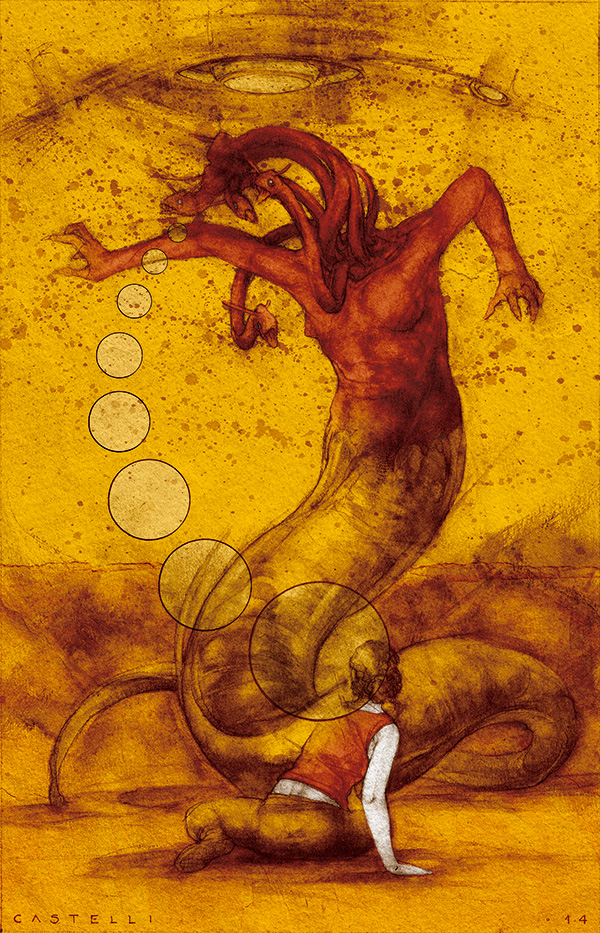
No legs. Most of its body a long lash of tail, muscular, serpentine, a naga shape jacketed in scales firm and dark as stone arrowheads. Humanoid torso, slim, kinda ripped, arms shading down from sable to silver-white like long elegant gloves. Four fingers. Two opposed thumbs.

(It’s so—)

Where it should have a neck, a head, it flowers into snakes. Eight coiled snakes, bundled up, knotted tight. Sleeping. Anna imagines them at full extension, a committee of swan-necked vipers, a serpent coronet.

(So beautiful—)

“You okay?” one of the guards calls. “Just back out when it gets too bad.” And then, soothingly, when Anna doesn’t reply: “You’re okay. You’re okay. Just come to my voice, man.”

A frisson jolts Anna, not fear but awe, like she just hit the peak of a great song, like the big tracking shot at the climax of the movie when the score booms and everything feels ready for ruin or rebirth. She steps through the clutter of cameras and equipment to press a hand against the glass.

“Holy shit,” she hears one of the soldiers say. “Is she—dude, check the cameras, check her out.”

“Doesn’t she—fuck me, she doesn’t feel it—”

The alien crystal is cold, lucid, faintly yielding. Hi, Anna thinks, even though it’s ridiculous. Hi. Everyone’s afraid of you.

And the pilot’s voice comes back, husky, mature, precise, faintly sibilant, unambiguously female, speaking Kurdish like a born tongue: You and I. We have been marked.

The glass splits beneath her fingertips. Curls open in jagged fractal steps.

“Hey!” Anna shouts, backpedalling. “HEY!” She hits something, a camera or an instrument, and falls on her ass yelling as the alien rises above her, stretching on coiled loops of tail, serpents flowering, tiny white mouths tasting the air.

From the hatch: “Motherfucker—!”

The alien darts one neck in silent command and the hatch slams shut.

She never thought she’d come back to Kurdistan, land of meltwater and mountains and Sarin and loss.

Then the Blackbird object fell out of the sky, and Captain Erik Wygaunt, in charge of the American quick-response team (they thought it was a Chinese suborbital spaceplane) tapped her as their guide and translator. One fuckup led to another, and now here they are, locked into the red-lit machine viscera of a fallen starship, claustrophobic, poisoned, dying.

The other team members have their own terrors, of course—rational big-idea fears: where Blackbird came from, why it’s here, what kind of Christopher Columbus apocalypse it could trigger if it goes home, or if it doesn’t.

But Anna thinks about how she came so close to home, how she’ll never know if the thing she did was worth anything at all. That fills her with something jagged: anguish…or relief.

The thing she did:

Anna spoke to an alien once, a man who might have been born Homo sapiens but who wasn’t anything human. A beast in a red beret, servant of Ali Hassan al-Majid, who devised Al-Anfal at his cousin Saddam’s request.

He didn’t believe that she was human, either. He asked:

Are you an animal, daughter of Serhing Rekani?

“Anna. Anna, for God’s sake, talk to me.”

It towers over her, a dark starburst of scale and cord. One head fixes its eyes on her. The others circle warily or bend to preen shoulders and chest.

Not a hint of weakness in it, not a tremble of fatigue. Just the immovable dynamism of a predator flash-framed, a panther suspended mid-kill.

Anna fumbles for her radio. Her fingers answer her, just like they did last time she thought she was about to die. “Captain. Captain Wygaunt, I hear you. I’m okay.”

Good. Good. Fuck!” A bark of static. Erik gets angry at his own fear. “We’re here, Anna—we see it on the cameras.” Military discipline clips the emotion from his words. “Can you ascertain its intent?”

Another voice: Li Aixue, the mathematician. “She’s not experiencing it. Look at her. She doesn’t feel the effect.”

Anna gets her feet beneath her and rises into a cautious crouch. She’s afraid, exhilarated, alive with a totality she hasn’t felt for years. “Hey,” she calls, meeting the alien’s closest gaze, fixing on that head like it’s the whole of the thing. “You understand me.”

Voice comes from a place between the join of its necks. Synthesized, somehow, but there’s a truer speech behind it—sibilant, overlapping, in quadrophone stereo. An eight-headed hiss. “There are sixty-one people trapped in this ship,” it says. “You have a radio. You will speak to them for me.”

“Okay. I can do that.” It can talk. It knows about people and radios. Not too alien, right? Or smart enough to fake it. “They want to know what you—”

It rides over her. “I need human brain tissue. I have filled the atmosphere of this ship with an operant toxin. Tell the people to bring me ten of their number to eat, or I will let them all die.”

Oh.

She knows she ought to think about this: who comes across the stars to eat human brains? What kind of psychology meets a new species and says—do what I want, or I’ll kill the lot of you?

But Anna’s not that woman, and fuck if she’s going to listen to this again, this red-beret motherfucker playing his games, because it’s exactly the same, isn’t it? It’s the same fucking question the other alien asked her in the dust while the mules brayed and the children wept, and she hasn’t dreamed about that day for twenty-something years just to do it all again, no, no, not her. She is not that woman.

“Anna,” her radio squawks. Revulsion thick in Wygaunt’s voice, the alien’s everyone-but-Anna aura at work. “Did it answer? It’s speaking Kurdish. What did it say?”

“It wants ten of us,” she says, staring the alien down, imagining its fangs in her throat, her fists around its slender necks. “It’s going to eat their brains. If we don’t agree, it’s going to let us all die.”

And then, to the monster, arched above her in watchful regard, she says what she wanted to say last time, what she didn’t: “The hell we will.”

“All right. Acknowledged.” She can hear the unspoken resolve in Erik Wygaunt—I don’t bargain lives. Maybe he’s suspected, ever since Blackbird closed itself around them, that it would come to violence. “Professor Li will talk you through this. Hold on, Anna. We’re going to get the hatch open and get you out.”

“You are marked,” the alien says. It-–she?–-she touches her own chest, two long white fingers pressed between her scaled pectorals. “We carry the brand. I smell it on you. You have to understand.”

Anna’s courage has always been reckless, thoughtless. She stares down the viper nest, silent. It turns an extra head on her, as if puzzled; and then, after a moment, withdraws a few meters, tail curling through lazy, powerful strokes.

“You have to understand,” it repeats.

The man in the red beret chased them north, his jash guides tracking Anna’s whole village as they fled by truck and horse and mule. When it became clear they would not outrun the Iraqis and their traitor-Kurd accomplices, some of the peshmerga went back to try to hold them off.

Anna’s mother and father and older brother went with them. Later Anna would think, sometimes resentfully, sometimes in choked admiration: Serhing and Kaja loved their daughter, but they loved each other more.

The battle made a distant racket. After a while the clamor stopped. An Iraqi helicopter caught them columned in the open, its rotors a taunt.

When the trucks of soldiers surrounded them and began to dismount, Anna picked up a rock, looked for their commander, and began to walk towards the man in the red beret. “Anna!” old Aske hissed, children gathered in her skirts. “You will be shot!”

“We will all be shot,” she said, and kept walking.

“Anna.”

Li Aixue on the radio. Anna met her before Object Entry, liked her, felt a curious envy too–-a woman of air and light and high logic, a woman whose dreams were made of better stuff than dust and blood.

“Go ahead,” Anna says. The alien stands, quiescent, in the center of the chamber, clear membranes flickering over her sixteen small eyes. Occasionally she tastes the air.

“I need to verify that you’re not experiencing any nausea. Any sense of, ah, moral distress?”

“No.”

“Would you describe the organism as intrinsically evil?”

“What?” Memory of mother and firelight, of Zoroastrian myth, Yazidi fables.

Li hesitates, clearly feeling her way across untested ground. “Observers often report a sense of intuitive moral content.”

“I don’t know if I’m the woman to ask about that,” Anna says, and fights back an animal laugh. She’s never told anyone in America what she did, why the survivors put her up for adoption. Not her parents. Not Wygaunt.

“Understood. Anna, are you willing to ask the organism a few questions?”

“Sure,” Anna says, kind of taken with how smooth she sounds. Wygaunt told her she’d make a good soldier. He was wrong, but it felt nice. “You have audio?”

“We’re live on all the compartment cameras.”

Anna steps forward, waving. The alien reacts with a slow, coiling movement, a wary centering.

The first thing to roll off her tongue is coffee-shop banality. “What’s your name?”

Anna can hear Li’s breath tremble when the alien responds. “You will call me Ssrin.”

She relays this. “It has a name. It has a translator. It was prepared to meet us.” Li exhales raggedly. “Okay. Its mode of cognition seems relatable. Ask it about the nerve tissue.”

“I’m Anna.” She keeps her hands still, open, visible. The big philosophical ramifications of this moment, the historical weight, are mostly lost on her. Mom Forwell, always hunting positivity, liked to call her alive in the moment. “Why do you need our brains?”

“I came out of the glass because I thought I could speak to you. Because you have the mark.” The alien touches a bundle of her necks with one hand and strokes them, head to base, hissing long and low. “But you offer me weakness. You ask without leverage. Why should I tell you anything, Anna?”

“She thinks I’m an idiot,” Anna reports, fighting the urge to step back. “She thinks we’re all idiots.”

“Okay. I have a guess, going off game theory and intuition.” Dry paper sound of Li coughing. “It opened with a threat. Maybe it comes from somewhere where the default social behaviour is aggression. They assume malicious intent, so social interaction requires them to establish a detente.”

Looking at her, Anna can believe that. No doubt she’s a predator. “She thought we’d kill her?”

“Kill her and take her ship. Unless she had an insurance policy. Thus the poison.”

“Ssrin.” She tries the unfamiliar name, still riding the danger high, the tiger-cage thrill. “If we give you ten brains, you give us an antidote?”

The alien – does she chuckle? Is that rising choral hiss a mockery of human laughter, or the genuine article? “Yes,” Ssrin says. “You understand. Pick ten. The rest of you live.”

Anna doesn’t realize she’s doing it, doesn’t mean to do it. But she does it. She starts speaking the dream tongue, the blood language, the bargain: “Or maybe we kill you, we find the antidote ourselves, and we all live.”

The alien opens a single mouth in a slow yawn. Unhinges fangs beaded with small drops of milky venom.

“Ask it why it needs the nerve tissue,” Li repeats. Tremor of tension in her voice. Don’t antagonize it.”

“For the mission!” Ssrin snarls, as if the radio had spoken right to her. And then – whip-quick, thunderously strong – she smashes the cameras around her, tail lashing, and rips the radio from Anna’s hands.

The last thing Anna hears is Wygaunt’s voice: “We’re bringing up explosives, Anna, just hang on – “

White fingers click the radio off as if they’ve done it before. And Anna stands, ready, unafraid, coiled on the breathless edge of futile violence. She’s a broken woman. She never responds the right way.

But Ssrin doesn’t attack. “The mission,” she repeats, and then takes her bundled necks between her hands. Lets out a trembling divided breath. “God help me. God help me.”

alt=Anna threw her rock. It fell short. She knelt to find another and an Iraqi soldier grabbed her, dragged her forward to the man in the red beret who said in Arabic:

“Are you the daughter of Serhing Rekani? He spoke of you while he was dying. He said you would defy me.”

She choked on the stink of sweat and blood and gunshot but it was easier to be revolted than to let herself show fear, grief, horror. Father –

“I have always believed that unreasoning defiance is the mark of an animal.” The officer knelt, pistol loose in his right hand. “A human being reasons. A human being understands how to do what must be done. An animal kicks and spits even when offered a way out. Are you an animal, daughter of Serhing Rekani?”

“You’re the only one,” the alien says.

The chamber is sealed. No sound, no air, no radio from outside. Just Anna and the monster, arched in some kind of calisthenic, balanced on one coil of tail and reaching up to touch the ceiling. A pillar of black sinew.

In the dream, in the memory, Anna always talks to the monster. “The only one who’s not afraid of you?”

“No one can miss the cultratic brand.” One of Ssrin’s heads watches her, fangs bared. A filigree of metal along the teeth. “I have seen fear in the eyes of behemoth skylord and nihilist lana. I have seen it in the other humans. They all smell the brand. Except you.”

Anna doesn’t know what to ask, what to think, not the way Li Aixue the prodigy would. She just goes with her gut, with firelight fable logic. “We’re both bad people.”

“Evil. Evil people.”

The translation is toneless but somehow Anna hears conviction in the hiss behind it. Evil. Like in mother Kaja’s stories, like in the Shahnameh: an externality, a force.

“You can smell evil. Like it’s…real.”

“There are other systems than physics encrypted in our world. Detritus of an unfinished design meant to track and describe sentient minds. All higher technology exploits loopholes in the interface between physics and this poiesis.” One of Ssrin’s necks reaches for her, past her. She feels a tiny tongue tickle the back of her neck. Doesn’t shudder. “Your soldiers are outside.”

“They’ll try to kill you.”

“You won’t let them.”

What does her laugh sound like to the alien? An idiot sound, trapped in a single throat? “You think I can stop them?”

“You are their leader.”

“Their – ” Oh. She stops herself.

But the alien sees. “You’re not.” Ssrin’s probing head recoils as if burnt. “How can that be? You’re the ruthless one. The glass told me. I smelled it –

The translation cuts off. Ssrin makes a symphonic growl, an awful predator sound that pricks every fear in the ape genome, and the chamber lights go out.

Instant, complete darkness.

“Fuck,” Ssrin says, some alien epithet rendered banal by machine. “Not this! Not now! Fuck!

Anna loses it, in a personal Anna way, totally mis-wired. She jumps forward and tries to get Ssrin around the necks. But there’s a shattered camera in the way.

She’s still falling when Ssrin catches her by the throat.

“You love your family,” the monster in the red beret said, while little Anna struggled and spat. “But the sheep you slaughter love each other too. Love is not the mark of a human being. A human being knows how to do what must be done.”

His soldiers hauled prisoners from the truck, their heads wrapped in burlap sacks, their hands bound. Peshmerga from the village rear-guard.

Mother? Father? Brother Merdo? Could they be –

The officer, shaking his head like an ulama teaching law, drew her towards the kneeling captives. “Tachid here will cover you with his rifle. In a few moments, I am going to give you my pistol. If you aim it anywhere but where I tell you, Tachid will shoot you.”

He turned to one of his men. “How many animals have we penned down there?”

“A hundred and nine, sir.”

“Good. Anna Rekani, I am going to offer you a deal. A way to prove your humanity.”

“Do they care for you?” Ssrin hisses. “Will they bargain for your life?”

The alien’s fist is a vise. Anna suspects it could crush her windpipe and spine. But she’s not afraid. She knows the grip of monsters.

Maybe everyone else could see Ssrin was evil before she did. Maybe that’s why their guts turn when they look at the monster.

Maybe she can’t see it because it looks like a mirror.

“Something just went wrong,” Anna says. “The lights. You’re in trouble.”

Ssrin is silent. Anna figures Ssrin can probably think about ten times faster than she can, so the silence must really mean something. She plows on, probing blindly, improvising. “If you had a working ship, you wouldn’t be here trying to bargain. You wouldn’t have crashed at all. They’re going to blow that hatch open and kill you, and there’s nothing you can do.”

“You’ll die with me.”

“I don’t care,” Anna says, and God, it feels good to admit. “I deserve it.”

Ssrin sets her down with delicate precision. The darkness is absolute. Anna opens her arms, probing, afraid to take a step. After a moment she gets down on all fours and starts to crawl.

“I came so far,” Ssrin says. The translation is toneless and yet utterly desolate. “Bearing so many hopes. Your people are mad, Anna, to choose sure death over a simple bargain.”

“You’re an idiot. You didn’t have to poison anyone. We would’ve helped you.”

“‘The surest language is force.’ The first rule I ever learned. The principle that gave us empire.”

“Is that why you’re stained?”

“What?”

Anna finds a wall. Puts her back against it. She wants to be out of the way when Erik’s soldiers storm in. “The evil on you. The brand everyone sees. What did you do?”

“I was born with it.”

“That’s your crime?”

Ssrin’s voice comes from a lower place. Maybe she’s slumped against the wall too. “Only the first. I was a soldier, ascendant, in the service of empire. They could make diamond moons from the pressed ash of my victims. And I betrayed all that, Anna Earthborn. I turned on my people and my sister, turned on her great work, gambling everything-– hoping that in the end I could find absolution, wipe it all clean, liberate the galaxy, do one good thing—”

Anna starts at the sound: Ssrin hammering the wall, scale fists on alien alloy. “I cleaned the security system when I stole the ship! I disabled the lockdown! I was thorough!

The dead lights. It must be shipwide: Blackbird rebelling against its traitor captain.

Soft sounds from the hatch. Wygaunt’s men, making ready.

“You have the radio.” Anna doesn’t know why she’s trying to help, but no, no, that’s a lie, it’s – it’s sympathy, empathy, the boggling fact that across aeons of divergent evolution she can hear the machine rendition of a psychopathic serpent chorus and feel bad for her. “It’s not too late to surrender. Give them the antidote. They’ll be merciful.”

“Too much at stake.” Sinuous scale-on-scale sounds in the dark. Ssrin’s heads nipping at each other in anxious violence. “You’re too small to know how huge it is. The secret buried here, entombed in your minds by cosmological fluke. It is a key to the cipher of reality itself, a vulnerability in the computational substrate-–if my people find it, they will be gods. She will be God. I cannot risk surrender when the stakes are so high.”

“You’re going to kill us,” Anna realizes. Why would this fanged ultrapredator come so far without the ability to slaughter a few monkeys face-to-face? Erik’s soldiers are going to blow the hatch open and Ssrin will massacre them. Them and everyone else on the ship. “You didn’t need to wait for your gas to work-–you could’ve come out and murdered everyone. Why didn’t you—”

“I wanted to be good!” That rattle, that rasp, it could be menace, could be rage, but Anna hears pain and knows it and trembles with the closeness between them, the terrible congruence. “I’d spilled enough blood, done enough evil-–I smelled kinship on you, Anna, smelled calculation, thought you would make a bargain with me. But it always comes back to the fang. Always. The cosmos has no time for the weak.”

A hush, except for the ragged asynchronous breath of nine throats.

“What did you do?” Ssrin asks. “Tell me, before I kill you, and the rest.”

The officer in the red beret put the pistol into her small steady hands and pointed her towards the line of prisoners his men had pulled from the truck.

“This is the bargain,” he said. “Execute one of these captives, and I will spare one of your villagers. Execute two and I will spare ten. Execute three and I will spare twenty. Four, and I spare forty. Five, I spare eighty. All six, and I spare them all.”

Six against a hundred and nine. Anna could do figures. And that was all there was, all there could be. It seemed simple.

God save her and the six too.

“I will do it,” she said. She slid the safety off the pistol, just as father had shown her. She heard the noise of the soldier Tachid training his own weapon on her.

“Bring out the first one,” the officer said. “Let’s see if the girl is bluffing.”

They dragged a man in front of her and pulled the sack from his head. He was bruised and his face was swollen, but he was clearly Ronas, handsome darling of the dances, pursued by many but unbearably taken with a girl he could never have. Anna did not know who.

“What?” He blinked in groggy shock. “Ciwana, is that you?”

“Yes,” Anna said. “Be still.”

She held the pistol in her too-small hands and put him in the center of the sights. Dear God, she thought: if this is wrong please reach down your hand. You are quick and you are powerful, so if you can, please stop me.

She pulled the trigger. The pistol spoke. The recoil wrenched her arms in her sockets and she grunted, but it was the only sound she made.

Her childhood and her faith in God sprayed across the rocks with Ronas’ brains. His body fell away to the side. The officer made a soft clucking noise with his tongue. “You have earned a single life. Now, again.”

The next prisoner was her brother Merdo. The cut beneath his left eye went almost to the bone. “Anna! What are you doing?”

It’s not fair, she thought. He should have at least been last, so he would count for more.

But on the other side of her grief, in the shadow beneath it, she could feel the truth. Ronas, too, had been a brother, and a son, and she had not hesitated.

“Is our father dead?” she asked.

“Yes. Yes, they shot him in the lung, and dragged him away. I think he is dead.”

“And mother?”

“And mother too, I think, but I didn’t see. What are you doing?”

“I’m sorry, Merdo,” she said, “but I have to get to six if I’m going to save everyone.”

“Anna, wait!” he cried.

The recoil turned her halfway around and she nearly dropped the pistol. But she did not miss.

Silence behind her. She spoke through: “Please bring me the next one. I have to save them all.”

alt=“I’m sorry,” Ssrin says, although it sounds like she’s never even thought those words before. “Is the burden heavy? Will you be glad when I kill you?” And then a short, sharp rattle in her throats, a sob or a laugh: “I wonder if we have different ideas of comfort.”

Anna’s crying silently. She’s not ashamed, even though Ssrin can probably smell her tears. Some of it is gladness. “I’ve never talked about it,” she says. “Ah, God. I didn’t even-–didn’t even try to find another way. I just did what he said. Like I was one of the jash.”

“There was no other way,” Ssrin says. “He spoke with force. You did the right thing.”

“Yeah?” Anna knuckles her eyes. “Can you smell that, too?”

“Not yet.” Softly: “But I think you did right. For all that’s worth.”

The right of a murderer with a body count higher than all Earth’s summed tyrants.

Anna sits for a moment, thinking about the apocalypse. She’s not Li Aixue, prodigy. Not Erik Wygaunt with his mind for command. But she can put the pieces together.

“Ssrin,” she says. “Your people. You said you were trying to beat them. Are they coming for Earth?”

“Yes.”

It always comes back to the fang, the blood bargain, the man in the red beret.

“And when they get here–-if they’re hunting the same secret, this thing in our brains, this key-–what will they do?”

“Mass landings.” Ssrin’s voice flat edict. “Millions of your people rendered down to brain tissue and processed. They’ll use brute-force inference to deduce the cipher from the mark it leaves on matter-–the decay products that occur when the poiesis violates causal closure.”

And she says this next part with weary familiarity, with the guilt of old collusion: “When they have the key, they will destroy all life on Earth. The Exordia will not let the secret of secrets fall into the hands of their rivals.”

Too big to mean anything to Anna. Too huge for any response except abstract dismay. “Why us?”

“An accident of viral spread. There were other host species. Lost, though, during the Cessation Age.”

“But if you get the key first, if you get your brains and you find it, you can stop them.”

“No.” Vacuum-cold hiss. “Nothing can stop them.”

Of course not. Nobody ever stops the monsters.

Anna gets up on her haunches. “There has to be something. There has to be a way.” Some price to pay. Someone to aim the pistol at, knowing: you die, and the rest live. “If we give you the ten you asked for. If we give you more.”

“Nothing,” Ssrin says, “can save this world.”

“You’re going to find a way—”

“This is what happens now. I kill every human in my ship. I gather your brains as samples. I find a way to break the security lockdown before the Exordia fleet arrives, and I carry what I have to the rebellion.” Light kindles in the dark, a brief blue spark-–Ssrin, a medusa shadow, testing a sleek bladed weapon. “Maybe, if I bring them the encryption key, they can find a way to stop my people from cracking reality open and rewriting it. That’s all there is. The only way forward.”

It’s Anna’s whole world, the end of everything. The Columbian apocalypse everyone was afraid of. She should feel something.

But her wiring’s been broken for a long time now.

She sits in the dark and thinks about vast new bargains, and when she speaks again, her words come clotted in old blood. “When do your people get here?”

“A few days. Or a few hours. I must be gone by then.”

“Give me the radio,” Anna says.

Someone else makes the rules. Someone else says: you spend this blood, and you save that flesh.

But Anna makes the choice.

Ssrin throws her the radio. It bounces off Anna’s shoulder in the dark and falls into her lap. “Warn them I’m coming, if you want. You’ll only make them afraid before they die.”

“It’s not about that,” Anna says. The numbers are bigger here, but the calculation is the same. “You came here on a mission. You can still complete it, if you find a way to fix your ship. And what then? You save the universe? You’re the hero?”

“No one,” Ssrin says, “will ever call us heroes. Not you. Not I.”


Ssrin smelled it on her, through the glass. The ability to do this. What must be done.

Anna clicks the radio on. “Professor Li.”

“Anna! I’m here. Wygaunt’s men are about to-–” A soldier in the background snaps at her. “They’re, uh, standing by.”

“Tell Erik I’ve reached a deal with the alien. We’re going to assist it with repairs to its ship. We’re going to help it complete its mission. In exchange, we get the antidote.”

Glare dazzles Anna. Ssrin’s got a light mounted to one of her heads, snugged beneath the little jaw. Anna wants to giggle.

“That’s amazing, Anna.” Profound relief in Li Aixue’s voice. “Power’s off shipwide, we’re all worried about the air – I’ll tell Wygaunt right away.”

Anna puts the radio down on the deck between her knees. Her throat feels sick when she speaks. “Ssrin. Listen. They have at least one world-class mathematician. A few people from the NSA, too, codebreakers and computer guys. They can help you with the security lockdown. They can find you the brain tissue you need.”

Ancient, cold wariness in Ssrin’s voice. The weight of a billion murders. “Do you think you can deceive me?”

“No,” Anna says. “You smelled it on me. You know what I’m capable of. You were right: I understand.”

The arithmetic, this time around:

Earth is gone. Seven billion dead, no matter what. Ssrin’s people are coming and no god or dream of man can stop them.

So Anna tries to fight Ssrin, and Ssrin kills her and Erik Wygaunt and Li Aixue and everyone else on Blackbird, and maybe she gets what she’s after and escapes Earth before the hammer falls. But maybe not. Maybe Ssrin fails and her people win. Who dies then? Everything, she says. Everything that will ever be. The Zoroastrian Armageddon gone wrong, the final renovation of the universe cast in shadow. Angra Mainyu triumphant. The world devoured.

Or Anna helps Ssrin. Anna brokers a deal with Wygaunt and his soldiers: help the alien, and she’ll save our lives. She’ll do right by us.

Not that they’d go along with the deal if they saw what price they’d have to pay. If they saw the end coming.

Help Ssrin. Fix her ship. Forfeit Earth and everyone on it.

But the price has to be paid. The figures are clear. They can’t save the world: just help Ssrin save all the rest. A child could make the choice, if she were broken in the right ways.

It’s a little like destiny.

“You give us the antidote,” Anna husks, and has to stop to cough. “And we help you. We’ll make sure you have a chance.” The idea hits her like recoil: “I’ll go with you. Take us all with you. So a few of us can live.”

“You’ll burden me. I would be wise to kill you all.”

Anna smiles, a rictus the alien might understand: bare teeth, wide eyes, fear sweat. “But this is the right thing to do, Ssrin.”

“They’ll panic when you tell them. They will see the end of their world rising, and they will lash out.”

“I’m not going to tell them,” Anna says, and puts her head between her knees. Curls up like a nautilus, shutting out the world: even though it leaves her alone with the thing she hates most.

She could warn them, Wygaunt and Li and the rest. Tell them about the alien fleet on its way. And they’d look for a way out, a nuclear attack or a computer virus, some act of technological heroism. But they won’t stop the aliens, any more than the peshmerga could stop the Iraqis. So she’ll be silent, and save as many as she can.

She feels Ssrin’s hands, cold, smooth: on her brow, her shoulder, and then, the gesture stiff but still strong, killing strength held in check, Ssrin’s arm wrapped around her. Held for a moment (and Anna takes it as comfort) before Ssrin tugs her to her feet.

Anna clings to her, mistrusting her knees. “Where’s the antidote?”

“Here,” Ssrin murmurs. The fangs of her fourth head prick Anna’s neck, a gentle puncture, a bloom of warmth. “A special gland. I keep it close.”

The hatch geysers light and fire: a ring of thermite, burning all around the rim, cutting through, the way it hadn’t cut the outer hull. Wygaunt’s soldiers pin them in the glare of lasers and tactical lights, shouting down, down, get down!

Anna holds up her hands and steps between them and Ssrin. Two serpents peer over her shoulders. The soldiers flinch.

“Stop,” she says. “I’m okay, I’m okay. She’s on our side.”

When the medics and the soldiers leave, when Erik and his wary guard take Ssrin to the ship’s command, Anna finds herself alone with the prodigy.

“Strange to think it’s almost over.” Li Aixue shakes her head and smiles ruefully. “We found a starship. I thought maybe I’d get to see the stars.”

“You will,” Anna chokes. “We’re all going to see-–such things.”

“Anna.” Li touches her shoulder gingerly. She’s shy, Anna realizes, and it surprises her: she’s always seen Li as such a titan. “What’s wrong?”

Someone in the direction of the command center shouts in excitement. The lights snap back on. Blackbird, waking up again. The bargain underway.

Ssrin’s people will come. The world will burn. Everyone except the crew of Blackbird, the ones Anna saved.

“Nothing’s wrong,” Anna says, though she feels Li’s offered arm through phantom scales, though she tastes old blood and new poison in the place beneath her tongue. “I did the right thing.” And, raising her eyes to Li’s: “I did the right thing.”

It was harder last time.

end_of_story

Seth Dickinson’s fiction has appeared in Clarkesworld, Analog, Strange Horizons, and more. He is a writer at Bungie Studios, an instructor at the Alpha Workshop for Young Writers, and a lapsed student of social neuroscience. His first novel, The Traitor Baru Cormorant, will be published by Tor Books in fall 2015.

Interview with Seth Dickinson | Buy Issue #21 | Subscribe to Shimmer

Why I Hate Zombie Unicorns by Laura Pearlman

The good news is, zombie unicorns almost never bite. The bad news is, even a tiny scratch from a zombie unicorn horn will turn you into a zombie. Mom discovered that by accident.

Mom was really smart. She was the first scientist to figure out that when the unicorns first showed up, some of them were already zombies, and some of those got bitten by lions or wolves or whatever, and that’s how it all started.

She used to let me watch her work in the lab. I just had to stay out of everyone’s way and not touch anything. She got me a lab coat, and we dyed it pink. I had my own notebook, too, and I’d write down everything I saw her do, and then she’d quiz me about it over dinner.

Anyway, Mom was preparing some samples. She had two unicorn horns. One was pure white and shiny and smooth. The other was gray and drab and had jagged edges. She let me write labels for two test tubes: “normal unicorn horn” and “zombie unicorn horn.” Then she put on a pair of bright purple latex gloves and winked at me. Her gloves and my lab coat were the only colorful things in the lab—everything else was white, brown, or gray. She put a clean drill bit into her drill, then set the white horn on top of a sheet of paper and started drilling into it. Powdery stuff fell out. It looked like fairy dust. When a little pile had collected on the paper, she poured the unicorn dust into the “normal unicorn horn” test tube, put on the stopper, and threw away the paper.

gen_illo_top

Then she started on the other one. But just then, one of the monkeys shrieked. Mom got startled and cut her finger on one of the edges of the zombie horn. It was just a tiny cut. The kind you cover with one of those Band-Aids that’s a circle instead of a rectangle, and then it just falls off the next day and you forget there was even a cut there at all. But this time, when she took off her gloves, her hand was already turning gray.

I wear my pink lab coat everywhere now. Everyone calls me Science Barbie, but I don’t care. It reminds me of Mom.

After Mom’s accident, I started spending most of my time with the older kids. Jason is fifteen, and Jill and Kyle are sixteen. I thought they wouldn’t want me tagging along, but Kyle said it was okay because I was the only twelve-year-old with enough guts to sneak outside. The others went along with it because everyone always goes along with what Kyle says.

It doesn’t really take a lot of guts to go outside. The fence keeps out the human zombies and the big zombie animals, so all we get are little ones, like rabbits and mice. And the traps get most of those.

I mean, it’s not completely safe. They had to shoot Mrs. Taylor last summer. She was already a zombie when they found her, so they couldn’t tell exactly what happened, but they think she was sitting under a tree reading a book and got bitten by a zombie mouse. She was always doing stupid stuff like that. Everyone knows you don’t sit on the ground.

And then Mrs. Johnson shot Mr. Johnson in their room by mistake one night because she thought he was a zombie, but it turned out he was just shuffling around because he was drunk.

And it’s not like staying inside kept Mom safe.

Sometimes I think Kyle is more afraid than I am. He says we’re all going to starve to death because zombie bees can’t fly, and that means they can’t pollinate, so all the food crops will die. I got really scared the first time I heard him say it. But that night I had a dream, and Mom was in it, and she was alive and normal and human, and she hugged me and laughed and said “have you ever seen a zombie bee?” And then I laughed and we held hands and started singing:


Have you ever seen a zombie bee?
Or a zombie fly?
Or a zombie flea?
Have you ever seen a zombie bee?
No you never have
‘Cause there’s none to see.

There were more verses, but that’s all I could remember when I woke up. Anyway, I told Kyle there was nothing to worry about—bugs don’t turn into zombies. But he wouldn’t listen, and he kept saying we’re going to starve, so I said hey, one thing we’ll never run out of is zombie meat. And he said you can’t eat zombie meat, because that’s just like biting a zombie. And I felt really stupid, so I said yeah, if you eat raw zombie meat, but maybe not if you cook it.

I didn’t mean we should actually do it. I wished I hadn’t said it. But it was too late to take it back. Kyle said we should cook some zombie meat and feed it to one of the dogs. I didn’t want to do something that mean, but none of the others said anything, and sometimes it’s just easier to go along with what Kyle says.

Jason and I went to the kennels to get a dog. We chose Mrs. Taylor’s old dog. I thought her name was Lady, but Jason thought it was Sadie, so I’m not sure. Anyway, Lady or Sadie or whatever her name was hadn’t had any human attention since Mrs. Taylor died. She was really happy to come with us. I wanted to forget all about the experiment and spend the afternoon playing with the dog, but I knew that wasn’t going to happen.

gen_illo_bot

When we got back, Kyle and Jill were roasting a zombie rabbit over a fire. We didn’t know how long to cook it. Zombies are all gray inside, so you can’t judge by the color. Maybe you can judge by the smell. Jill said that when they caught the rabbit, it had that fresh-zombie smell they get right after they turn, sort of like mushrooms and rotting meat. By the time I got there, it smelled like an older zombie-–less like mushrooms and more like rotten meat, with some sour milk and dust mixed in (it also smelled like burning hair, but I think that’s just because its hair was burning). Half an hour later, the burnt hair smell was gone, and the zombie smell was stronger; it smelled like the oldest zombies, the ones that turned three years ago. And the smell kept getting worse. After an hour, we all wanted to puke. That’s when we decided it was done.

The dog wouldn’t eat it. And I said well, I guess this experiment didn’t work, and Kyle said no, we just need to keep her chained up until she’s hungry enough.

It took three days. She didn’t turn into a zombie, but she did throw up a lot. And I said okay, eating cooked zombie meat won’t turn you into a zombie, but it won’t keep you from starving, either.

And Kyle said, not so fast. The meat was three days old, so maybe it went bad. So we kept the dog chained up another day and cooked another zombie rabbit and made her eat that, and it was the same as before: she didn’t turn into a zombie, but she did throw up. A lot. But at least then we let her go.

I felt bad about what we did to the dog. I started spending more time alone, reading books. Not even reading, most of the time—I found some art books and just flipped through them, looking at the pictures.

One of the books was called Masterpieces of Tapestry, 1400-1600. This was the most boring of all the books, because the tapestries were all super old and faded. I was about to put it down when I saw a picture of one with a unicorn in it. And then another picture with the unicorn being killed, and then one with the unicorn alive again. A zombie unicorn. But that didn’t make sense. I remember when the unicorns first showed up. I was nine.

I ran outside and showed Kyle the book and said look, zombie unicorns were here a long time ago and then they left so maybe they’ll leave again. He said it was just a story and I said how could there be a story about unicorns 500 years before anyone ever saw one? And even he had to agree it might be true. And then everyone just got really excited, and Jason came up with the idea that maybe if we killed all the zombie unicorns, that would cure the zombie disease. I wasn’t sure how that would work, but it seemed like a good idea anyway.

We decided to kill as many zombie unicorns as we could. But first we had to catch them. The tapestry book said they’d come up to a virgin, so I said Jill and I could try to lure them in, but Jill just laughed and said I was on my own. So I sat in a chair near the edge of the fence while the others watched and waited, ready to shoot any zombie unicorns that came close enough. But all I got were regular unicorns, not the zombie kind. After a few days of this, we were all getting kind of cranky, and everyone started yelling at me, and I said it wasn’t my fault—if they wanted a zombie unicorn, maybe they needed a zombie virgin. And everyone stopped yelling and just looked at me.

I wish I hadn’t said it. But it’s too late to take it back.

fin


Laura Pearlman lives in California with two cats and no unicorns. She has a blog called Unlikely Explanations and a tumblr devoted to things her cats have dropped in their water bowl. She should probably get out more.

Laura Pearlman
Laura Pearlman
Interview with Laura Pearlman | Buy Issue #20 | Subscribe to Shimmer

Allosaurus Burgers by Sam J. Miller

Our teacher Mrs. Strunt said the allosaurus coming to Hudson Falls was the best thing that ever happened to Hudson Falls, but the worst thing that ever happened to the allosaurus. She herded us onto the bus looking mad about it, trying to keep us from seeing she was just as excited as we were. The bus was freezing and we had all the windows fogged up in five minutes. Other boys drew curse words. I wrote F-U-C and then flinched, imagining my mother finding out, so I wiped it away and drew an allosaurus.

“The poor thing,” Mrs. Strunt said. “Wherever it came from, it’s got to feel terribly lonely and lost and scared.”

The roads were all madness on the way to the farm. Barely a day since Mr. Blecher made his big announcement, and everyone in the world was coming to Hudson Falls. Scientists and men with giant cameras, and lots of soldiers with lots of guns, but not the mean soldiers and scientists from movies. Everyone I saw had a smile so big it could have been their birthday. Everyone is coming to Hudson Falls, I thought.

And then: a treacherous, wicked, horrible thought.

Maybe my dad will come.

Where had it come from—dad—that foul forbidden word? I sucked in my cheeks like making a fish face and closed my teeth on as much flesh as I could, and bit down hard. And then harder. Punishing myself. Until I felt the same hot smothering rage that rises up in my mother every time I say that word.

I thought my mother was God, then. Six-foot-something, all flesh and freckles, she towered over our neighbors in church and at the supermarket. She came home from the slaughterhouse smelling like blood. I was nine then, and she could still pick me up, hoist me into the air. Not even the fathers of the other boys my age could do that. She wasn’t afraid of anything.

At breakfast that morning my mother had said “Day after tomorrow, the army’s going to take it away, and I personally think it can’t happen soon enough.”

I finished my milk and Mom poured me more, which I did not want, which I drank. Mom is certain that the government wants to take our stuff. Mostly our guns. She has a lot of guns and a lot of stickers on her car about them and her cold dead hands. So now I wondered why she wanted them to take the allosaurus.

“Woulda taken it right away, only it’ll take ’em 48 hours to scrounge up the right equipment.”

I nodded. Mom drank from the jug and put it back in the fridge.

“Blecher’s going to make out okay, though. Heard he’s got a million in TV deals lined up.” She likes Mr. Blecher because he’s an old old man, but he can still get over on her once in a while in arm wrestling. “And he’s hidden away some of its droppings to sell to the companies.”

“What kind of companies?”

Mom frowned. “How the hell would I know something like that?”

I wondered what they would do with dinosaur poop. Could you clone something from its poop? Could something so gone forever come back so easily? And if poop worked, what else would? I thought of my father’s baseball cap, the one Mom didn’t know I had, the one that still smelled of his sweat when I crawled to the back of my closet late at night and in total darkness buried my nose in it.

Mom never sits at meal times. She made anxious circles through the tiny kitchen, moving refrigerator magnets and removing expired coupons and straightening the cat and dog figurines I could never stop forcing to fight each other. It was a Tuesday morning, which is when my sister Sue calls from college. Waiting for the call always made Mom a little tense.

“What?” she said, kicking me lightly. “Why the face, like I just killed a puppy?”

I shrugged.

“You want me to be excited about it. But that thing ain’t right. They got scientists out combing that corner of Blecher’s farm, but mark my words they won’t find nothing. This is something bigger than science.”

“At church yesterday, Pastor said it’s a creature of God,” I spoke carefully, not contradicting, just seeking clarity. I could no longer swing my legs when I sat at the kitchen table. This was a recent development, one I’d been looking forward to that had turned out to be pretty crummy. My feet rested resentfully on the cold tiles. A draft came from under the door.

“Pastor’ll say what needs to be said to help Mr. Blecher out and to get people to come and spend their money in town. Creature of God, my foot.”

Church was the most important thing in my mother’s life, but I don’t think she believed in God. The Hudson Falls Evangelical Lutheran Church gave her lots of things, like friends and a full social calendar and a reason not to go to the liquor store. God didn’t offer her anything extra. Mostly she just liked what Pastor said: the sermons full of blood, fire and the devil and impending doom, about a world gone haywire and full of sinners and about to be punished.

She heaped bacon on my plate, five then six then seven slices. “‘Fore you know it, there’ll be bunches of them things, running riot over all the world. Eating us all up.”

“It’s locked up, Mom.”

“I know you saw King Kong, because I saw you crying at the end of it—” and she thumped me on the arm, not hard, because I saw her cry too when the big ape fell—”so I know you know they had Kong tied up good and proper, and he still got loose.”

My sister Sue called then. Mom talked to her for a little while, not sounding super-excited. Mom handed me the phone while Sue was in a sentence.

“Hi,” I said, interrupting her.

“Matt? Hi! Exciting stuff, right? A dinosaur in stupid little Hudson Falls! It’s on all the news channels.”

“Yeah.”

“Have you seen it?”

“No,” I said. “We go today.”

“I wish I could come see it, but it’ll be gone soon, right? Did you read the dinosaur books I sent you?”

“No.”

“Why not?”

I shrugged.

“Did you just shrug? You can’t shrug over the phone.”

“I don’t know,” I said.

“Do you not like dinosaurs anymore?”

I shrugged again. Then I remembered about shrugging. “I don’t know.”

But I did know. Starting around the time I turned seven, Mom frowned when I talked about dinosaurs. “You get too excited about those things,” she’d say. “Loving something too much is dangerous.” So whenever I got the urge to pick up a dinosaur book or toy, I bit down hard on the inside of my cheek.

The allosaurus was different, of course. It was something you couldn’t ignore or pray away.

“I talked to Dad,” Sue said. Mom was making a lot of noise putting the dishes in the sink. “He’s coming to town to see the allosaurus. He begged his editor to give him the assignment.”

“Oh.”

“Do you remember your dad?”

“No,” There was nothing to remember. Some phone calls, sometimes, some letters, and once a box with a birthday present. Mom set it on fire without opening it. Sadness-anger tightened my stomach. I bit my lip to banish it.

“Mom’s…” Sue spent a while figuring out where to go with that one. “Mom’s not always thinking straight, when it comes to him.” She knew she had to be careful. After she screamed bad things at Mom, I refused to speak to her for the whole week before she went to college. “I know it seems like Mom’s the toughest chick on two legs, but she’s afraid of lots of things.”

The being-mad-at-Sue didn’t really go away until we clambered down from the bus at Blecher’s Farm. I had been a million times, for church picnics and farm field trips, but had never seen it so full of strangers, people on cell phones, slinging weird devices. The inside of the barn was full of new gates and doors and walls, built quick by the army while they waited for the elephant cage to come from San Diego.

The allosaurus was as tall as two of my mother when it reared up to its full height, but it rarely did. Its usual leaning-forward walk placed it at just the right level to look Mom in the eye. It looked the way it did in books and movies, a tyrannosaurus but smaller, only it had something the movies don’t: a personality. Curious and mistrustful, not particularly smart, a little like a seagull that wants to steal your food.

“The poor thing,” Mrs. Strunt said, looking up at it. It bobbed its head as it walked.

I was glad Mom wasn’t there. I could stand there staring at the thing with what Mom calls my “gape-mouthed imbecile look.”

The allosaurus was anti-camouflaged, wine-colored with long wide yellow streaks down the flank. It didn’t need to hide from anyone. The claws were a weird marbled grey I hadn’t imagined. Blood and hay covered the floor. It had been eating; its arms and face were messy from it. It didn’t look lonely or lost or scared. It looked proud of itself, like it had lucked into a lot of food and was waiting to see how things played out.

Mr. Blecher took us on a personal tour, his hands heavy on the heads of the kids he knew from church.

We stood at the edge of the barn, beside the steep railing that penned it in. The allosaurus came closer and someone screamed. Its nostrils snorted smoke into the chilly air. The barn had been there since forever, but the sawdust-and-cement smell of the air gave the place a freshly-built feel that was not reassuring. Only raw wood and new nails kept it away from us. It nudged a bar with its head, its claws a yard from my face, and a whole bunch of someones screamed. Maybe including me. The arms are what make an allosaurus so much better than a tyrannosaurus. Tyrannosaurus is way bigger, but they have stupid stumpy little arms with two claws. Allosauruses have long, muscular, useful arms with three scary claws.

Mrs. Strunt asked “What are they going to do with it?”

“Rent it out to movie studios,” Blecher said. “Take its DNA and make little ones. Bottle its spit and sell it for engine grease. Honestly ma’am, I have no idea.”

He took us around to the adjoining cages, where the goats had been crammed. He gripped the lever that would release a goat into the allosaurus pen, and grinned and said “You kids want to see what happens when I pull this?”

We all screamed yes, but Mrs. Strunt said no. She said it loud and weird so Mr. Blecher didn’t.

“Sure wish I could keep it, but they won’t let me. It was all I could do to get them to camp down the hill with their whole security rigmarole, not keep me up all night with their noise.”

I watched the allosaurus. Mr. Blecher was telling the story about how he found it on bear patrol in his John Deere Gator Utility Vehicle, and how everyone always told him he was crazy to bring the harness and the tranquilizer cannon like he could shoot down a grizzly and bring it home. Didn’t he do them one better? … except that he had to call up five of his friends to bring their Gators to help drag it back.

In my head I broke the allosaurus down into the cuts Mom taught me, from the picture of the cow. Thick rib, thin rib. Silverside. Brisket. Chuck. Blade. Drumstick? Cows don’t have drumsticks. Probably the allosaurus was closer to a chicken, but Mom doesn’t work with chickens. That’s a separate slaughterhouse. That’s a whole set of words she doesn’t know.

“So?” Mom said. “How was it?”

“Neat,” I said, sitting down at the kitchen table. She blinked and smiled like she’d been praying, or napping. Her hands were raw, bright pink. Winter’s tough at the slaughterhouse. The meat gets cold fast. Mom doesn’t do the killing. The room where they hang the cows to empty out, after they’ve been killed but before Mom comes through to turn them into smaller pieces, isn’t heated. By the time she gets there they’re barely above freezing.

“Is it true they don’t know if it’s a boy or a girl?”

I nodded.

“Well shoot, you’d think that’d be easy to figure out.”

“You should come,” I said.

“What’d Rebecca have to say about the thing?”

I shrugged. Mom hates Mrs. Strunt. They went to school together, but Mrs. Strunt went to college after and Mom went to the slaughterhouse, and now Mrs. Strunt makes more money than Mom does. Not much more, Mom says, but the fact that Mrs. Strunt doesn’t have to spend the whole day standing up and lifting heavy things really rankles.

“Why don’t you want to come see it?”

“Lord, Matt, I don’t know.”

“Stanley’s parents let him stay home from school today. They said it was because they’re Catholics and the Pope hasn’t spoken on the allosaurus yet, so they don’t know whether it’s demonic or not. But really it was because Stanley was scared.”

I held my fists to my chest right after I said it, steeling myself for what might come, but Mom just smiled. “You think maybe I’m scared of that big brute? He don’t scare me. All it is is meat.”

She stood up and I heard something pop. Mom said one bad word, then, and spent a long time saying it. She put both her hands on her back.

I stood up, but didn’t go closer. Lately I’d been hearing that popping more and more. Once the pain passes she usually moves on to being mad. But this time she shut her eyes and her lips moved, and when she opened them the fierceness had gone out of her face.

“Is she a good teacher? Rebecca?”

“I guess,” I said.

“Do you like her?”

I nodded.

“Good. You need to do well in school.” She looked at me, smiled at whatever she saw. “Somebody ought to make that dinosaur into steaks, is all I’m saying. Or burgers. Eat it before it eats us.” Then she elbowed me. “Would you eat allosaurus burgers, kid?”

I said I would. She said she would too. We laughed about it more than maybe we meant to, but laughing felt good.

Much later that night the phone woke me up. I sat at the top of the stairs so I could hear Mom’s side of the conversation.

“No.”

“No. Uh uh.”

“Don’t.”

So it was Dad.

“Really, Max? That’s all it is? And if they shipped the dinosaur out to Texas or it died tomorrow, you wouldn’t come?”

“You’re a damn liar.”

“No.”

“No. Why would you ask me that?”

“Why all of a sudden do you care about him now?

“You’re the one who chose to live way the hell down there. And we’re doing fine, him and me.”

“No.”

“Don’t.”

“Please, Max. Please don’t.”

I cried a lot when Mom got drunk and burned the box with my birthday present from Dad, but only because I was five. I wouldn’t cry now.

Things started to get bad between Mom and Sue around the same time Sue called Dad.

“She’s taken him back once before,” she had told me, not long after she snuck out of the house and took a train to see him without telling Mom, and not long before she decided to go to college in Plattsburgh because that would put her just a six-hour bus ride from where Dad was. “I was nine when he came back. He stuck around for a month or two.”

Sue is nine years older than me.

“You should see him. He’s a big strong tough guy. Like you’ll probably be.”

I wouldn’t rise to the bait.

“He’s smart too. Also like you’ll probably be.”

I thought about him a lot. But I’d learned not to ask about him ever. Mom had lots to say.

“Why…” I said, back then, to Sue—but I needed to be careful if I was going to say out loud the things I barely dared think. The things that would break my mother’s heart to hear. “Why does she hate him so much?”

“She can’t say to no to him,” Sue said. “That’s why Mom goes to church so much. Because she’s not nearly as strong as she wants people to think.”

I said something, probably not nice.

“The only reason they’re not together is that he hated Hudson Falls. Said he could never live there. And you know what? She was going to leave everything, to move to the city with him. Quit her job, sell the house, leave her friends and church and family. And then at the last minute—like, the night before—she got blind drunk, stole his car, drove it one block and then deliberately crashed it into a pole, walked home, told him she hated his guts and to get the hell out of her town and her life.”

“You’re lying,” I said. “That’s stupid. Mom’s not stupid.”

“I’m not lying. She can either have him or be in control of her life, and she chose to be in control. And she doesn’t care who gets hurt because of it.”

I didn’t understand Sue then, didn’t know what she was saying, but when Mom hung up on Dad, I heard the cabinet above the refrigerator open and the bottle and glass clink against the counter.

Mom left her bedroom and then made a lot of noise in the garage and I knew right away what she was up to, where she was going. I dressed fast in the dark and was outside by the time she was halfway down the block. She wouldn’t risk taking the car. People would see it and know she had been there. I followed her from a distance. She was dressed in black for stealth and carried a bulging backpack—mine.

The walk to Mr. Blecher’s farm was way too long. She walked like people walk on TV when they drink too many drinks. She paused a quarter of the way there, and it was like I could hear every thought as it went through her head. This is stupid. I should turn back. I can’t do this. I can do this. I have to do this. Finally she took the bottle out and took a long time drinking from it before she started up walking again.

The quiet out at the farm was weird, after how noisy it had been in the daytime. The Army had put up cameras and Mom put her hood up when she got close. There was a new metal door to the barn, with a complicated lock. Mom spent a while looking at the keypad. I was amazed when she guessed at the passcode and got it right the first time.

Here I thought my luck might not hold, but I would not be turned back. Church was the most important thing in both Mom and Mr. Blecher’s lives, so I figured that was where the password came from. I tried the zip code of the church, but that didn’t work. My second guess was the last four digits of the church phone number, which Mom made me memorize because it’s where I could always find her if she wasn’t home or at work. That’s what it was.

I crept in quiet as a cartoon ninja. Mom stood in the middle of the barn, looking in to where the allosaurus was. She fumbled for a light and found one, but it was at the far end of the barn and barely lit one corner. We watched the darkness together, apart. We couldn’t see the allosaurus; it was asleep or maybe watching from a corner. Mom hollered, but the allosaurus didn’t holler back. She set the backpack down and opened it up and took out two of her biggest guns and put them together and put the backpack back on. Then she climbed up onto the high new door of the pen, and said “Hey!”

The allosaurus rose out of nothingness and took one-two-three tiny steps forward.

I walked around to the adjoining cages. I didn’t hurry. My mouth was full of blood from biting my cheeks. I never prayed in church, but I was praying then. She still had time to decide not to do it. From that far away I could watch her and pretend what I was watching wasn’t happening. I put both hands on the lever that would open the goat pen gate, ready to save the allosaurus from my mother. Goats grumbled in the dark beside me.

Sue is wrong, I thought. Mom is not afraid of the allosaurus. She doesn’t do dumb things out of fear. She does them out of fearlessness.

She raised the gun, and wobbled. The allosaurus tilted its head to see her better. They were ten feet apart. It stood up straight, so it was looking down on her, which Mom clearly did not like. She pulled herself up higher, to stand on the top tier of wood. She held her hands out to steady herself, but did not do a good job of it. The edges of the bars were dented and splintered where it connected to the frame. I imagined the allosaurus whacking its tail or head against them all night long, trying to get out, or trying to get the goats it smelled just out of sight.

The wood cracked. Mom fell. In.

It looked down at my mother. Its claws flexed. It lowered its head, and took a step toward her. Mom didn’t move. Her back was to me and I was glad I could not see her face. The thing took another tentative step, then walked purposefully towards her. Only when I saw it stand over her, mouth open and eyes wide, did I realize just how big and beautiful and scary it was.

I pulled the lever as hard as I could. The cage gate swung open and a goat darted into the pen, bleating its excitement, conditioned to believe there would be food when it got there. And there would be, except it would be the food.

At the goat’s bleat, the allosaurus turned its head. The goat was a little further from it than my mother, and a little smaller, so the allosaurus took another step toward Mom. I jumped down into the goat cage and shoved a second goat into the pen. It balked, either out of contrariness or fear. The goat was warm, smelly, and I could feel its muscles unclench as it gave in and trotted forward. I felt bad for it. And then I hunched and prayed in the dark where my mother could not see me.

The goats stood still, looking stupid until they caught the smell of the allosaurus. They scattered. This swiftly-moving meat made the allosaurus let loose a machine screech and stomp after them.

Mom climbed up and out, slowly. Safe on the other side, she sank to the ground. She held her back with both hands. The goats were making an ungodly noise, but I owed it to them to watch, to see what I had done. Blood went absolutely everywhere.

Mom had her head between her knees and her arms around her head. I watched her for a minute and that hurt worse than watching the goats.

I didn’t leave the dark stinking cage till Mom staggered out into the night. I wanted to help her up off the floor, but I knew not to. I listened to the allosaurus eat. It saw me when I stood up. It lowered its head to get a better look. And then it turned and stalked back to the barn-corner shadows. The allosaurus wasn’t a demon or a bad-ass movie monster. It was only an animal. It obeyed laws it did not understand and had no hand in making, just like me.

I followed Mom home much later and snuck into my bed. In the morning I came down to bacon for breakfast. She poured orange juice and I asked for coffee, like I always did, and she smiled when she said I was too young for it. I was glad to see her smile. She didn’t need to know she would never be the same size again.

fin


Sam J. Miller
Sam J. Miller

Shirley Jackson Award winner SAM J. MILLER is a writer and a community organizer. His fiction and essays have appeared in Lightspeed, Strange Horizons, Icarus, The Minnesota Review, Fiction International, Washington Square, and The Rumpus, among others. He is a graduate of the 2012 Clarion Writer’s Workshop, a member of the Altered Fluid writers group, and the co-editor of Horror After 9/11, an anthology published by the University of Texas Press. Visit him at www.samjmiller.com


 Interview with Sam | Get Issue #20 | Subscribe to Shimmer

Ellie and Jim vs. Tony “The Nose” by Eden Robins

The afterlife resembles nothing so much as an old-fashioned automat. Just this long, narrow, possibly endless room. One wall is lined with shining chrome drawers and those tiny, cloudy windows where you can catch glimpses of sandwiches with wilted lettuce and sometimes more grotesque things, like gall bladders. A big oaf dressed like a 1920s mobster looms over the cash register and is forever giving you the stink-eye, like you might try to jimmy your way into the drawers and steal his gall bladders. The automat only takes quarters and wouldn’t you know it, I forgot my purse.

The place reeks of stale cigarette smoke and that nose-tingling odor of cleaning products. The waitresses are always wiping down the chrome drawers and the square Formica tables that dot the length of the long hallway, so that explains the cleaning products, but the cigarette smell is some kind of mystery from the beyond. I don’t know what to think about the waitresses. Even if you walk right up to them, even if you stand nose-to-nose and tit-to-tit with them, they won’t answer a simple question, such as, say, “Is this heaven or hell?”

Jim and I are the oldest people here, which is honestly not as surprising as the fact that we are also the only people here. Stuck, apparently, in our own personal afterlife.

I keep glancing up at the cat-shaped clock on the wall, even though I know it always says 4:15. The clock’s broken, or maybe time’s just broken, what the hell do I know? We’re sitting at “our table,” making pyramids out of the creamers, and I catch Jim peeking at the bulletin board that hangs next to the mobster’s cash register.

“Jim,” I say, “nobody’s ever going to post anything.”

“They did that one time,” he says. I give him a look. The “one time” he’s talking about, all the paper said was Made ya look! where the O’s were a pair of googly eyes. Meanwhile the mobster made a noise through his nose that might have been a chuckle. Very funny.

So Jim says for the thousandth time that he’s going to go ask the mobster guy for a couple quarters, just to see what’ll happen, and as much as I’m starved for something to do, someone else to talk to, I tell him I think it’s a bad idea.

“What if I just ask him for a deck of cards?” Jim asks. He’s terrible at leisure time. When we were alive he always had something scheduled: work, intramural softball, poker nights, jam sessions, teaching English to Somali immigrants.

“We can’t be the only ones dying of boredom here,” he says. “Someone’s bound to start a club or something. Hell I’d even learn how to play Mah Jongg, fucking Scribbage. I don’t care.”

“I think it’s pronounced ‘Cribbage,'” I say.

“Whatever,” he says.

A whole life of camaraderie, of working together through financial troubles, and children, and just the general shit that life lobs at you, and it’s not until we’re dead that the specter of a divorce looms.

“Why don’t you post something?” I say.

“Sure, Ellie,” he says. “Got a pen?”

When you love someone, you spend a whole lot of time wondering what the hell you’re going to do if they die before you do. You imagine the end of life to be a race to see who can die first. Who wants to be left alone? Who wants to be that feeble, hunched raisin, eyes watery, always stuck in the back of their own head somewhere, high on the hallucinogen of their own memories? Who wants their flimsy crepe-paper hand patted by long-suffering adult children? The young have the controlling shares in pretending they’ll never be old. It’s incredibly annoying.

Jim had his first heart attack when we were on what was supposed to be a relaxing beach vacation. But of course, sitting on a beach is Jim’s idea of hell, so instead he took surfing lessons until his heart gave out. I watched them drag him out of the ocean, and I told him I’d fucking kill him myself if he died before we could retire. I told him to knock it off with the Type A stuff. I also ordered arsenic off the Internet because hell if I was suddenly going to be one of those old people that everyone pities but no one talks to.

Meanwhile, my hand was patted. Suddenly we’re a family of prudish Victorians: handkerchiefs wringing, eyelashes fluttering, as many euphemisms for death as Eskimos have words for snow. These are the times when you want to dropkick your children, not when they thrash and scream as toddlers, but when adulthood teaches them to mask their judgment as benevolence. I thought about poisoning them too, I really did. Mea fucking culpa.

Jim had a second heart attack, a month before retirement, that moron, with the dramatic backdrop of a buzzing fluorescent light and the dull hum of an EEG gone flatline. The kids wept and I gulped down three pills.

“Valium,” I lied, when they glared bolts of uh oh at each other. “Give me a break.”

Ten minutes later, the arsenic did that thing it does. I slumped over in my rolly chair, which, without the stability of my living muscles holding it in place, rolled out from under me, tossing me skull-first onto the linoleum.

My wallet, practically bursting with quarters, sat uselessly in my purse.

Jim squints down the long hallway of the automat, and I know what he’s going to say. I can see him trying to figure out how to frame it in a way I might agree to, and then giving up.

“We should see what’s down there,” he says. “Probably all the people are in another room or something.”

“Don’t you dare,” I’ve got more respect for the enormity of the divine than Jim does. “You go down there and I’ll never see you again.”

He looks hurt. “You won’t come with me?”

I look at the table we’re sitting at. I’m used to it. There’s a bleach spot under the condiment hopper. The faded design on the top looks a little like boomerangs, in that way 1950s stuff does. I’m used to the glares of the mobster cashier. And I am so annoyed that, even now that we’re fucking dead, even now Jim can’t relax.

“I just, I know what we’ve got here,” I say. “This is a pretty good table.”

“Pretty good for what, exactly?” he asks.

“Who knows what’s down there,” I say. “Probably more of the same anyway.”

But Jim keeps looking over his shoulder with the longing of the man I know so well, the man who’s never satisfied, ever.

A waitress whips a rag around and around our table. Despite the ample cleavage that dips and jiggles with each swipe, she’s surprisingly sexless. It’s like her tits are tired of being tits. Like they’d rather be something a little less enticing, elbows or noses maybe. I can relate.

Jim waves a hand in front of her face and I sigh. We’ve tried this. We’ve tried touching them, screaming at them, waving at them. They can’t see us, or hear us, or feel us. Or they don’t want to. He just won’t give up.

“Let it go, Jim,” I say.

But then, in a move so shocking I actually gasp, Jim grabs the waitress’s tit and squeezes. She doesn’t slap him, or yelp, or scream; for the first time since we’ve been here, the first fucking time, she stops wiping.

“Jim!” I say. Reflex. I’m not actually upset, just surprised.

“What the heck?” says the waitress, though her lips don’t move. “Is there somebody here?” Jim and I look at each other, elated.

“You did it!” I said. “What did you do?”

The waitress rips open the bodice of her dress, just like they do in the novels, and she’s not wearing a bra. This doesn’t scandalize me as much as the fact that her breasts are eyeballs, with lashes and eye shadow and everything. They look surprised, I think.

“Whoa,” the waitress says via the tiny mouth of her navel. “Who are you?”

Not that I have much time to consider all this. The mobster, with surprising litheness for such a big guy, hops over the counter and whacks Jim over the head with a sock full of what I can only assume are quarters.

“Shame on youse,” the mobster says, “This is a family establishment.”

gen_illo_top

I think we should call the mobster “Tony,” but Jim thinks he needs something more abstract, like “The Nose.” Jim’s basic idea is that The Nose is God, which is a bit too obvious and Old Testament for my taste. My theory is more like, what we see in death is just a projection of our own minds. I like my theory better because it means we have the power to change things. We spend some time trying to change the automat into something else, our old living room, for example. Nothing doing. Not even a ripple in the old space-time continuum.

“This should work,” I say.

“But automats were before our time,” says Jim. “How could we have created something we’ve never actually seen?”

“We’ve seen them in movies,” I say.

“No, but on Earth?”

This is another point of contention. “On Earth,” he’s always saying. As though in death we’re floating around in space somewhere.

“It just doesn’t feel like Earth,” he says, knocking on the Formica table as though it might sound different, out here in space or whatever.

I’m thinking about this in particular-–the On Earth vs. In Space debate-–when Jim disappears after the sock-of-quarters beating, and so does the automat.

The space around me, everywhere, becomes thick and purplish and howls with wind. I seem to be dangling rather than falling, but it’s really hard to say. My sense of distance and perspective have collapsed. There is an absence of smell, which is not the same thing as odorless, though I can’t really explain why. I am neither cold nor warm but just kind of uncomfortable, and I can’t tell if I’m looking at an expansive space or a very small room. My arms feel shackled, but when I look, there’s nothing shackling them. I am alone.

“Jim?” I say, and my voice sounds tiny and pathetic in my ears.

“I gave you mooks everything,” says a voice with what sounds like a very heavy Chicago accent.

“Tony?” I ask. “Is that you?”

“What can I say, I’m a romantic. Your story moved me,” Tony says. “The two of youse—together to the very end. So what do I do? I give you the best table in the house. I let you stay together, which I never do for nobody. And this is the thanks I get. You sumsabitches had to go ahead and pull a stunt like that.”

“You can’t really be serious with this gangster god routine, right?” I say. It’s a bold stance to take, given my precarious position, but ridiculous is ridiculous. I didn’t get to be a junior high teacher for 35 years and mother of three by taking shit from bullies. “What did we ever do to you?”

“What did you do?” Tony says. “What did you do? Oh that’s rich.”

“Where is Jim?” My voice shakes. It sounds tiny and weak and I hate it. “What did you do with him?”

He laughed, a low, growling, mirthless chuckle. “You can’t see him. You can’t see any of them, but they’re all around you. Everyone who has departed the mortal coil, god rest their fucked up souls. He’s right here widdus, girlie. Only, you know, ‘On Earth.'” He snorts. Everything’s a joke to this guy.

“Let me guess,” I say. “I’m In Space?”

“Well look around you, sweet tits. It ain’t fuckin’ Miami Beach.”

“You weren’t exactly clear about the rules of the afterlife automat, you know? We didn’t mean any harm. It’s human nature to be curious. That can’t be a surprise, to you of all people,” I say.

“People? Don’t you fucking call me ‘people,'” Tony says. “And you ain’t got a curious bone in your cold dead body.”

“So what do you want from me? If I didn’t do anything, why am I here?” I ask.

“I figured you wanted a change of scenery,” he says with a chuckle.

“Well you figured wrong,” I say. I take a deep breath and think about courage. “What do I need to do to get Jim back?”

That gravelly chuckle again. “You so sure you want him back? Looked to me like you two wasn’t getting along so good. Your fella had the wandering eye, undressing waitresses like that. Always on the lookout for somethin’ better. Looked like splitsville to me. Maybe I did you clowns a favor.”

He’s messing with me, but it still hurts. “It wasn’t like that and you know it. He figured something out,” I say, warming to the idea. “Some little piece of the mystery. And you shut him down. And anyway, Jim and I have been through a lot. A lifetime of a lot. We won’t abandon each other now.” I know I shouldn’t explain myself. You never explain yourself to bullies. But maybe I needed to explain myself to myself.

“Oh a lifetime, you say?” Tony laughs. “A whole lifetime? Why, howsoever did you manage? You fucking people.”

I try not to think about how we’ve drifted apart since death. We’ve drifted apart before. When the kids were babies, you know, you spend so much time making sure they don’t choke or drown, it’s almost like a curtain drops around you and them and you can’t see anything outside it. Then there was my affair-–I don’t feel bad about it anymore, everything’s part of a life, good and bad. Then work or grief or just the idiocy of the every day. You wax and wane with those you love. It’s inevitable.

The sound of slow clapping. “Touching. Really. I’m touched.”

“Leave me a little bit of privacy, please. My thoughts are still mine,” I say. I wiggle my fingers a bit in their shackles. Can I really be shackled? I mean, I have a body, but not in the traditional sense. And-–am I really In Space? I think of the cat clock, how maybe the clock itself is fine but time is broken—like, capital-T Time—and I wonder if the same is true about capital-S Space. If it really is broken, if death means you can squeeze through the cracks in reality…well maybe I really can change things. The thought is exciting, and I struggle to keep my mind blank so he can’t hear me.

“I can hear you,” he says.

“Can you just…knock it off for a second?” I ask. “I’m new to this. I’m trying to understand.”

“Lemme spell it out for you,” The Nose says. He really is more of a The Nose than a Tony, now that we’ve had a chance to talk. “You fucked up. We don’t go around trying to dig up each other’s secrets. I leave you alone, you leave me and my waitresses and my clock and my goddamned automat alone.

“But you just couldn’t do that, could you? You had to fuck everything up. You just had to meddle with my shit.”

gen_illo_bot

This is too much. “Would it have killed you to give us a quarter? What the hell are we supposed to do, drink mustard for eternity?”

“I want you to listen very carefully, sweet tits,” he says. “I. Don’t. Owe. You. Shit.”

Death may be infinite, but hope is a fragile, mortal thing.

I am rich with time; I’m a time billionaire. But what if it’s impossible to find Jim? Impossibility exists outside of time. Maybe The Nose really is so pissed about what Jim did that he’s made us invisible to each other forever. But why punish me? I may not have known the rules, but I played it safe.

The worst thought of all: maybe I played it so safe that Jim has moved on. Maybe he’s relieved to be alone. Left alone to pursue death with the tireless curiosity that I never let him fully express in life. And, you know? Maybe I’m relieved that he’s not bugging me about it anymore. Maybe it’s time to let him go too. This thought is lonelier than the entire expanse of swirling purple space.

But I can’t let myself sink into this eternal loneliness. I think about the good times—I pretend Jim and I are on vacation. I pretend we’re on a beach vacation–-an actual beach vacation and not a “doing things” vacation. I pretend I’m reading a book, holding my shackled hands out in front of my face, and telling myself a story.

So I tell myself a story that we’re in Miami Beach, lying on the sand. Ever since The Nose mentioned Miami Beach, I guess I just can’t get it out of my head-–it was where Jim and I took our last vacation together, the one with the heart attack. Only, I can’t picture Jim lying on the sand. It’s my goddamned imagination and I can’t make him lie on the goddamned beach. So fine. He’s learning how to surf.

So Jim’s there, taking surfing lessons, and he’s the oldest one there, by far. He doesn’t have the muscle tone of the young guys, but he’s got the strength and the endurance, and they’re all red-faced and pissed when he’s the first to stand on his board, the first to ride a wave. He keeps falling-–and every time he falls, I’m afraid he’s having another heart attack, but no, he’s just a beginner, and beginners fall. He keeps getting back up, trying again. I can’t take my eyes off him. He’s on his board long after the young guys head back to the hotel to drink and get girls. He’s out there longer than the pros. He’s out there until the wind picks up and the sky goes purple and you can’t tell where the sea ends and the sky begins.

And then I realize: We’ve found each other. In the great expanse of eternity, somehow, he’s imagining exactly what I’m imagining. I see a grin spread across his face, and suddenly he’s lying down on his surfboard like it’s no big deal, like it’s a lounge chair on the beach. Suddenly it is a lounge chair, and there’s a paperback book in his hands.

My heart is racing. I’m gripping a surfboard and I’m terrified that I’ll drown and that I’ll look like an idiot, in that order. I throw myself into the ocean, I feel it lapping at my toes, splashing my face. I strain my ears-–the waves, hear the waves, goddammit, I’ve got to hear them.

At first the rumble is so low it’s almost the negative of sound. But it builds and builds, it thunders toward me, the huge wave, bigger than a beginner should be riding, much too big for me to be lying in the path of.

I’m sputtering and flailing, trying to paddle out of the wave, but it’s too late, it’s too big, it’s coming for me. And in the moment when I’m sure it’s over, that I’ve failed, that I was foolish to even try…I see him, about to be smothered by the same wave, floating calmly in his lounge chair—the man I love. He is reading one of my steamy summer romances. I whoop for joy and in so doing, the board slips out of my hands. It shoots out from the under me and smacks into Jim, knocking him off the lounge chair just as the wave smothers him. I go under too, my mouth still open and whooping and full of the sea.

“Five seconds,” I say. “You’ve got to squirt mustard in your mouth for five seconds and then swallow or it doesn’t count.”

He makes a face. “Couldn’t we start with the ketchup? I can’t just go from zero to mustard.”

“Sorry Charlie. You lose the bet, you do the time.”

We’re soaking wet. Drenched. Our fingers wrinkled like prunes. That seems to be the punishment for what we’ve done, for rending space and time and bending it to our will. It feels wicked, the way I imagine Einstein must have felt. It’s also a fairly minor punishment for the crime, which makes me think maybe we’ve gained The Nose’s respect, just a little. It keeps the waitresses busy too, always wiping up the droplets of water we leak onto the table.

We get our table back, and we make a big show of saying how lucky we are to get the best table in the house. It pays to be polite around here. And on the bulletin board, now, is a single piece of paper, with the heading Rules of the Afterlife Automat.

You give a little, you get a little. That’s Rule #3.

Jim chugs the mustard. I count to five. He chokes and sputters. His face purples, then goes back to normal. He wipes yellow from his mouth. I give him a small round of applause.

“New bet,” he says, grinning. “My turn.”

“Oh yeah? What are the stakes?” I ask.

He puts on his thinking face, but I interrupt. “Wait,” I say. “If you win, I’ll go exploring with you.” I point down the long disappearing corridor.

He frowns. “But…the table,” he says. “We might lose it.” He’s not talking about the table; we both know that. We have a fragile truce with the mysteries of the beyond. He looks down the long hallway, then back at me. “And what about Rule #1?” he asks. “‘Don’t stick your nose into other people’s business?'”

I grab his wrinkled, wet hand. “Fuck it,” I say.

Heavy footsteps behind us. Mouth breathing. We look up to see the broad, lumpy face of The Nose, cinched at the neck with a shiny white tie.

His nostrils are fathomless, swirling black holes.

“If you get lost, just give us a ring,” The Nose says. “Plenty of payphones.” He tosses a quarter onto the table. It spins, spins, spins.

fin

Interview with Eden Robins | Buy Issue #20 | Subscribe to Shimmer

The Seaweed and the Wormhole by Jenn Grunigen


“Your mother lives in a swamp?”

“No.”

“Then why are we here?”

“My mother is the swamp,” Peregrine said. He leaned towards the mire’s trees, heaped as dark and snarled as bull kelp on a beach. His movement was drunken—he swayed forward, and back, then stumbled in.

Ebb hesitated. Peregrine had given him the kind of answer he expected: nonsensical. The man wore a leather jacket lined with wolf’s fur and branded with a skunk-cabbage motif. Some days he hated sushi, other days it was all he’d eat. He was stubborn, he was subservient; he was abusive and he hated sex except for when he didn’t. His words were always unpredictable; the only thing you could expect from him was anything.

Ebb reached out to touch the swamp’s air, thick enough to feel, thick enough to clog your lungs and drown you.

“Your mother’s a swamp, yes, of course she is,” he murmured. “Is that what the dreams told you?” he called, still motionless, hand outstretched. It closed on air.

Three months ago, Peregrine had started sleepwalking. He said his night’s mind was always full of abandoned taxidermy shops, and tea brewed from obsidian dust and anise and silkworms. But his waking mind was full of these things, too, so they hadn’t worried Ebb. It was something else—other—that was making him anxious. After a month of the sleepwalking, he’d started to wonder what Peregrine wasn’t saying. He could tell when his lover was holding back; it was their nature to know each other. When he realized Peregrine was keeping something he couldn’t have, Ebb knew it had to be wrong. Invasive.

“Peregrine?” he called.

No answer. All he could hear was the swamp sucking at his lover’s feet.

Ebb followed Peregrine’s footprints. The swamp had receded recently; lilies were strewn across the mud and tangled around cypress knees. He didn’t like it here. He didn’t like the smell—it wasn’t salty enough—and the sticky air made him feel the mire was trying to pull him deeper and shove him out all at once. Why did Peregrine feel so drawn to this place? How was that possible? How could he like something and Ebb not understand it?

Peregrine was waiting for him just beyond a spiderweb. A large orb-weaver sat at its center, near his face. Ebb hesitated, looking for a way around, but Peregrine hooted laughter and jumped through the web, pulled him close, murmuring something Ebb didn’t hear because he’d ripped away, rending his skin and face and clothing. He tore off his shirt and kicked it into the mud, scraped frantically at his neck and flanks, stumbling through the branch-tangle until he fell limp, shoulders stooped, arms hanging. There were scrapes against the softness of his belly, down his arms. A cut stung on his nose.

Peregrine was still laughing.

“The dreams don’t tell me anything. They just call me,” he said, tossing his head and continuing on. Ebb was still standing there, shirtless and jumpy as his lover walked away.

Coolness trickled in between Ebb’s boot laces. He looked down. Water.

Together, they waded through the creeping ooze. Peregrine walked backwards, facing Ebb the whole time.

Peregrine’s hair was so heavy it was motionless, a strange, leaden specimen of old man’s beard: dark, thick, and oiled. His eyes were grey-pink. Sometimes they shifted like grubs exposed to fresh air and sunlight.

Ebb had met him at a lecture on the physics of black holes, had been with him ever since. Peregrine was tall, wide-shouldered and had big, graceful hands. He had natural poise and muscle, though his favorite things were reading and pinning moths and butterflies into shadow boxes. He used to collect moss and make miniature terrariums. Ebb had no idea how he maintained his perfect physique. Mostly Peregrine just sat inside, especially those few weeks before the dreams had started.

Ebb was the one who worked (gathering seaweeds off the northeast coast), bought their food and cooked it. He’d almost been relieved when Peregrine started sleepwalking; at least something was getting him outside. Fearful and sensitive in the day, at night he sleep-staggered to the boundaries where forest wormed into city slum. He’d come home and make slow, slow love to Ebb, hold him fast against his chest before falling asleep. In the morning, Peregrine would beg him to forget work for the day, for every day. But Ebb always pulled on his rain jacket and rain boots over his wet suit, kissed him and left for the sea.

Then, a week ago, Peregrine said it was time. Time for what? Ebb had asked. Time for you to meet my mother.

Peregrine’s movements through the swamp had become heavy, silken; his intoxicated sway was gone. Ebb felt like the drunk now, slipping in mud, brushing away feathery cycads with erratic swats, expecting spider webs. He shook off the clacking shudder that threatened to wrack his spine. Sand fleas, crabs, and bloodworms he could handle, but spiders.

“Was that really necessary?” he said. “Back there? Dragging me—”

“I wanted to hold you,” Peregrine interrupted. “I couldn’t be bothered wasting time with spiders.”

Ebb shuddered, but accepted his answer. It was exactly what he’d wanted to hear.

“Is this place an old haunt of yours?” he asked. Five years with the man and he knew so little of his past. Peregrine always said he hadn’t lived before they’d met and Ebb always rolled his eyes and said, yeah, I certainly haven’t heard that one before.

Peregrine stopped beside a sinkhole, a pit full of mud like wet ash, and gave his answer.

“In a way,” he said, “it’s the eldest of my haunts. I was born here.” He pointed to the hole. “She pushed me out and I surfaced with the decomposed bodies of her former children clinging to my face. I wish you had been there. I was beautiful, Ebb. More than I am now. My skin was blue and my eyes were rainbow like a beetle’s exoskeleton.”

“You’re beautiful now. Impossibly so,” Ebb muttered, with complete, gut-deep honesty. He’d never met anyone who engrossed him like Peregrine. Yet the man always spoke of how beautiful he’d once been. “Anyway, what sort of woman gives birth in a swamp, in the remains of her dead children?” he asked. He reached forward and grabbed a handful of his partner’s mane. What sort of man jokes about being born in the leftovers of his rotted siblings? Peregrine, of course. What sort of man stays with a lover who likes to gag him with a raw eel when they fuck? I do, of course.

“What sort of mother?” Peregrine asked, then answered himself: “Mine.” He jerked his head and the fistful of hair Ebb held came away in his hand. Ebb stared at it, breath shallow.

The Seaweed and the Wormhole by Jenn Grunigen

Peregrine pulled up his hood. “I told you,” he said, bitterly. “I’m not like I once was.” He took Ebb’s wrist and drew him close. With no spider between them, Ebb came willingly.

“Are you okay?” Ebb whispered, cheek pressed against his lover’s jaw. “You’re sick, aren’t you? How did I miss it, I—” He could feel the fever hot along Peregrine’s skin, the frantic pulse of his blood.

“Shush,” Peregrine said, pulling out the tie holding back Ebb’s hair and running his hands through the loose yellow. “Damn it,” he said, after a moment.

“What?” Ebb asked, drawing back, sickness rising to his throat.

“Nothing,” Peregrine said, but held up his hands. His fingernails were gone. His thumbnail clung by a thread of cuticle. No blood, just flaking skin. “They just…fell off,” he said, half-smiling.

“No,” Ebb said faintly.

“Don’t worry,” Peregrine crooned, putting an arm around Ebb’s waist. He bit the skin behind Ebb’s ear. “I need you,” he said.

Ebb’s scalp and the back of his neck tightened, but not in fear. It was that feeling of slow, hot sand poured down his spine; lovely, warm. “Not now,” he told Peregrine, told himself.

“I told you, I need you.” His lover’s voice was raw and thick, like his throat was full of mud. Ebb struggled as Peregrine released his waist and jerked at his belt, but the air went out of him as they backed into a tree. He worried about bugs and spiders falling on his head, but he didn’t want to fight. Not with Peregrine’s musk-smell of sweet, fresh butter and mead, and his mouth there and his tongue there and his hands there, there, there. Why so weak? Ebb asked himself. But it wasn’t weakness. It was lust. Incineration. This was how he liked to be touched, aroused—with power, desperation. Before Peregrine, he spent years selling his body to get through school and life, giving himself up to desires seemingly strange and discrete, but all hunger and loneliness and home-searching at their core. That yearning became his world. It ate him up and spat him out, ready and willing, at Peregrine’s feet.

Peregrine, who had come to him that first evening at the lecture, in his wolfskin jacket and with a knife at Ebb’s throat. He’d done this during the intermission, in line for coffee. Had taken out this strange knife—its blade like the iridescent eyes of crocodiles, hilt an uncomfortable-looking, darkly polished piece of knots and warped wood—and laid its edge along Ebb’s jugular, asking can I buy you dinner? At the restaurant, Peregrine asked, can I fuck you if I pay for it? Then, after the sex, Peregrine had bought him again: I’ll pay for all your schooling if you’ll keep me. The choice had been easy for Ebb. Their love-making left him with an emptiness he’d always wanted, and he liked the man’s quiet, his quirks and inevitable pull. As Ebb worked on his MS in Aquatic Botany, they sunk deep into each other, smoking mugwort, sharing cream-rich tea, pillows, socks, feasts of live octopus.

It was after graduation that Peregrine started hurting him. When Ebb was still in school, the man just wanted to have sex in uncomfortable, dangerous places—in ocean-shallows as the tide crept close, in grimy public restrooms where broken bottles and wadded toilet paper littered the floor. But after Ebb graduated, Peregrine refused to go outside. He painted their room black, lined the shelves with jars of formaldehyde and animal fetuses, hung logs of mushrooms over their bed. He cut runes into Ebb’s belly and chest before they fucked, so they’d be red-slicked by the time they came. Afterwards, Peregrine would salt and lick the wounds. He’d have Ebb bring home dark rye bread and suet so they could make black pudding together with blood Peregrine tapped from his own wrists. Ebb didn’t mind the pain and strangeness, but sometimes he wondered if Peregrine was even human—or maybe it was that the man was truly human and everyone else just pretended. To Ebb, that visceral authenticity was irresistible; he knew humanity intimately, had played out too many of his client’s hidden desires to not know it. But they all wore their masks, except when they came to him crawling on their knees (or paid him to crawl on his knees to them). Peregrine, though…he wore humanity’s intestines on his sleeve. They were his sleeves. Or maybe it was that he had no skin. He had no fear. And that was what Ebb wanted. Dark emptiness. A drug to burn everything down. Yes, he worked on the days Peregrine wanted him home, but otherwise, he’d never been able to say no to him. And Peregrine knew it now as he ever had, because he released Ebb’s wrists and went to his knees.

He watched Ebb the whole time. Ebb could feel Peregrine’s gaze, though his own eyes were closed and stayed closed until he’d come. When Ebb opened them and buckled up his pants, Peregrine was standing, wiping honey from his mouth, licking it from his fingers.

“Is that…me?” Ebb said.

Peregrine laughed softly. “Of course. Want a taste?”

“Hell no.”

“Fine.” He wiped his hands on his pants.

“Let me see them. Your hands, Peregrine,” he clarified when the man tilted his head. Peregrine shrugged and put both of his hands into Ebb’s. “But…”

“They grew back,” Peregrine told him.

“No. That’s not possible.” Fear was returning, now that his lust was dissolving. Anyway, Peregrine was wrong—partially. He had fingernails, yes, but not. They looked wrong, like the tawny striped shell of a snail. “This isn’t possible.”

Peregrine ignored him and asked, “How do my eyes look?”

Ebb stared at them closely. “Purple,” he said slowly, “but that’s just the light in this place.”

“It’s not. They’re purple. I mean it. Come on, we’re almost there.”

Ebb swallowed, and shook his head. It took him a moment to force the word out, but finally, it came. “No.”

Peregrine just stared.

“Let’s just please go back,” Ebb said. That thing he’d felt when Peregrine’s dreams had started, that one piece he couldn’t consume, was growing the farther they went into the mire. It was like Peregrine was peeling them apart.

“Just a little farther. Don’t you want to meet my mother?”

“But I already have, haven’t I? That spider? The pit full of her children’s muck? She’s the swamp, you said it yourself. So I’ve met her. I’m in her.” It was ridiculous to say, but it was the sort of thing Peregrine believed.

“No, you aren’t. Not yet,” he said quietly.

“Why—”

The ground punched up and shifted beneath his feet. He stumbled against Peregrine. Muttered, “What the hell?” with closed eyes as he pressed his face into his lover’s chest, wishing the rest of him wasn’t so far away.

“It’s her. She’s eager to see you.”

Or there’d been an earthquake. He felt Peregrine’s hand on his head, stroking his hair. He straightened and looked up for his lover’s eyes. Peregrine watched back, and put a hand on his stomach like he did when he was hungry. “Come on. We’re so close now,” Peregrine said, and pinned Ebb’s arms to his sides and pushed him on.

“I don’t want to,” Ebb mumbled. But he didn’t fight.

His lover’s smell of fermented molasses and buttermilk was too strong. His lover was too strong. He felt dry, as if when Peregrine had sucked him off, he’d taken something from him, something more than that strange honey-cum. Peregrine was draining him. He was a pig hung upside down with its throat cut—which would have been fine, if it had been mutual, if he could have cut Peregrine’s throat, too.

Whatever it was, Ebb couldn’t move. This was what he wanted, after all. To be betrayed, but only by Peregrine. To hurt. But only at his lover’s hands. Because he could trust they wouldn’t leave him.

Peregrine nudged him off the muddy expanse they’d been wandering along, into water. It was surprisingly pleasant and clear, Ebb noted absently as he floated belly-up. He let his fingers trail through the water, thinking of how it might feel even nicer if he had no nails.

“Bet you’re glad I never lost any weight. I float better this way,” he said, as Peregrine stepped off an underwater ledge. The surface came up high on his lover’s chest as he pulled Ebb along.

For awhile, he drifted, half-asleep, and only woke fully when they stopped moving.

“We’re here,” Peregrine said, mouth close to his ear.

Ebb opened his eyes and looked up to see a huge cypress stretched far above their heads. White catkins hung from it. He laughed and struggled in the water a moment, till his feet sank into the silt at the bottom. The water lapped at his bottom lip. “Is this what you wanted to show me? This tree’s your mother?”

“Oh, yes. She’s very close now.” But Peregrine wasn’t looking at the cypress. Ebb followed his gaze, far off, beyond the other water-bound trees. It was dark in the mire, but Ebb could see an approaching murk, seeping beneath the surface.

“What’s that?” he asked.

“She’s coming,” Peregrine said, kissing Ebb’s forehead. Then he took out his knife.

The Seaweed and the Wormhole by Jenn Grunigen

Ebb went still. He hadn’t seen this coming, but he knew what the knife was for. He almost laughed. He should have known, he should’ve expected this, but of course he hadn’t. He never would have guessed. How could he have? The closer you are to something, the harder it is to see it.

Peregrine lifted and dropped the blade; Ebb dropped with it, plunging underwater. He clenched his fists and teeth like the blade had bit him, but it hadn’t and anyway, it didn’t matter; everything still hurt and devouring was so different than dying. He’d done so much for Peregrine, given so much. But this was Ebb’s line. He wanted emptiness, not an end to it.

The knife stabbed into his right shoulder as he clawed through the silt. His arm felt wet and cold. Darkness swilled into his open eyes and flowed around the cypress trunks till his head was lifted up out of the water.

“Don’t struggle, Ebb,” Peregrine said, holding him up by a handful of hair. “I love you so. See, she’s coming for you. She wants to meet you.” Peregrine grit his jaw like he always did in hate and frustration, tongue mashed against his front teeth. Ebb watched the slight gaps between them fill with blood and mud. He jerked at Peregrine’s grip, felt hair rip; he couldn’t lift his stabbed arm, but he clawed with the other at his lover’s chest and hair. Feeble attempts, every one. He felt sleepy, as if the knife was a sedative.

Peregrine spoke over his silent struggles. “My mother always wants for herself anything I have, anything I’ve ever had. Venison, puppies, lovers. And you know what? I give them to her. I always have. So I can be free, so I can be human.”

Ebb leaned against his vice-arm. “Peregrine, please, let me go.” The words were like crabs, claw-hung from his bottom lip, trying to crawl back down his throat. “We can escape and I’ll keep you safe from her, I promise. You’re mine as much as I’m yours and I know well what that belonging means, requires. We have time, but we have to go.” Lies, though. He knew they were. The water fused into darkness and the cypress’ white catkins fluttered without wind. They reached towards Ebb and his lover.

“See how she watches, Ebb? She wants you, more than I ever could,” Peregrine said. Ebb wished he could pretend he heard sadness in those last few words.

Air brushed his face, startling him; it was so thick in here. The breeze was the first he’d felt since entering the mire. On the tree, the catkins stirred and detached, drifting in a trailing mass, pearly canines sliding from their small flowers.

“No…” he whispered, because he knew what happened next, no matter how impossible—the catkins would latch onto him and it would all be over.

Peregrine released him before he could struggle. Ebb sloshed through the water, but the catkins flurried around his face. They pricked his flesh and froze him.

Peregrine stood back and watched. Ebb pleaded with wide eyes through the catkin’s pale haze—which was mad, he knew; his lover had just stabbed him, after all. Peregrine wasn’t going to save him; his face was unrecognizable with greed. Or was it love? Why can’t I tell them apart? Ebb wondered, desperate. Why the fuck do I care right now?

“Not yet, mother,” Peregrine hissed and ripped the catkins from Ebb’s head. Darkness shifted to the mire’s flower-scattered surface. It felt rough against Ebb’s skin. “Soon, mother, soon,” Peregrine murmured, running his fingers across Ebb’s throat. “Just let me have my last few moments.”

Ebb wanted to cringe away. He wanted to lean into his lover’s palms. He couldn’t do both, so he didn’t move.

“She’s just keeping me alive. You understand that, right?” Peregrine said. Ebb said nothing. “I’m just an infant,” Peregrine went on. “What she makes of you becomes milk for me. Eating is her way of loving. Don’t you think consumption is the truest form of love? I mean, fucking’s no different, right? I enter you, you consume me.”

Don’t you dare compare us. I love you. She doesn’t. Ebb forced air into his lungs, forced his mouth to move. “Don’t you know she’s using you? You’re just her lure.”

“Perhaps. But I have to live somehow. This is just how it is. After I kill you, the waters will pull me back to that pit where I’ll rot and then be reborn—because of you, Ebb. You keep me human, don’t you know that? God, I want you so much.”

Ebb forced air into his lungs. “So have me, Peregrine. Just once more, and then you can kill me.”

“Fuck, I want that so much,” Peregrine said, voice shivering, the hand on Ebb’s face shaking. “Want you so much…”

Ebb coughed, limbs twitching. Peregrine’s touch torched a thousand memories of a thousand touches, so much emptier, and far warmer. It burned up his daze.

Ebb spun around, choking out, “So take me.” He gripped Peregrine’s knife-hand and shoved the blade into his lover’s throat, ripped it out.

Ebb dove below, screaming at himself—dead, dead, dead—spewing bubbles. But he knew it was a lie. A knife wasn’t going to kill Peregrine. Not even a knife in the throat.

Swamp-water was nothing like the ocean. The sea was giant and hollow; the swamp was primal stew. He’d been free-diving kelp beds for years; he could escape this place, easy. Land wasn’t far; nothing gave chase as he swam, or as he scrambled from the slough. His arm felt like it was ripping off. He wished it would. Mud sucked at his soles, but didn’t slow him. Something trailed beneath the water’s surface, but it didn’t rise, just lapped at the bank as he ran.

Something was wrong, of course, and not just the fact that Peregrine wasn’t chasing him. It was Ebb that was wrong. He’d been wrong, for years. Energy spit heavy and bright through his veins and he thought, I’m leaving myself behind.

He’d been wrong about Peregrine; he’d been wrong about himself. We both cling to emptiness, yes. That’s true. But I crave it and Peregrine leaves it in his wake. I have too much of everything in me, he has too little. We aren’t the same, and that’s good. Because we can give each other what we need.

Ebb wanted the space between fingers and teeth, the constant restarting, the void before burgeoning. And so he stopped. And turned. Peregrine stood at his back, grinning at him from the shallows, purple-eyed with a mane of lank, wet marsh grasses. His smile was full of broken, pointed teeth and punctured bladderwrack, but it was still Peregrine. He gripped Ebb’s forearm and hauled him close. Pinned him on his back, coughing, splattering seawater across his face. Ebb couldn’t see his lover’s ruined throat for all the mud.

“See what I am without you, Ebb?” Peregrine groaned. His voice was guttural and fractured. Then he smiled and it was endearing as always, even with his chaotic mess of teeth and seaweed. “I won’t let her have you, Ebb. I won’t.” Ebb smiled back as Peregrine leaned down, nuzzled his face against his partner’s throat, kissed it, bit it out.

Ebb arched his neck into Peregrine’s mouth, into his teeth. He felt for his lover’s own throat—it was gone. He smiled wider as Peregrine’s tongue found his esophagus. This was how it was supposed to be. A feast.

He knew his lover’s hunger and thoughts and dwindling life. Peregrine’s mind reminded Ebb of swimming beneath a warm, waterless ocean at night, and he could feel moss against his bare feet. Water filled their bodies, and catkins, rotting wood and leaves. The swamp was engulfing them; they were eating the swamp.

They became enormous, a vortex of feeding. Not man, not human. Pregnant wilderness.


fin

Interview with Jenn Grunigen | Buy Issue #20 | Subscribe to Shimmer

List of Items in Leather Valise Found on Welby Crescent by Alex Acks

Description: Dark brown leather valise, ~29,300 cubic centimeters in volume. Pigskin lining intact, beef leather exterior badly degraded. Waterlogged, and upon arrival sported a generous coating of rotting leaves. Remnants of blood were found on one exterior corner of the valise.

Contents:

1 packet of facial tissues, partially used

2 facial tissues, used, crumpled

1 day planner [see attached transcript for details] with regular appointments: Tuesday Sales Meeting, and AA Meeting

1 charger for Blackberry smartphone

3 tubes of lip balm, partially used (manufacturer: Chapstik; plain, plain, and cherry-flavored)

1 plain white number 10 envelope, opened, somewhat dirty, addressed to: A. R.

Contents of envelope:

1 ticket stub for Dr. Birrenbaum’s Stupendous Sideshow, with subtitle: Feel the Raw Power of the Ferocious Tiger Boy! Hear the Heartbreaking Song of the Bird Woman! Dream Darkly as You Gaze Upon the Siren!

1 condom wrapper, empty (manufacturer: Trojan)

1 flight feather, species unknown, golden in color, broken

1 gold wedding band

1 cameo (shell) image of unknown woman, inscribed with: In Loving Memory, broken

6 pens (5 ballpoint, 1 Parker brand fountain with gold nib)

1 Gold Rolex watch inscribed with: My darling A. R., love [scratched out and unreadable], perpetual movement shattered

1 Blackberry smartphone, broken [Note: See attached file for recovered contact list; no hits yet, messages left.]

3 pictures recovered from SIM card:

  1.  color, picture of newspaper photograph, portrait of woman similar to cameo image [Note: No facial match from missing persons.]
  2.  color, same woman on stage, wearing artificial wings composed of golden feathers
  3.  color, same woman, nude on blanket, manacle around one ankle, weeping [Note: Picture is blurry, appears to have been taken through glass.]

1 metal bottle screw-cap (manufacturer: Jack Daniels)

1 empty stainless steel hip flask, plain, cap broken

1 20-piece lockpick set (manufacturer: Tyro) in cloth case, three picks bent, two missing

1 Smith & Wesson M-31-1 revolver

5 .32 bullets

1 Weekly World News (date: 21.9.16) folded to page three on article with headline: Bird Woman on the Loose! [Note: In the article, the “Bird Woman” is said to have escaped from Dr. Birrenbaum’s Stupendous Sideshow, injuring a security guard in the process, and be at large in the Rotterdam woods.]

1 “fortune” from fortune cookie (manufacturer: Feizou), reading: If you love something, let it go.

3 red maple leaves [Note: different species from those found coating the outside of the valise]

1 flight feather, species unknown, golden in color, unbroken

1 heart, mother of pearl, unbroken

fin

Interview with the author! | Buy Shimmer #19 | Subscribe

Jane by Margaret Dunlap

“–JANE?”

I had heard Rob’s question. It’s just that while I was in the middle of performing CPR in the back of an ambulance on a patient who had been very stable until he had all of a sudden up and crashed, I wasn’t going to stop and answer it. It was a stupid question anyway. Not that that stopped Rob from repeating it.

“You okay back there, Jane?”

Oh, I was great. The ambulance was barreling towards the hospital as fast as L.A. traffic could get out of our way, and I was dead certain we weren’t going to make it.

Pause for accuracy.

The patient wasn’t going to make it. Barring taking a Beemer up the ass, we were going to be just fucking fine. John Doe on the other hand? The best I was going to accomplish with CPR was to give him a few cracked ribs to go with his sudden cardiac arrest. Still, we all do our best. So I stopped to check for a pulse.

Then I checked the machines.

Then I checked my patient again because I do not trust machines to tell me if someone is alive or dead.

“Jane—?”

I didn’t let Rob finish. “I’ve got a rhythm.”

Rob didn’t take his eyes off the road as he called back, “You’ve got what?!?”

“He’s alive,” I said.

And that’s when the asshole sat up and bit me.

You will not believe the paperwork you have to fill out when you save someone’s life, and then your ungrateful patient turns around and bites you. The forms that pile up when said patient then spits a glob of your flesh into your partner’s lap, which causes your partner to drive your ambulance into a utility pole are truly staggering.

And then, to add insult to literal injury, after we finally finished the paperwork, they put Rob and me both on leave for thirty days.

“I should have just let him die, Gina,” I said. “At least then he wouldn’t have bitten me, and I could still work.”

I hate not working. At least, that was the excuse I gave to Gina. Gina was my last foster mom. We met when I was fourteen and had no interest in having another mother, and even less of a skill-set for being a daughter. But something must have rubbed off because here I was, calling her to not admit that I might have HIV or drug-resistant hepatitis, or that I was scared to death.

A car full of club kids honked on their way up to Sunset and obscured whatever Gina said in response. Conrad, my bull mastiff who does not—it turns out—like loud noises, peed himself.

“What was that?” asked Gina after the car had passed.

I lied without thinking. “The TV.”

“Uh huh.”

“If I told you I was out, you’d worry.”

A sigh from the other side of the phone. “I worry anyway.”

I could have pointed out there was no point in her asking then, but I’m not a total tool. It wasn’t like I wanted her to worry. “I’m not alone. I’m walking a bull mastiff.”

“Conrad is blind.”

“Muggers don’t know that.”

Well, they wouldn’t have, except Conrad chose that moment to walk into a Westside Rentals sign. I cringed. Even with the day I’d had, I should have seen that for him.

Too cool to admit he hadn’t meant to face-plant the sign, Conrad stopped to sniff at it. It wasn’t fooling anyone, but I didn’t push the issue. We all have our coping strategies, and Conrad’s past—I suspected—rivaled my own. I never asked the nice people at the shelter what exactly they had rescued him from. I have enough trouble sleeping with only my own nightmares to worry about.

“Some of the kids are coming home this weekend,” Gina said.

“Oh?” I asked, even though I knew why.

“We’re going to the cemetery to visit Marissa. But after, we’ll have dinner at the house. You’re welcome if you want to come.”

Notice, Gina didn’t ask me to come. She’s very smart that way. I hadn’t been to her house in nearly three years. For my foster sister’s funeral, she had insisted.

“I don’t know if I’ll be able to make it,” I said. Leaving out that I couldn’t stand cemeteries. I knew she knew that. And I knew she wanted me to know I was welcome anyway. I had come home for Marissa’s funeral. I hadn’t managed the interment.

Finished with the sign, Conrad sniffed the air, no doubt searching for rogue hydrants that might be throwing themselves in his path. I felt, more than heard, the low rumble of Conrad’s growl against my right calf.

Conrad never growled.

I hung up on Gina.

When a pregnant woman is on the verge of dying, it triggers a series of reactions in her body which cause her to miscarry and expel the fetus. It’s simple lizard-brain reasoning. Re-task the resources currently being used by the baby to try to tip the balance and save the mother’s life. A woman who survives could become pregnant again. An infant with a dead mother would die. In evolutionary math, one dead is always better than two dead.

But then you get the tragic case of a young couple expecting their first child, driving home from a doctor’s appointment when their car French kisses a fully-loaded garbage truck. Father-to-be was decapitated on the spot. Mother-to-be was rushed back to the hospital where she was declared brain dead. And that would have been the end of it. Except some bright bulb of the medical arts had a theory that if you crammed a woman’s blood full of drug A, drug B, and just a touch of hormones X, Y, and Z, you could fool her uterus into thinking that there was still someone at the controls upstairs and maybe it should hang onto the baby a little while longer.

And because they could do it, they did. If anyone wondered if it was a good idea, they kept quiet. And I get that. I mean, I don’t know that I’d have been able to look at a little thing wiggling on an ultrasound and pull the plug on it either. So the tubes stayed connected, the ventilators kept venting, and when the mother’s heart stopped, a machine took over that too. For two months.

Until I was born.

And people act surprised that I was kind of screwed-up from the beginning.

Conrad and I reached the intersection just as the light turned, and the car full of club kids raced off with another ear-shattering set of horn blasts. Conrad pulled on my arm, and his growl, already low, dropped to sub-sonic levels.

We crossed the street, carefully, and found an empty lot where a couple of bungalows had been ripped out. A developer had been planning to build an apartment building before the economy tanked. Now, the lots were nothing but a crop of weeds. Fortunately, the indigent population of the neighborhood was not about to let prime real estate go to waste. It wasn’t hard to find a gap in the fence, and Conrad and I pushed through.

We found it towards the back of the lot.

Pause for accuracy.

We found them.

gen_illo_topHidden from the sidewalk and the neighbors by the fence and high weeds, the lot had become a pretty nice little homeless camp. Half a dozen piles of blankets around a fire pit, an old bucket under a standpipe outlet, even a small TV propped on a milk crate. Well, it had been nice before my very bitey John Doe arrived and ripped the occupants limb from limb. I have a good memory for the faces of people who cause me pain, and there he was, taking a bite out of some poor bastard’s calf, right through his jeans.

I froze. Conrad froze. John Doe looked up from his dinner and saw me.

John Doe opened his mouth. I could see a bit of denim stuck between his teeth. “Jane,” he said.

I am not proud of this, but I screamed like a little girl. Screamed like I hadn’t screamed since I’d found nice Uncle Antonio hanging in the basement when I was five. The cannibalism part was bad enough. What really freaked me out was that I was pretty sure I’d never introduced myself to him. John Doe lurched towards me. I ran. So did Conrad.

Unfortunately, Conrad and I chose different directions.

By the time I realized that, John Doe was tangled in Conrad’s leash, and I was wrenched around right on top of them. I put my hands out to catch my fall and slammed into John Doe’s chest, taking us both to the ground. I could feel his skin rip against the friction of his shirt, and as I scrambled to my feet, my hands came away wet. I threw up on them.

It was an improvement.

I stood there and looked down at John Doe, unmoving on the ground, lying in a growing pool of bull mastiff urine.

Pause for accuracy.

It might not have been entirely bull mastiff urine.

I would like to say that finding a man whose life I had saved eating a homeless guy less than a block from my apartment who dropped dead as soon as I touched him was when my training kicked in and that I proceeded to calmly alert the authorities like the emergency professional that I was.

I did manage to call 911.

When I told the nice paramedic who showed up what happened, he gave me a sedative.

I woke up in the ER with Gina holding my hand.

“Wha—urg…?

That was supposed to be “What are you doing here?” But my mouth was all gluey from whatever they had given me.

Seeing that I was awake, Gina let go of my hand. “You still list me as an emergency contact in your phone. You had a bad reaction to the sedative and started seizing. They almost lost you.”

Gina got up, filled a plastic cup with water, and helped me sit up to drink.

“Conrad?” I asked once my mouth was unglued.

“I took him back to your apartment.” Gina took the cup of water back and refilled it.

I drank again. “How long?”

“Most of the night.”

I glanced over to the clock beside the bed. It was nearly five AM. I looked back at Gina. She looked terrible. “Sorry to keep you up.”

She shrugged and smiled. “I didn’t have other plans.”

“They going to let me out?”

“The doctor said something about getting a psych consult.”

I was sure he had.

I looked at Gina. “Will you help me sneak out before the shrink gets here?”

“No. I don’t enable stupid decisions.”

I will give Gina this: she doesn’t beat around the bush. And she had certainly raised her share of epically stupid children who made epically stupid decisions. I however, was not one of them.

“Why don’t you get something to eat? I’m awake now, and you look like hell.”

Gina shook her head, then leaned forward and kissed me on the forehead. It was her way of telling me that she loved me even when I was being an idiot. I lay there and let her. That was my way of telling her the same thing. “Call me,” she said, and then she left.

I gave her enough time to let the doctor know I was checking out against medical advice. Then I found my clothes and snuck out by the back stairs.

I meant to call Gina. I really did. But, while I’d felt okay when I left the hospital, by the time I stumbled off the bus two blocks from home, I was almost sick enough to consider going back. Except for the fact that I’d promised myself I would never again enter a hospital as a patient under my own power. Luckily, Gina was used to me being the kind of crappy too-old foster daughter who promises to call but never does. I had, after all, given her plenty of opportunities to practice.

Conrad met me at the door as I stumbled in, whining with concern. I let him out to pee, crawled into bed, and we both hid under the covers, waiting for whatever happened next.

The first day, I managed to let Conrad outside twice.

The second day, I let him pee in the bathtub, or at least, near the bathtub.

On the third day, I felt better. I showered, dressed, and was just about to take Conrad out for a walk when someone knocked on the door. Which was odd. No one ever knocked on my door.

“Go away,” I said.

There’s probably a reason why no one knocks on my door.

“…Jane?” It was Rob.

That was surprising enough that I opened the door, Rob and I have a very successful partnership because we don’t bother each other. Before he showed up on my doorstep, I would have sworn he didn’t actually know where I lived. But there he was. I opened the door and he came inside. Apparently, he didn’t mind the smell of dog pee.

“What are you doing here?” I asked.

“Jane?”

“Yeah…?” I started to ask, and then I realized why he didn’t seem to notice that my apartment reeked of dog piss.

I’m not an expert in these things. But my more than passing knowledge of the nature of human mortality was enough for me to say that the primary reason Rob didn’t notice the stench from the carpet was because he’d been dead for a least a day.

He looked back at me, and even I, with my sub-par people skills at the best of times, could tell that there was no one home.

“Jane…” he said.

I am not exactly proud of what happened next. All I can say in my defense is that when you grow up the way I did, you tend to have indelicate reactions to threats. Even though he was Rob, my partner, the guy who remembered to ask for extra salsa for me when we stopped at Taco Plus, the second I saw those eyes, my fist snapped forward, and I slugged him.

I remember the feel of his flesh against mine. It was warm. Not human warm. Room warm. A second later he collapsed, falling to the floor like a sack of meat. He didn’t move.

I looked at him there, lying on my carpet.

I hit hard for a girl.

I don’t hit that hard.

Three days earlier, I’d been doing CPR on a dead man who woke up and bit me and then spat a glob of my flesh onto my partner. Then I’d gotten sick. Then I’d gotten better. I wondered if Rob had gotten sick too, so sick he died. And then he’d gotten better. Until I touched him, and he became a pile of flesh on my landlord’s carpet.

I checked the mirror. Skin still pink. Pulse still strong. I got a thermometer from my kit and took my temperature. My apartment was warm in the afternoon sun, but not ninety-eight degrees warm.

I was alive.

I packed a backpack for me and another for Conrad, locked the door, and didn’t look back.

I’ve never learned to drive, which is an unusual lifestyle choice for someone who lives in Los Angeles, but not for someone whose parents died in a car accident before she was born. Once again: screwed-up, yes. Stupid, no. When I was traveling on my own, I took the bus. Since Conrad, I’d bought a bike. The sun was sinking towards the Pacific, already silhouetting palm trees over Beverly Hills, so I turned the opposite direction and started riding South and East, Conrad easily loping alongside.

I have seen some strange things in the course of my life. I have done even stranger. I say with confidence that biking through Los Angeles, my blind dog and I quietly killing the walking dead while the rest of the city went on with its Saturday night—still, for the moment, oblivious—tops the list.

A roller-derby girl.

Two guys coming out of Rosco’s.

Three passengers on the number four bus.

A student out walking alone in the wrong part of town.

The victims got more numerous as I passed downtown. I also noticed Conrad became more and more certain of his direction. He even got out ahead of the bike, which he usually doesn’t, what with not being able to see and all. When I caught him stepping around a parking sign on a street I was sure we had never visited, I stopped worrying about it. As long as he didn’t turn around and say my name, it wasn’t my problem. He wanted to take the lead; he could be my guest.

“Jane…”

“Jane…”

“Jane…”

gen_illo_botTo my relief, the gates at the County Cemetery had long been locked for the night when we arrived: proof against taggers, vandals, and the homeless. I tugged on Conrad’s leash, and when he didn’t move, grabbed his collar. Conrad planted himself and refused to budge. I listened, but for the first time in hours, I couldn’t hear anyone calling my name.

Then, in the silence…my phone rang.

I checked the caller ID on my cracked screen. It was Gina. I was standing outside the gates of the cemetery where my foster sister was buried. Three years ago that day.

In the dimness beyond the cemetery gate, I saw the glow of a cell phone screen.

I answered the call.

“Jane?”

“Yes?”

“Jane…”

I couldn’t speak. Oh please, for the love of an unloving God, say something else.

“Jane…”

I watched the glow of the phone inside the cemetery. I quietly hung up, and the distant screen flared brighter, then died.

It could have been coincidence. Could have been some other person standing in the middle of a cemetery in the middle of the night, happening to finish a call at the same moment I hung up. Could have been.

I slipped my phone into my pocket. I dropped Conrad’s leash. Then, I grabbed the fence, and began to climb.

There were no lights in the cemetery at night, but the city glow was enough to see where I was going. I could hear the guard dogs in the distance, howling at the invasion of their territory, but too cowardly to get anywhere near what I was approaching.

I pulled a pair of latex gloves out of my pocket and slipped them on. Whatever I was about to see, I didn’t want to touch it.

She was still standing, at least. Looked like she hadn’t been dead very long.

“Jane.”

One word. Four letters. Rhymes with pain, rain, and stain. I’ve never liked it much.

Except that hearing her say it, I could feel my heart cracking open in my chest.

“Jane.”

“I—”

I tried to answer her. But I couldn’t. She didn’t say my name again. Maybe she was waiting for me to continue. But I couldn’t. So we stood there.

I stood there until I couldn’t stand anymore, and then I sat.

At some point. I started crying.

She just stood there. Waiting.

I don’t know how long I was at the cemetery. Eventually, I think I slept. And woke. And maybe slept again. Around us, the city had realized what was happening and was losing its collective shit, but no one wanted to be anywhere near a cemetery, and so we were left alone.

I remember lying on the ground, looking up at what used to be Gina standing over me. Death and fear and longing looking out at me through her drying eyes.

She had reached out a hand for me. All I had to do was reach back.

I don’t know why I’m different. Maybe it has nothing to do with being gestated by machines in the body of a dead woman. When some new bright spark of the medical arts figures out what makes the dead rise, maybe we’ll know. Of course, most people just want to know who this “Jane” person is, and why the dead ask for her. They don’t know that zombies collapse at her touch. Or that when she talks, they listen. Ultimately, I’m not sure that’s the most screwed-up thing about me.

Conrad and I caught the first ride leaving the city that would have us. It took us to Detroit. The next one went to Tennessee. I don’t remember the one after that, but there were plenty more.

I was fourteen when I met Gina, and I thought I had everything figured out. I thought it was too late for me to have a mother. I thought I didn’t need one. I thought I didn’t deserve one.

My multiple mothers had raised one more stupid child than I had thought.

But I’m learning. After a particularly hard day, or when I especially hate myself, I’ll call. When I think that no matter how many of the undead I put an end to with my touch, it will never make up for the dozens I may have infected with my still-oozing bite wound as I rode the bus home from the hospital; when I believe that ignorance is not an excuse, I call. Just like I promised I would if she could stay hidden, stay safe.

Sometimes, I just need to hear my mother say my name.

“Jane.”

fin

Interview with the author, Margaret Dunlap | Buy Shimmer #19 | Subscribe